
Gambia’s 2026 presidential election: What candidates have agreed to in the peace pact
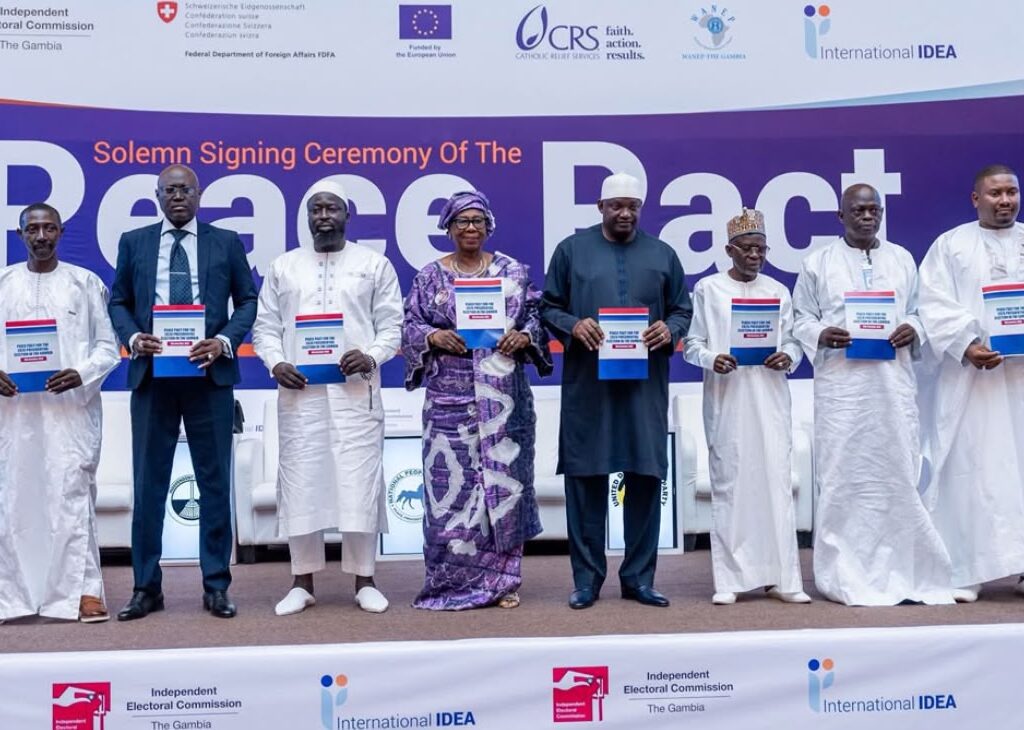
Campaigning for The Gambia’s December 5 presidential election begins today. As the eight presidential candidates prepare to seek voters’ support, they have signed a peace agreement setting out how they intend to conduct their campaigns, respect the electoral process and respond to disputes before and after the vote. But what exactly have they committed themselves to? And what does the agreement say about hate speech, the use of artificial intelligence, access to state resources and the announcement of election results? This explainer breaks down the key provisions of the agreement and what they mean for candidates, political parties and voters.
What is the peace agreement?
On November 16, 2026, the eight presidential candidates signed a code of conduct intended to promote peaceful campaigning, prevent political violence and guide their conduct throughout the electoral process.
The agreement sets out commitments on issues including peaceful campaigning, hate speech, press freedom, the use of digital media and artificial intelligence, the role of state institutions, the independence of the Independent Electoral Commission (IEC), and the handling of election results and disputes.
It also establishes a monitoring mechanism to oversee compliance with the commitments.
What are the key provisions of the agreement?
The agreement contains 11 sections. Here is what the provisions covered in the document say:

Article 1: Peaceful and issue-based campaigning
The candidates committed to peaceful, issue-based campaigns and pledged to respect the right of every candidate and political party to campaign freely across the country. In practice, this means political parties should focus on their policies and proposals rather than intimidation, provocation or attacks against their opponents.
Article 2: Hate speech and tribal bigotry
The candidates pledged not to dehumanise individuals or communities, threaten violence or make statements that encourage violence. This commitment is particularly important given concerns about hate speech and divisive rhetoric in political discourse ahead of the December 5 election.
The provision seeks to discourage political messages that exploit ethnic, religious or other differences to create hostility among communities.
Article 3: Press freedom, digital media and artificial intelligence
The candidates committed to respecting press freedom and the work of journalists covering the election. They also pledged not to create, commission or circulate AI-generated or manipulated audio, videos, images or text intended to mislead the public.
In addition, they committed to providing journalists with fair, accurate and timely information. This provision is significant as social media platforms increasingly shape political debate and manipulated content can mislead voters or inflame tensions.
Article 4: Violence, intimidation and inclusion
The candidates agreed to reject violence and intimidation and to protect the participation of women, young people, persons with disabilities and minority groups in the electoral process. They also committed to opposing online abuse and other forms of intimidation that could prevent these groups from participating freely in political activities.
Article 5: State institutions and public resources
The agreement states that state media and public facilities should be made available to all candidates on equal and transparent terms, including candidates willing to pay for their use. The provision is intended to promote fairness and prevent the misuse of public resources or state institutions to give an advantage to the incumbent or any particular candidate.
Article 6: Religious and traditional leaders
The candidates pledged to respect the neutrality of religious and traditional leaders and support their calls for peace. This recognises the influence religious and traditional authorities have in communities and the importance of ensuring that their positions are not exploited to deepen political divisions.
Article 7: The electoral process and the IEC
The candidates committed to respecting the independence and constitutional mandate of the Independent Electoral Commission. They also pledged to cooperate with the Commission throughout the electoral process.
The provision reinforces the IEC’s role as the institution responsible for administering the election.
Article 8: Election results and disputes
The candidates recognised the IEC as the institution mandated to declare the results of the presidential election. They committed to accepting the results as announced by the IEC chairperson.
This is one of the agreement’s most significant provisions because disputes over election results can create uncertainty and tensions. However, the commitment should be understood alongside the constitutional and legal right of candidates to challenge election results through the appropriate legal channels.
Article 9: Expectations of other institutions
The agreement also sets out expectations for the IEC and other relevant institutions. Among the commitments and requests outlined are:
- The IEC should continue providing regular briefings to election stakeholders.
- It should publish timely and consistent voter-register data and explain any deletions or discrepancies.
- It should make available both the cleaned voter register and the register of deleted names, as planned.
- Results should be posted at polling stations and published by polling station.
- The Commission should respond promptly to complaints.
These measures are intended to improve transparency, strengthen public confidence and make it easier for stakeholders to scrutinise the electoral process.
Article 10: Monitoring and enforcement
The agreement provides for a monitoring committee comprising eminent persons and representatives of the moral guarantors, including the Supreme Islamic Council, the Gambia Christian Council and civil society.
The committee is expected to monitor compliance with the agreement and support efforts to address violations. Its effectiveness will depend on its independence, credibility and ability to respond to breaches.
Article 11: Dissemination and duration
The candidates committed to communicating the agreement to their respective party structures, campaign teams, spokespersons and social media managers within 72 hours of signing. This is important because the commitments should not remain with presidential candidates alone. They must also be understood and respected by party officials, campaigners and supporters.
The agreement will remain in force until the IEC has declared the results, any election petitions have been concluded, and the transition process is complete. The candidates also agreed to commit to a separate code of conduct for the parliamentary elections scheduled for April 10, 2027.
What does the agreement mean for voters?
The peace agreement is intended to create an environment in which voters can make their choices freely, without intimidation, violence or manipulation.
If respected, its commitments could help to:
- Reduce inflammatory political rhetoric and hate speech.
- Protect journalists and promote access to accurate election information.
- Prevent the misuse of state resources and public facilities.
- Discourage the spread of manipulated and AI-generated political content.
- Strengthen confidence in the electoral process and the announcement of results.
- Encourage candidates and their supporters to resolve disputes through lawful and peaceful channels.
Will signing the agreement guarantee a peaceful election?
Signing an agreement is an important first step, but its value will ultimately depend on whether candidates, their parties, campaign teams and supporters honour their commitments. The monitoring committee will also have an important role in documenting violations and encouraging compliance.
Ultimately, the responsibility for a peaceful election does not rest with presidential candidates alone. Political parties, the IEC, security institutions, the media, civil society and voters all have a role to play.
The real test of the agreement will be whether its commitments are respected not only during the campaign but also on election day, when results are announced and throughout any subsequent dispute or transition.
