
By the Numbers: Who Is in The Gambia’s Prisons?

Nearly one in three people held at The Gambia's largest prison had not been convicted when the NHRC conducted its latest monitoring mission. But the figures tell only part of the story, exposing deeper challenges within the country's prisons and wider justice system.
When the National Human Rights Commission (NHRC) conducted its 2025 monitoring mission, 784 people were being held at Mile II Central Prison, The Gambia’s main correctional facility. Nearly two-thirds had been convicted of crimes, while more than one in every three was still awaiting trial.
The prison population also included nationals from several countries across West Africa and beyond.
The figures, contained in the NHRC’s latest prison monitoring report, offer more than a headcount. They provide a snapshot of who is in custody, their legal status and some of the broader challenges facing The Gambia’s criminal justice system.
The monitoring mission, which covered prisons and selected police stations, assessed detention conditions, the treatment of detainees and compliance with national laws and international human rights standards. Alongside documenting prison conditions, it also provides insight into the composition of the country’s prison population.
Prison population at a glance
At the time of the NHRC’s visit, Mile II Central Prison housed 784 inmates.
Of these:
- 515 inmates (65.7%) had been convicted and were serving sentences imposed by the courts.
- 269 inmates (34.3%) were on remand, meaning they had been charged with criminal offences but had not yet been tried or convicted.
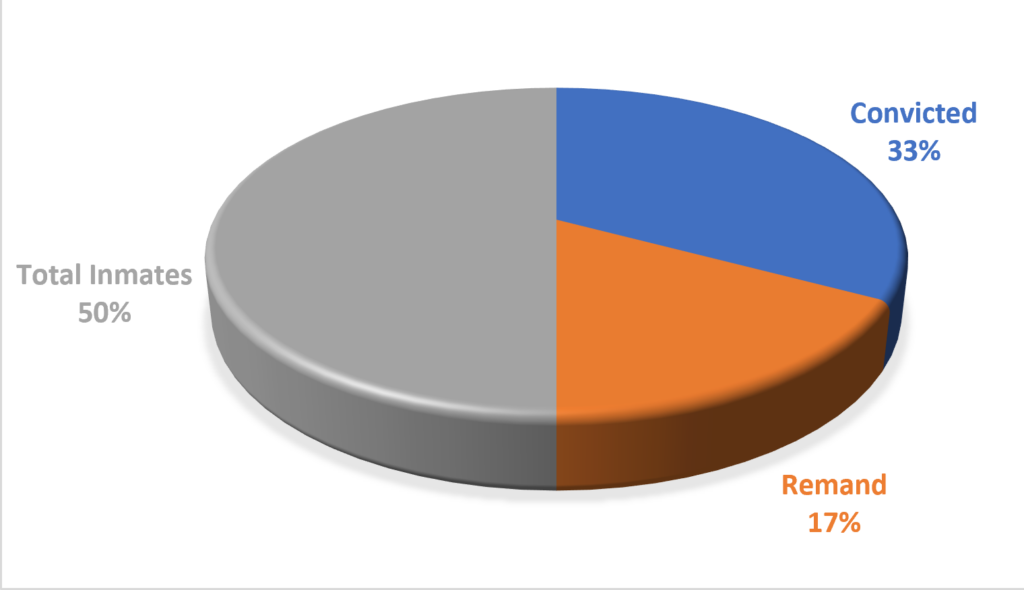
In practical terms, more than one in every three people in custody had not been found guilty by a court of law. Under both Gambian law and international human rights principles, remand prisoners are presumed innocent until proven guilty.
What does “on remand” mean?
A person on remand has been arrested and formally charged with an offence but whose case has not yet been concluded by the courts. They remain in custody while awaiting trial, the completion of investigations or a court’s decision on bail.
Being on remand does not mean a person has been convicted.
Courts may refuse bail because of the seriousness of the alleged offence or concerns that an accused person may abscond, interfere with witnesses or evidence, or fail to appear in court. In other cases, lengthy investigations, court backlogs and repeated adjournments can leave accused persons in detention for months—or even years—before their cases are resolved.
,
The presence of 269 remand prisoners raises broader questions about access to bail, the availability of legal representation, the efficiency of criminal investigations and the speed at which cases move through The Gambia’s courts. It also places additional pressure on prison facilities originally designed to accommodate convicted offenders.
Who is behind bars?
Although Gambians make up the majority of the prison population, the figures also reflect The Gambia’s position within a highly interconnected West African region where people move across borders for trade, work and migration.
According to the NHRC report, inmates came from several countries.
The largest group comprised 535 Gambians, including 522 men and 13 women.
They were followed by:
- 140 Senegalese (138 men and two women)
- 61 Nigerians (55 men and six women)
- 48 Guineans
- 29 Sierra Leoneans (28 men and one woman)
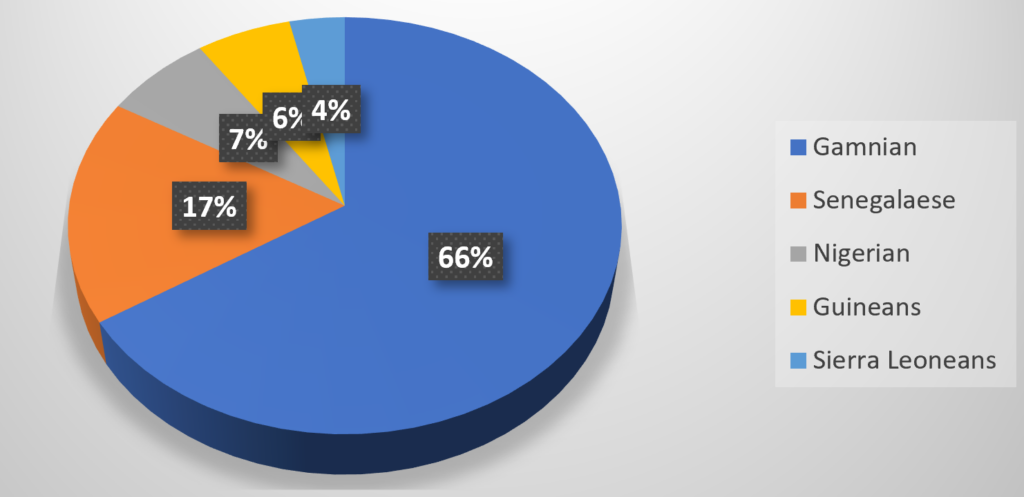
The report also recorded inmates from Ghana, Guinea-Bissau, Mali, Liberia, Côte d’Ivoire and Cameroon, as well as a small number from outside Africa, including Europe, South America and one American citizen.
While Gambians account for the overwhelming majority of inmates, foreign nationals make up a significant share of the prison population, reflecting regional migration patterns and the cross-border nature of some criminal offences.
Beyond the numbers
The National Human Rights Commission, established under the National Human Rights Commission Act, 2017, is mandated to monitor places of detention and assess whether detainees are treated in accordance with the Constitution, national laws and international human rights standards.
Its 2025 monitoring mission shows that the challenges facing The Gambia’s prisons extend far beyond the size of the inmate population. The Commission identified persistent overcrowding, poor sanitation and living conditions, ageing infrastructure, inadequate healthcare and rehabilitation services, weak case management, and poor welfare for prison officers as some of the most pressing issues affecting detention facilities.
To address these challenges, the NHRC called on the government to renovate and expand prisons and police detention facilities, increase funding for healthcare and rehabilitation programmes, strengthen coordination across the criminal justice system to reduce prolonged pretrial detention, improve the welfare and training of prison officers, and ensure that all detainees are treated in line with national laws and international human rights standards.
