
TRRC Five Years On: Only 48 of 263 Government Commitments Fully Implemented

The NHRC's latest implementation tracker shows modest progress since May 2025, but most Truth Commission recommendations remain unfinished, with victims increasingly questioning whether justice, reparations and accountability will ever be delivered.
More than five years after The Gambia’s Truth, Reconciliation and Reparations Commission (TRRC) submitted its final report, the implementation of its recommendations continues to move slowly.
The latest Supplementary Report to the Third Status Report, published by the National Human Rights Commission (NHRC) and covering June to December 2025, shows that while some progress has been made since the Commission’s previous update in May 2025, the overwhelming majority of the Government’s commitments remain incomplete.
The NHRC, which is mandated to independently monitor the implementation of the Government’s White Paper on the TRRC report, found that only 48 of the 263 recommendations accepted by the Government have been fully implemented.
Malagen breaks down what has changed, what remains outstanding and why the findings matter.
How much progress has been made?
The latest report shows incremental rather than transformative progress.
Since the NHRC’s previous update in May 2025:
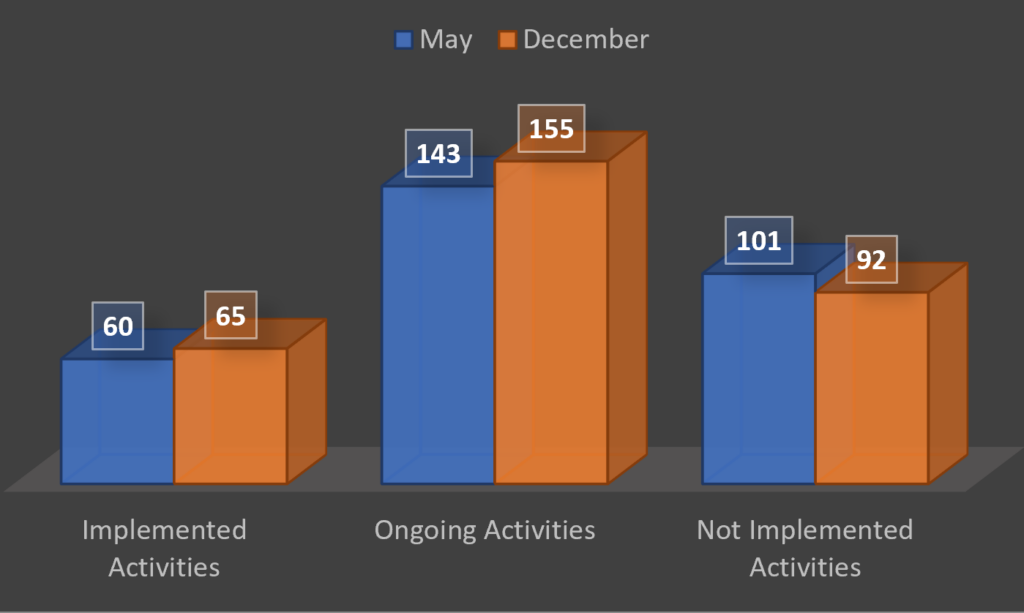
The figures indicate that five additional activities were completed during the six-month reporting period, while 12 more activities entered the implementation stage. At the same time, the number of activities yet to begin declined from 101 to 92.
Although this represents progress, implementation remains slow considering the scale of the commitments made after the TRRC process.
Recommendations vs activities: What’s the difference?
The NHRC distinguishes between recommendations and activities, two terms that are often confused. The Government accepted 263 recommendations in its White Paper following the TRRC.
However, implementing a recommendation often requires several separate actions or activities, such as drafting legislation, establishing institutions, adopting policies or conducting investigations.
As a result, the number of implementation activities is higher than the number of recommendations.
According to the latest report:
- 48 recommendations have been fully implemented.
- 92 recommendations remain under implementation.
- The remaining recommendations have either not started or are only partially addressed.
No theme has been fully completed
The Government’s implementation plan is organised into 22 thematic areas, covering issues ranging from unlawful killings and enforced disappearances to institutional reform, reparations and accountability.
Despite progress in some areas, none of the 22 themes has been fully implemented since implementation began in 2022.
One of the clearest examples is Theme Three, which concerns the killing of former Finance Minister Koro Ceesay.
The implementation plan identifies three activities under this theme, yet none had been implemented as of December 2025.
Other themes have recorded stronger progress.
Theme Ten, which deals with the President’s Alternative Treatment Programme, remains among the most advanced. Of its 26 planned activities, eight have been completed, while 14 are ongoing.
Why is implementation taking so long?
Beyond tracking numbers, the NHRC identifies several factors slowing implementation.A perception survey commissioned by the Commission in 2025 found a growing gap between government commitments and public expectations
While many Gambians acknowledged the TRRC’s role in uncovering the truth about past abuses and recognising victims, more than half of respondents doubted that the Government would fully implement reparations and accountability measures.
Urban residents expressed the highest levels of scepticism, while rural communities showed more mixed opinions. The study also identified several structural challenges slowing implementation, including:
- inadequate funding for transitional justice institutions;
- staffing shortages;
- delays in establishing institutions such as the Special Prosecutor’s Office and the Reparations Commission;
- political sensitivities surrounding criminal prosecutions;
- limited public awareness about implementation progress; and
- inadequate support services for survivors of sexual and gender-based violence, with women remaining underrepresented in decision-making processes.
According to the NHRC, these challenges have widened the gap between commitments made in the Government’s White Paper and their implementation in practice.
Gaps in the implementation plan
The Commission also identified shortcomings within the implementation plan itself.
It noted that 25 recommendations relating to amnesty—contained in paragraphs 572 to 597 of the Government’s White Paper—were omitted from the implementation plan altogether. Consequently, these recommendations continue to appear as not implemented.
The NHRC further observed that 34 activities listed under Theme Twenty-Two are not directly linked to any specific TRRC recommendation. Instead, they are broader cross-cutting actions voluntarily undertaken by the Government.
The Commission says this explains why the number of implementation activities exceeds the 263 recommendations accepted by the Government.
What do the findings mean?
The latest figures suggest that implementation is moving forward, but at a gradual pace.
Although the number of completed activities has increased and more recommendations are now under implementation than six months ago, less than one in five Government commitments has been fully implemented.
For victims who participated in the TRRC process, the pace of implementation remains a central concern.
The NHRC warns that unless implementation accelerates, public confidence in the transitional justice process could continue to decline, particularly among victims who are still waiting for reparations, accountability and institutional reforms promised after the Commission concluded its work.
The Commission therefore calls for stronger political commitment, increased funding and faster implementation to ensure that the TRRC’s recommendations translate into meaningful justice and lasting institutional reform rather than remaining commitments on paper.
