
Explainer: Why the murder charges against Sanna Manjang did not proceed
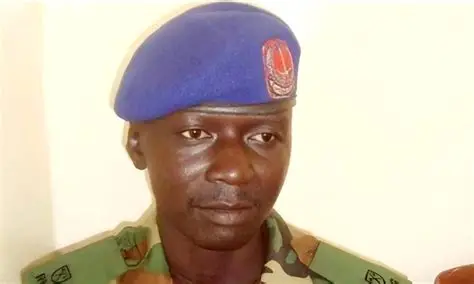
The former Jungler was accused of involvement in alleged Jammeh-era killings, including cases linked to some of The Gambia’s most prominent human rights concerns. But a High Court ruling has now shifted the focus of his trial to assault allegations.
The trial of former Jungler member Sanna Manjang took a major turn at the High Court in Banjul on 17 July 2026, after Justice S.K. Jobarteh allowed the prosecution to amend the charges against him. Manjang was initially facing allegations of murder, conspiracy and assault. However, following a review of the case, the court allowed the prosecution to amend the indictment, removing the murder-related allegations and narrowing the case to two assault charges involving individuals who testified before the court.
The remaining allegations concern Tamsir Jasseh and military officer Yaya M.S. Darboe, who both gave evidence during the proceedings. The development marks a significant shift in a case that had drawn public attention because of Manjang’s alleged association with the Junglers, a covert security unit accused of carrying out serious human rights violations during former President Yahya Jammeh’s 22-year rule.
The case is also being closely watched because Manjang’s name has featured in wider accountability discussions surrounding alleged abuses investigated by the Truth, Reconciliation and Reparations Commission (TRRC), including allegations linked to some of the most serious violations committed during the Jammeh era
How the charges evolved
The charges against Manjang changed several times during the proceedings. When the matter was brought before the High Court, the prosecution filed allegations linked to killings, conspiracy and torture. An amended indictment later expanded the case to six counts, including:
- Two counts of murder relating to the alleged killings of Kajali Jammeh and Samba Wurry in Kanilai in 2006.
- Two counts of conspiracy linked to the alleged offences.
- Two counts of assault causing actual bodily harm involving Tamsir Jasseh and Yaya M.S. Darboe.
The defence later challenged aspects of the amended charges, arguing that some allegations lacked sufficient details, particularly regarding the alleged conspiracy.
Why the conspiracy charges were removed
The conspiracy allegations could not proceed because conspiracy, by law, requires an agreement between two or more people to commit a criminal offence. For the charge to stand, the prosecution needed to establish that Manjang acted together with another person or persons in planning or agreeing to commit the alleged offence.
However, the State was unable to produce sufficient evidence identifying another person involved in the alleged conspiracy. With only Manjang linked to the allegation, the charge did not meet the legal requirement for conspiracy and was removed.
Why the murder allegations did not proceed
The murder-related charges also failed to continue after the prosecution was unable to present sufficient evidence to prove the allegations to the required legal standard. The proceedings raised concerns about the evidence available to establish the alleged killings, including questions relating to the identity of the alleged victims and supporting evidence required to prove the offences.
Without sufficient evidence capable of proving the murder allegations, those charges could not proceed before the court.
Why the assault charges remained
Unlike the murder allegations, the assault charges were supported by testimony from individuals who appeared before the court and gave evidence about the alleged attacks.
The remaining charges relate to allegations that Manjang:
- Assaulted Tamsir Jasseh, who testified about alleged physical abuse.
- Assaulted Yaya M.S. Darboe, a former military officer who also gave evidence about alleged mistreatment.
The prosecution argued that these allegations were supported by evidence presented during the trial, allowing them to proceed.
The wider accountability context
Although the current High Court case has moved away from the murder-related charges, Sanna Manjang’s name remains part of The Gambia’s broader efforts to address alleged human rights violations committed during Yahya Jammeh’s rule.
Manjang was identified as a former member of the Junglers, a covert security unit whose operations were extensively examined by the Truth, Reconciliation and Reparations Commission (TRRC).
While he did not appear before the commission to give testimony, his name featured in accounts and investigations concerning alleged abuses committed during the Jammeh era.
He has also been linked to allegations surrounding the killing of veteran journalist Deyda Hydara, who was assassinated in 2004, as well as other alleged violations investigated as part of the country’s transitional justice process.
The TRRC’s final report recommended prosecutions against several individuals it found responsible for serious violations. Under Theme 14 of the TRRC recommendations, which examined the unlawful killing of West African migrants in The Gambia in 2005, the commission recommended the prosecution of former President Yahya Jammeh, his former Interior Minister Ousman Sonko , who is currently serving a prison sentence in Switzerland for crimes against humanity as well as former Junglers Malick Jatta and Sanna Manjang for their alleged roles in the killings.
The recommendations formed part of the commission’s wider push for accountability for crimes committed under Jammeh’s 22-year rule.
What the court’s decision means
The amendment of the charges does not amount to a judicial finding that Manjang was responsible for, or cleared of, the alleged killings.
Rather, it means the prosecution will now proceed with the allegations for which it believes it has sufficient evidence before the court.
The next stage of the case will focus on whether the prosecution can prove the remaining assault charges beyond reasonable doubt, the standard required in criminal trials.
