
Explainer: Why the Supreme Court Ruling on the Former Auditor General Matters
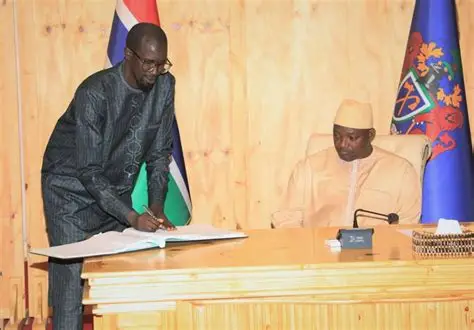
The Supreme Court's decision on the former Auditor General's dismissal could have far-reaching implications for presidential powers, public accountability, and the independence of constitutional offices. Malagen explains the issues at the heart of the case before the ruling.
When the Supreme Court delivers its judgment today on the dismissal of former Auditor General Momodou Ceesay, it will decide more than the fate of one public official.
At the heart of the case is a constitutional question that could shape the relationship between the presidency and independent public institutions: Can the President remove the Auditor General before the end of his constitutional tenure, and if so, under what circumstances?
The ruling could clarify the limits of presidential power, define the legal protections afforded to holders of independent constitutional offices, and influence how similar offices are treated in the future.
In this explainer, Malagen examines what the case is about, why it matters, and what is at stake ahead of the Supreme Court’s decision.
Who is Momodou Ceesay?
Momodou Ceesay was appointed Auditor General in November 2022 for a nine-year term.
As Auditor General, he headed the National Audit Office (NAO), an independent institution responsible for examining how public funds are collected, managed and spent. The office audits government ministries, departments and agencies and submits its findings to the National Assembly, helping lawmakers scrutinise public expenditure and hold state institutions accountable.
The office is widely regarded as one of the country’s most important accountability institutions because it provides independent oversight of public finances.
The National Audit Office Act 2015 reinforces that independence. Sections 3(2) and 14(a) provide that the institution operates independently and should not be subject to political or administrative direction in carrying out its mandate.
Why was he removed?
In September 2025, President Adama Barrow announced a cabinet reshuffle in which Ceesay was nominated to serve as Minister of Trade.
Ceesay declined the appointment, maintaining that he wished to continue serving as Auditor General.
The presidency subsequently removed him from office. President Barrow later stated that Ceesay had initially accepted the ministerial appointment before changing his position.
Ceesay, however, challenged his removal before the Supreme Court, arguing that his dismissal was unconstitutional.
Having served for less than three years of his nine-year tenure, his departure from office raised questions about the constitutional security of tenure afforded to the Auditor General.
What is the Supreme Court being asked to decide?
The central issue before the court is not whether Ceesay accepted or rejected the ministerial appointment.
Rather, the court is being asked to determine whether the President had the constitutional authority to remove the Auditor General in the manner that he did, or whether constitutional safeguards protecting the office were breached.
The judgment is expected to clarify how the Constitution should be interpreted regarding the appointment, tenure and removal of the Auditor General.
Why does this case matter?
For many Gambians, this case is about much more than one individual.
The Auditor General plays a critical role in promoting transparency and accountability by independently auditing how taxpayers’ money is spent. Audit reports often uncover weaknesses in financial management, procurement practices and public spending, enabling the National Assembly and the public to demand accountability.
If the independence of that office is weakened, it could affect public confidence in one of the country’s key oversight institutions.
The judgment may also set an important constitutional precedent for other independent offices whose holders are protected from arbitrary removal.
What could today’s ruling mean?
The Supreme Court’s judgment is likely to have implications beyond this individual dispute.
If the court rules in favour of Ceesay, it could reinforce constitutional protections for independent office holders and clarify the limits of presidential authority in removing them before the expiry of their terms.
If the court rules in favour of the government, it may affirm the President’s interpretation of his constitutional powers while providing guidance on how those powers should be exercised in relation to constitutionally protected offices.
Either way, the ruling is expected to become an important reference point for future questions involving executive authority, constitutional independence and the protection of public oversight institutions in The Gambia.
The Supreme Court’s judgment is expected to shape the interpretation of presidential powers and the independence of constitutional offices for years to come.
Malagen will report the ruling as soon as it is delivered and provide an in-depth analysis of what it means for governance, accountability, and the rule of law in The Gambia.
