
Explainer: What The Gambia’s corruption score really means
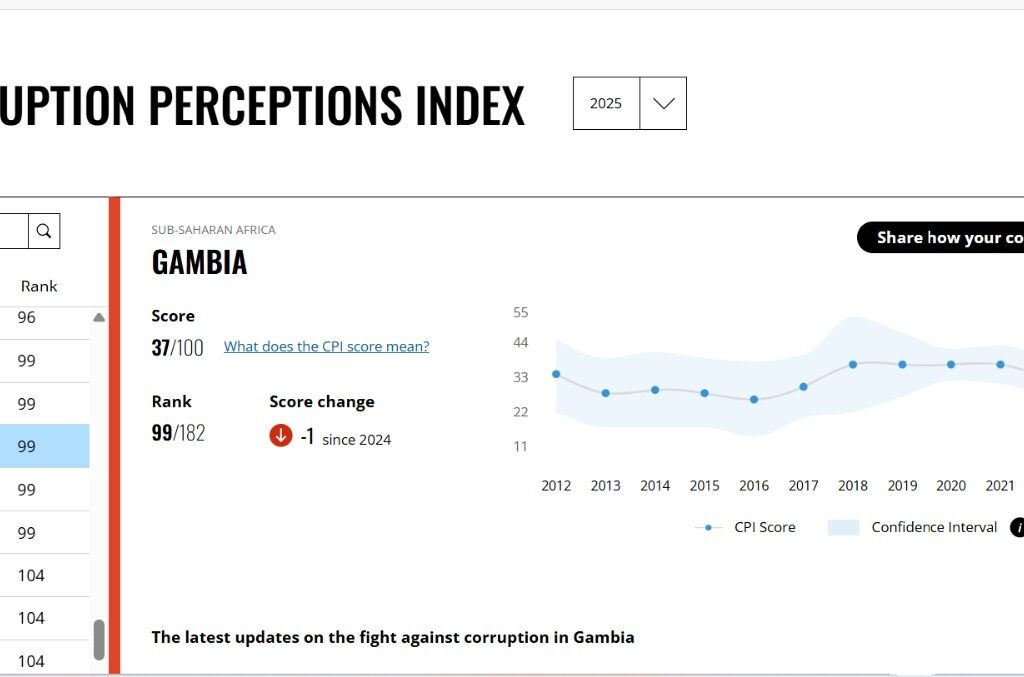
In 2025, The Gambia’s corruption index declined slightly compared to 2024, keeping it among countries perceived to have high levels of public sector corruption on the CPI.
The latest Corruption Perceptions Index (CPI) released by Transparency International suggests that The Gambia continues to face persistent challenges in tackling corruption, with little sign of significant improvement in recent years.
In 2025, The Gambia scored 37 out of 100 on the index a scale where 0 represents highly corrupt and 100 represents very clean. This marks a slight drop from its 38/100 score in 2024, indicating a marginal decline in how the country’s public sector is perceived by experts and business leaders. In terms of global standing, the country is ranked 99th out of 182 countries, down from 96th out of 180 countries the previous year.
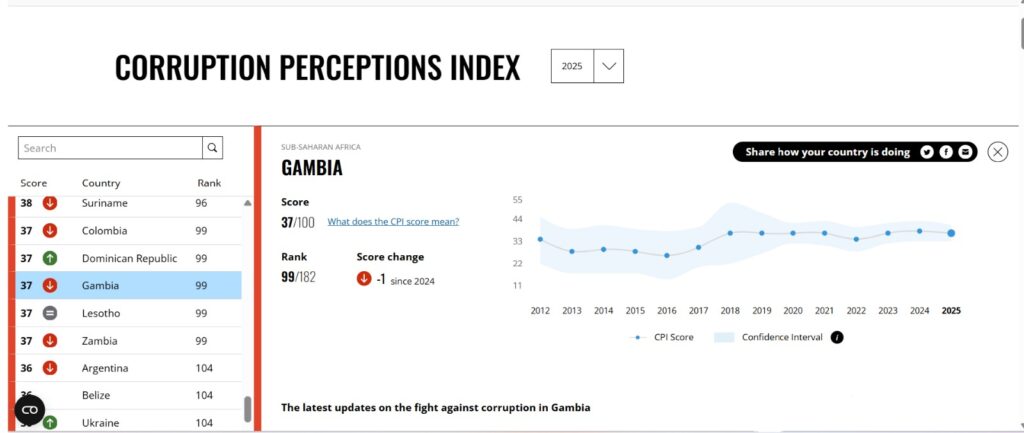
While the numerical change may appear small, such shifts often reflect growing concerns about governance, accountability, and the effectiveness of anti-corruption efforts, rather than dramatic changes on the ground. Over time, these incremental declines can signal a broader pattern of stagnation or weakening confidence in public institutions.
What do the score and ranking mean?
The CPI uses a scale that runs from 0 to 100, where 0 indicates a highly corrupt public sector and 100 reflects a very clean one. This scoring system helps show not just where a country stands, but how serious corruption is perceived to be within its institutions.
With a score of 37, The Gambia falls within the lower half of the index , suggesting that corruption is seen as a notable and persistent issue in the public sector..
The country’s ranking of 99 out of 182 countries provides further context. Rankings are comparative, meaning they show how a country performs relative to others:
- A position at 99 indicates that a significant number of countries are perceived to manage corruption better than the Gambia
- While others perform worse, with a score of 37, The Gambia still sits below the global average, which generally remains in the 40s score range
Although the drop from 38 to 37 may seem minor, in CPI terms even a one-point change matters. These shifts often reflect changes in perception among experts, investors, and analysts, particularly regarding whether governments are making progress or losing ground in addressing corruption. Over time, such small declines can signal eroding confidence in public institutions and reform efforts.
How has The Gambia performed over time?
The recent trend points more toward stagnation and even slight decline rather than clear progress in tackling corruption. In 2024, The Gambia scored 38 out of 100 and was ranked 96th out of 180 countries. By 2025, the score had dropped to 37, with the country slipping to 99th out of 182 countries.
While these changes may appear marginal, they suggest that perceptions of corruption are not improving and may, in fact, be worsening slightly. Over the past few years, The Gambia has consistently remained in the mid-to-high 30s, a range that reflects ongoing structural weaknesses. Taken together, this pattern signals that while efforts may exist on paper, they have yet to translate into strong, visible gains that build public and international confidence in the country’s ability to effectively address corruption.
How the CPI is calculated
It is important to understand that the Corruption Perceptions Index does not track individual corruption cases or court convictions. Instead, it measures how corruption is perceived within a country’s public sector, drawing on the views and assessments of experts, analysts, and business leaders who closely observe governance and institutional performance.
A country’s score is compiled using data from multiple sources, with each country required to have at least three separate datasets to be included. In total, the CPI draws from up to 13 different surveys and assessments, produced by well-established institutions such as the World Bank and the World Economic Forum.
By combining these sources, the index aims to provide a balanced and comparative picture of how corruption is experienced and managed across countries, even though it reflects perception rather than direct measurement.
What kind of corruption does it assess?
The CPI focuses specifically on corruption within the public sector, looking at how power is exercised, resources are managed, and whether institutions are held accountable.
Rather than capturing a single issue, it reflects a range of practices that shape how corruption is experienced in everyday governance.
These include:
- Bribery, where money or favors are exchanged to influence decisions
- Diversion or misuse of public funds, including unexplained spending or missing resources
- Abuse of office for private gain, where officials use their positions for personal benefit
- Weak enforcement of anti-corruption laws, allowing wrongdoing to go unpunished
- Nepotism in public appointments, where jobs are given based on connections rather than merit
- Lack of financial disclosure by officials, limiting transparency around wealth and potential conflicts of interest
- Limited protection for whistleblowers, discouraging people from reporting corruption
- Restricted access to public information, making it harder for citizens and journalists to scrutinize government actions
- Influence of powerful private interests on state decisions, sometimes referred to as state capture
Together, these factors help explain why a country may score poorly, as they point to systemic weaknesses in transparency, accountability, and oversight.
What is driving concerns in The Gambia?
While the Corruption Perceptions Index is based on perception, its findings often reflect real, documented concerns raised through audits, investigations, and court proceedings. In The Gambia, a number of these issues have been consistently flagged in recent years, reinforcing the concerns captured in the index.
Reports from the National Audit Office of The Gambia have repeatedly pointed to gaps in financial management across public institutions. These include instances of unaccounted-for public funds, weaknesses in internal controls within ministries and state-owned enterprises, and irregularities in procurement processes.
In several cases, audits have highlighted significant financial discrepancies, raising broader questions about oversight, compliance, and the effectiveness of enforcement mechanisms.
Beyond routine audits, the findings of the Janneh Commission which examined the financial dealings of former President Yahya Jammeh offered deeper insight into systemic failures.
The commission uncovered large-scale misappropriation of state resources and exposed how weak institutional safeguards enabled abuse of power over an extended period.
More recently, the sale of assets belonging to former President Yahya Jammeh has further highlighted concerns around transparency and accountability in public financial management. Investigations, including a detailed probe reported by Malagen, found significant gaps in record-keeping and oversight in the disposal of these assets, despite the recovery of billions of dalasis.
Findings from a parliamentary inquiry also pointed to poor documentation, fragmented processes, and weak coordination between institutions, raising questions about whether the full value of the assets was properly accounted for.
These issues add to a broader pattern in which corruption-related concerns continue to surface in areas such as public procurement, the management of state-owned enterprises, and the handling of funds in government projects. In some cases, asset sales were conducted without competitive processes or proper legal oversight, and proceeds were not always channelled through the appropriate state systems, further deepening concerns about compliance with public finance laws.
While not all allegations lead to prosecutions or convictions, their recurrence in audits, investigative reports, and official inquiries reinforces a growing perception that corruption remains an ongoing challenge.
This matters because perception is central to how the Corruption Perceptions Index (CPI) is calculated. When concerns about transparency, accountability, and enforcement persist, they shape how experts and observers assess a country’s performance, ultimately influencing its score and ranking.
At the global level, Transparency International notes that the 2025 CPI reflects a wider trend: the fight against corruption is being undermined by limited political will, weak enforcement of existing laws, and the growing influence of powerful interest groups. These are challenges that continue to resonate not just globally, but within national contexts like The Gambia as well.
What this means going forward
For The Gambia, a score of 37 is more than just a number it points to ongoing governance challenges that continue to affect public trust and institutional credibility.
It suggests that gaps remain in how power and public resources are managed, highlighting the need for stronger accountability systems, improved transparency in areas such as public finance and procurement, and more consistent and effective investigation and prosecution of corruption-related cases.
Without visible enforcement and consequences, efforts to address corruption risk being seen as insufficient.
