
Beyond Tribe and Personality: Why The Gambia Needs Issue-Based Politics in 2026
Every citizen must empower themselves with the understanding that a candidate's ethnicity will not lower the about 75 percent debt-to-GDP, nor will their personality reduce the cost of imported rice.
Kebba Jeffang
As The Gambia is about to enter a full swing election year (scheduled for late 2026), it is time to discuss and set the record straight on the elephant in the room. The politicians’ game of divide-and-rule to win votes. The media’s failure to set the agenda on an issue-based basis. And the voters’ inability to discern issues from tribe and personality. It is now time for these key sections of society to adopt new strategies to maintain peace and tolerance in their efforts to secure votes throughout the election season. In this article, I rely on verifiable data for discussion.
What has been the style of politics in the Gambia?
In 2021, Malagen established a media monitoring unit to track the first national presidential elections since the fall of Yahya Jammeh in 2016. It was anticipated and proved to be the most contested presidential election in the country’s history so far, a development that election observer bodies attributed to the country’s improved political freedom. But we knew it would also be the ugliest in terms of rising hate speech, disinformation, misinformation, personal attacks, and slandering among players and supporters, driven by increased participation, greater political and media freedom, and social media access across almost all generations of the population. Malagen media monitoring developed a strategy to monitor political speeches actively, social media platforms to correct the misinformation and disinformation, flag and shame those engaging in hate speech, personal attacks, and slandering.
In the platform’s media monitoring report on hate speech, published on June 18, 2023, after the completion of the 2021-2023 electoral calendar, the findings indicated that the country’s elections were driven by information disorder rather than issue-based politics, as shown below.
● 16 incidents of hate speech have been flagged during the electoral cycle
● Ethnicity was flagged as the most common basis for hate speech, accounting for 62.5% of cases countered
● Immigrants settling in the Gambia were a target of hate speech as the second most targeted group, accounting for 18.8%, followed by religion (12.5%, and other targets (6.3%)
● The report also pointed out that there are strong claims of the prevalence of gender-based hate speech during elections.
● The hate speech incidents flagged belong to different types, such as hateful misinformation, accounting for 11.8%, including Musa Batchilley’s comment against candidate Essa Faal, which was both misinformation and hate speech.
Among these cases,
● 23.5% of cases advocated instability as they fueled hate.
● 23.5% of cases were cases of Advocacy for discrimination
● 17.6% were cases of group-labeling and
● 23.5 comments were flagged as incitement to violence
● The two largest political parties found themselves at the top of the hate speech chart.
● The ruling National Peoples’ Party (NPP) won 61%, while the main opposition party, the United Democratic Party (UDP), received 23.1%. The Gambia Democratic Congress (GDC) was also involved with 15%. Note that their political leaders and influential members were responsible for these incidents within their parties.
On a rare occasion, the National Human Rights Commission (NHRC) publicly named the leader of both the NPP and the UDP for “worrying concerns” about their rhetoric, which it deemed provocative and liable to incite violence.
How do we make a shift in the 2026 election?
- Cost of living: A lot is at stake in this election. While the country’s economy has been projected to grow by approximately 5.8% to 6% in 2025-2026, according to the recent IMF-published Second Review Under the Extended Credit Facility Arrangement report, it’s clear this is not felt in the cost-of-living by average Gambian primarily due to inflation, which stands at around 10%, according to the same report. A bag of rice hovers around D2000-D3000, while the salary of an average Gambian civil servant is around D10,000, as seen in the report. Within this amount, the earner is expected to pay daily fish money, provide healthcare for themselves and their family, fund children’s education, and meet other needs.
Issue-based: If we adopt an issue-based politics, a serious question that the ruling class, the opposition, the media, and the citizenry must ask is “why is this GDP growth not reflecting on our living realities? If the economic data do not reflect our market realities, it is only right for all concerned citizens to ask questions and demand answers, and the authorities must provide those answers.
- Are we not the ones paying all this debt through taxes? Secondly, the IMF data indicate debt distress stemming from significant government borrowing, raising serious concerns as the situation continues to worsen. The report states that the debt-to-GDP ratio hovers around 70-75%. As of March 2025, the country’s domestic debt stands at D45.6 billion (23.4% of GDP), according to the Central Bank of The Gambia. IMF also states worrying figures regarding external debt, accounting for 60-65% of the total public debt, and a large chunk of which is owed to loans from the IMF itself, the World Bank, AfDB, and other bilateral partners of the government. In fact, a substantial portion of national revenues is allocated to debt service, which constrains spending on social services and investments that directly affect voters.
Issue-based: With all these hanging over the country, the elections should serve as a critical thinking moment for the ruling party, opposition, the media, and the citizenry to offer critique and establish a clear road map as to how this debt financing is not going to have a detrimental impact on the lives and livelihoods of the voters. The media and the public in general must ensure that agendas are set on this by redirecting any politician who attempts to discuss personality and tribal politics. In other words, voters must demand to get specific answers from each contesting party regarding how they plan deal with this debt – whether they will renegotiate, and if so, how or whether they intend to increase income tax or will they expand the tax base, which will have a consequential impact on Gambians given the poor take-home salaries. Once politicians observe this change in citizens’ behavior and the seriousness with which journalists ask the right questions, it is reasonable to expect a more peaceful election centered on issues.
- Recent rise in deaths of irregular migrants: Women constitute the majority of the population, and young people account for about 60%. Yet, according to the Gambia Bureau of Statistics (GBoS) 2025 Gambia Labour Force Survey Findings Report, as seen in its snapshot version, “the rate of youth not in education, employment, or training (NEET) is 41.3 per cent nationally, with nearly half of young women (45.3%) affected compared to 36.6 per cent of young men. This underscores the urgency of youth-focused employment and skills development interventions to harness the demographic dividend and reduce vulnerability among young Gambians.” The IMF report states that youth unemployment remains high due to structural challenges, macroeconomic and fiscal issues, and social inclusion issues. It also emphasises the need for skills development, job creation, and support for small and medium-sized enterprises (SMEs), thereby heightening social pressures, including increased crime rates.
Issue-based: The IOM Irregular Arrivals to Europe (Nationality Data) report published in June 2025 indicated that Gambians accounted for 8.1 percent of irregular migrants, making them the sixth most common nationality in Africa. Thousands of young Gambians have died at sea, which has continued as recently as this week, as 200 people went missing following the capsizing of the boat that took off in Jinack village in the North Bank Region. In 2024 alone, over1600 Gambians were reportedly killed en route to Europe through the ‘back way.’ International Journal of Academic Multidisciplinary Research (IJAMR), published by Pan African University’s Institute of Governance, Humanities and Social Sciences, found that “bad governance, which produced limited economic opportunities, is identified as the main push and pull factors for migration for young Gambians.”
With such devastation, it is about time citizens take charge of their own destiny by considering this as a security issue, by demanding that the politicians from both sides of the aisle provide specific solutions to end this unfolding strategy, and refuse to be played with issues of division based on tribe and personality cultism. Journalists and citizens must critically engage politicians on how they intend to provide the necessary market access beyond skills training, so that they can realise their dreams of building a meaningful life at home and end devastating travel. This issue must be framed as a security emergency because it has the potential to cause civil unrest.
- Failing agriculture: Agriculture remains the largest employer with about 45-50% of the workforce. However, according to the IMF report, the sector contributes far less to GDP than its potential, owing to low productivity. According to a news report, Farmers in The Gambia report mounting financial strain following the government’s decision to maintain the official groundnut price for the third consecutive year. The price remains fixed at around D38,000 per tonne, a rate farmers argue no longer reflects the rising cost of production. Many producers report that stagnant prices, coupled with increased fuel and input costs, are eroding their already narrow profit margins. For rural farming communities that rely heavily on groundnuts as their primary source of income, the impact is becoming increasingly severe each season. The worst-case scenario is the failure to purchase groundnuts from farmers after incurring substantial costs and undertaking hard labour throughout the season, a concern that sometimes arises.
Issue-based: Given the manpower intensity that characterised Gambian farming, the lack of purchasing power for fertilizer among most farmers, the impacts of climate change, and the low post-harvest buying prices for produce, this is almost a betrayal of Gambian farmers after six decades of independence. Beyond farmers, this is continuously contributing to a crippling economy, as highlighted by the IMF. Voters and the media must compel politicians, including the ruling party, to move beyond rhetoric and make clear commitments on how they intend to address these challenges, particularly the transition to mechanised farming.
The bottom line
Gambians should unite, regardless of political affiliation, to demand timely answers by turning away from rallies of clapping, hate, fear-mongering, propaganda, and misinformation toward rallies of the battle of ideas. Adopting this will ensure that we sanitise our politics from every idealess individual who is merely seeking attention but cannot make the change we yearn for. It’s time to reclaim our country from individuals who speak hate to divide us.
Every citizen must empower themselves with the understanding that a candidate’s ethnicity will not lower the 75 percent debt-to-GDP, nor will their personality reduce the cost of imported rice. The Gambia’s challenges are mathematical and structural. To move forward, the political discourse must pivot from ‘who are you?’ to ‘How will you manage a 6 percent growth rate so that it reaches the 50 percent of our people working in subsistence farming?’
About the author:
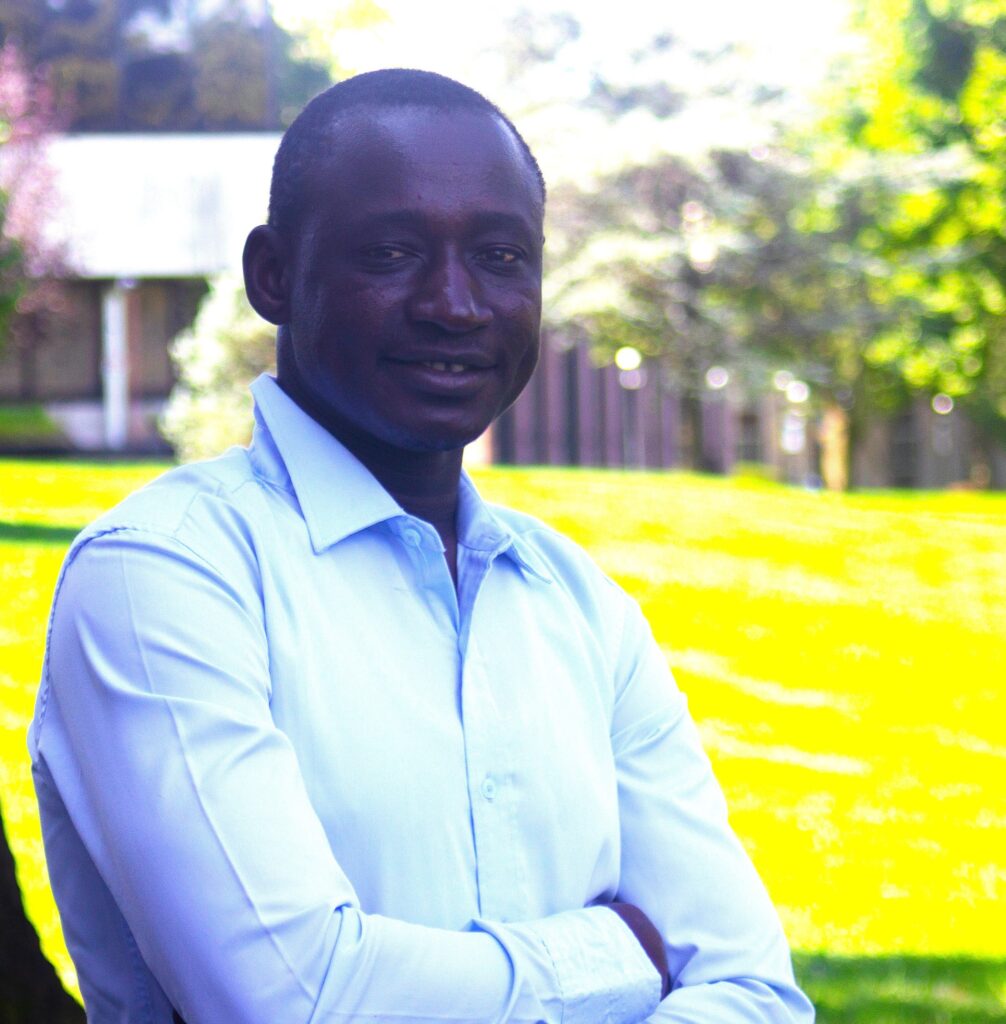
Photo credit: Lisa R Pescatore, SHU
Kebba Jeffang is a Gambian journalist currently pursuing a Master of Science in Professional Communication and Digital Media Arts in the College of Human Development, Culture, and Media at Seton Hall University in New Jersey, United States. He also holds a Bachelor of Science in Business Administration. Before relocation, he served as head of the media monitoring & factchecking desk at Malagen, Gambia’s premier investigative journalism platform, established to counter misinformation and hate speech during the 2021-2023 electoral cycle. He was recently awarded the ‘Best Story – Honorable Mention at the recently held Africa Science Journalism Awards held in Pretoria, South Africa, organised by Nairobi-based Science for Africa Foundation (SFA).
