Dangerous Speech Alert: Malagen flags a prominent UDP member for an inflammatory statement

There is no evidence to support the claim that foreign nationals are participating in The Gambia’s electoral process. Statements of this nature risk casting doubt on the credibility of the country’s electoral system and may undermine public confidence in the integrity of elections.
As The Gambia prepares for the December 5, 2026 presidential election, Malagen has flagged a public statement made by a man who identified himself as Chairman Falang Sonko, a member of the United Democratic Party (UDP), for language that risks inflaming tensions and undermining social cohesion.
The statement was made during a discussion on a YouTube platform known as UDP Media and TV. At around the 19:10 mark of the broadcast, Mr. Sonko alleged that Senegalese, Guinean, and Bissau-Guinean nationals are involved in Gambian elections.
What Mr. Sonko said
Speaking in Mandinka, and translated by Malagen’s media monitoring team, Mr. Sonko stated:
“Any foreigner who gets involved in this year’s election, whatever happens to you, you should take responsibility for it, because Gambians are ready this time if you want to get involved in our 2026 elections.”
Why the statement is dangerous
This statement is dangerous because it singles out foreign nationals as a group and suggests collective involvement in Gambian elections without providing any evidence to support such claims. Mr. Sonko did not offer proof that Senegalese, Guinean, or Bissau-Guinean nationals participate in or influence the country’s electoral process.
The wording of the statement carries an implied warning that can easily be interpreted as a threat, especially in a politically charged pre-election environment. Its broad and ambiguous nature increases the risk of misinterpretation, potentially encouraging hostility, vigilantism, or violence against individuals who are perceived as “foreigners,” regardless of their legal status or actual conduct.
Given Mr Sonko’s political affiliation and public visibility, such rhetoric has the potential to spread fear, reinforce suspicion, and erode trust between communities that have long coexisted peacefully in The Gambia.
Context
Mr. Sonko’s remarks reflect narratives that have circulated within some political spaces since the 2021 presidential election. Following that election, the UDP challenged the results at the Supreme Court, but the case was dismissed on procedural grounds.
At the same time, regional and international observer missions, including ECOWAS, the African Union, the European Union, and domestic civil society organisations, assessed the 2021 election as free, fair, and transparent.
As the December 5, 2026, election approaches, the reintroduction of these narratives risks deepening public mistrust in the electoral process and the institutions responsible for managing it.
Why this matters
The Independent Electoral Commission (IEC) is central to The Gambia’s democratic stability. Its effectiveness depends largely on public confidence in its neutrality, professionalism, and competence. When influential political figures cast doubt on the credibility of the electoral system without substantiated evidence, it weakens trust in election outcomes and undermines the IEC’s role as the guardian of electoral integrity.
In a small and politically active society like The Gambia, such statements can quickly take on wider meaning, shaping public opinion and influencing behaviour. This can discourage voter participation, heighten political polarisation, and increase the likelihood of tension during voter registration, campaigning, and the announcement of results.
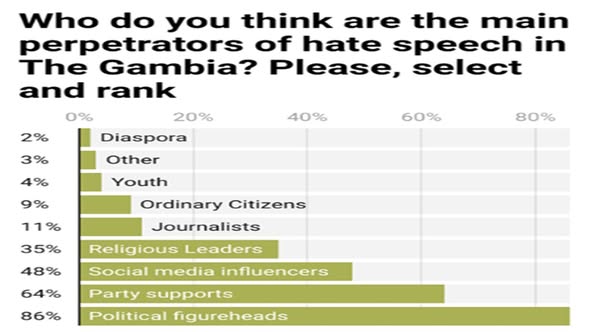
A survey by the National Human Rights Commission (NHRC) on hate and dangerous speech found that political figures and their supporters are among the leading sources of such rhetoric. According to the survey, political actors account for approximately 86 per cent of recorded hate speech incidents nationwide..
Potential political impact
If left unchecked, rhetoric of this nature can erode public trust in the IEC to the point where citizens begin to question whether their votes truly count. In politically competitive areas such as the Kombos, it may deepen divisions among supporters and heighten tensions throughout the electoral process.
When amplified online, these claims can spread rapidly and become tools for misinformation, fuelling anger and suspicion. Over time, this environment may discourage voter turnout, as citizens grow disillusioned or convinced that participation is futile. Ultimately, unchecked dangerous speech risks weakening The Gambia’s democratic stability and reversing gains made since 2017.
Conclusion
As a prominent political figure, Mr. Sonko carries a heightened responsibility to communicate with accuracy, restraint, and care, particularly on issues related to electoral integrity.
Safeguarding The Gambia’s democratic progress requires political leaders, media platforms, and institutions to prioritise responsible public discourse. Allegations of electoral misconduct should be pursued through appropriate legal and institutional channels, supported by verifiable evidence, rather than through public rhetoric that risks inflaming tensions or targeting communities.
As the country moves toward this year’s presidential election, rebuilding and reinforcing public trust in electoral institutions must remain a shared national priority.
About Malagen Media Monitoring
Malagen’s MM tracks and counters misinformation, disinformation, hate speech, and dangerous speech to ensure that political discourse remains respectful, inclusive, and fact-based.
For more information, read our report on Hate Speech in The Gambia (2021–2023), produced with the support of UNESCO, which provides an in-depth analysis of hate and dangerous speech during past electoral cycles.
Report to Us:
If you come across hate speech, misinformation, or disinformation, don’t hesitate to get in touch with us at editor.malagen@gmail.com or call/text: 3834715
