
Dangerous Speech Alert: Barrow’s Warning to NAM Bah Raises Concerns Over Peaceful Protest
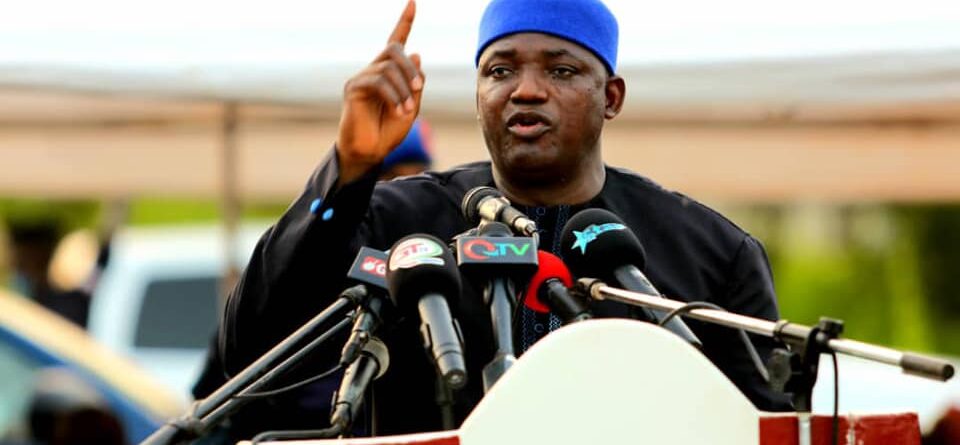
President Barrow’s threatening remarks against Hon. Bah raise concerns about political intimidation, the safety of elected representatives and the right to peaceful protest. His reference to lethal violence against protesters under former President Yahya Jammeh risks heightening political tensions and fuelling fear ahead of The Gambia’s December 5 presidential election.
Malagen’s Media Monitoring has identified a video in which President Adama Barrow issues a stern warning to Hon. Modou Lamin Bah, the National Assembly Member representing Banjul North, over his participation in a youth-led protest outside State House in Banjul in september 6, 2026
The remarks were made during the President’s Meet the People’s Tour meeting in Banjul on October 19, 2026, speaking in Wolof, President Barrow characterised the demonstration as a treasonable offence and issued a warning to Bah over any future participation in a similar protest.
What the President Said
The President said:
“We are warning him. If he ever comes to the State House to protest again, he will never do it again. What we will do to him, he will never forget for the rest of his life. This is the last warning to him.”
The President also reportedly invoked the era of former President Yahya Jammeh, saying that if the protest had taken place under Jammeh’s rule, he would have shot the demonstrators dead.
Why does this matter?
The significance of these remarks lies not only in their threatening language but also in the identity of the speaker, the person being targeted and the circumstances in which the statements were made.
President Barrow is the country’s head of state. His words carry the authority and influence of the highest office in the executive branch and can shape how political supporters, public officials and members of the public perceive those who challenge the government.
When a president threatens an elected representative with unspecified consequences that he may never forget for the rest of his life, the language can reasonably be understood as a warning of possible retaliation. The reference to shooting protesters dead under the former regime adds a further dimension, bringing lethal violence into the discussion of political protest.
Although the remarks do not establish that violence will occur, they create a legitimate concern about the safety of the person targeted and the wider implications for citizens who wish to express grievances through peaceful demonstrations.
The danger is that supporters or other individuals may interpret such statements as permission to intimidate, harass or threaten the person being singled out. Those who hear the remarks may also conclude that confronting the government through protest could expose them to serious consequences.
This is particularly concerning when the warning comes from a leader whose public statements can carry considerable political weight.
How could the remarks contribute to dangerous speech?
Dangerous speech is assessed in context rather than by examining words in isolation. The Dangerous Speech Framework developed by scholars including Susan Benesch considers five key elements: the speaker, the audience, the message, the social and historical context, and the means through which the message is communicated.
Applied to this incident, several factors warrant attention.
The authority of the speaker
President Barrow is not an ordinary political commentator. As head of state, his remarks may be perceived as carrying the weight of government authority, even when they are not accompanied by an explicit order to security personnel or supporters.
A threat from such a powerful public figure can heighten the perceived vulnerability of the person targeted and influence how others respond to them.
The direct targeting of an identifiable individual
The warning is directed at Hon. Modou Lamin B. Bah, making the potential target identifiable to political supporters, the public and people who may encounter him in his constituency or elsewhere.
Directly singling out an individual in threatening terms can expose that person to further intimidation, particularly if the remarks are circulated widely on social media.
The threat of severe and unspecified consequences
The statement that Bah will never forget what will be done to him, even until his death, does not specify the nature of the threatened action. However, its severity and the reference to shooting protesters dead create a reasonable basis for concern about how the message may be interpreted.
The absence of an explicit instruction to attack Bah does not remove the potential risks associated with threatening rhetoric. At the same time, the remarks alone do not establish that the President intended to incite others to commit violence.
The historical context
The reference to Yahya Jammeh’s former rule is significant in The Gambia, where the legacy of authoritarian rule, repression and abuses by state actors remains an important part of the country’s democratic history.
Invoking the prospect of protesters being shot dead risks normalising lethal force as a response to public dissent, even if the statement is framed as a comparison with the past.
The historical reference should therefore be assessed in its full context, including the President’s precise wording and the way the audience received it.
The potential for amplification
Once circulated through social media, news reports and political discussions, the remarks can reach audiences beyond those present at the meeting. Repeated sharing without context may intensify tensions, encourage hostile commentary or expose the targeted representative to further threats.
These factors make the incident worthy of monitoring as a potential dangerous speech concern. They do not, by themselves, establish that the remarks meet a legal threshold for incitement.
The broader context
The incident occurred against the backdrop of electricity shortages that have fuelled public frustration in Banjul and other parts of the country.
In September 2026 demonstrations over prolonged power cuts had prompted the government to restrict protests without official permits, following unrest that included damage to public property. The authorities cited public-order concerns, while the power crisis continued to generate public discontent.
This context matters because public demonstrations can provide citizens with a means of drawing attention to failures in essential services and demanding accountability from public institutions.
Section 25(1)(d) of The Gambia’s 1997 Constitution guarantees the right to assemble and demonstrate peacefully and without arms, subject to applicable legal restrictions.
The right to peaceful assembly does not exempt protesters from applicable laws, nor does it automatically resolve questions about permits, public order or conduct during a demonstration. Equally, concerns about unlawful conduct must be addressed through lawful, proportionate and accountable procedures rather than threats of personal retaliation.
If authorities believe that a protest was unlawful or involved criminal conduct, the appropriate response is to establish the facts and pursue any necessary action through the relevant legal processes.
The President’s description of the protest as treasonable should therefore not be treated as a determination that treason occurred. That is a serious legal characterisation, and any such allegation requires an appropriate legal basis and due process.
Why the President’s Remarks Raise Serious Concerns
The remarks come during a politically sensitive period, with The Gambia scheduled to hold presidential elections on December 5, 2026.
During an election period, political rhetoric can influence public attitudes towards opposition figures, activists, protesters and other people who criticise those in power. Threatening language from senior political leaders can contribute to an environment in which dissent is viewed as disloyalty or treated as a threat to the state.
If the President’s words are repeated by political supporters or interpreted as a signal that hostility towards Bah is acceptable, the consequences could extend beyond the individual concerned. They could contribute to intimidation, self-censorship and a reluctance among citizens to participate in public debate or peaceful protest.
This is a risk that warrants attention, not a claim that such consequences have already occurred. Political leaders have a particular responsibility to communicate in ways that reduce tensions and protect the space for lawful disagreement. Their authority gives their words a reach and significance that ordinary political speech may not have.
Potential Risks and Consequences
The President’s remarks pose potential risks to Hon. Modou Lamin B. Bah’s safety, the right to peaceful protest and the broader political climate ahead of the election
One immediate concern is the potential impact on Bah’s personal safety. By directly targeting an identifiable elected representative and warning that he would face consequences he would never forget, the President’s remarks could expose Bah to further threats, harassment or intimidation.
Given the President’s position of authority and influence, there is a risk that some individuals may interpret his words as a signal that hostility towards Bah is acceptable. Although there is currently no evidence presented here that anyone has acted on the warning, the possibility of such a response warrants attention.
The remarks could also have a chilling effect on peaceful protest and public participation. Young people and other citizens who are dissatisfied with the country’s electricity crisis or other public service failures may become reluctant to demonstrate or openly criticise the government if they fear that doing so could expose them to retaliation. When citizens perceive protest as a potential threat to their personal safety, they may choose silence over participation, weakening the space for public accountability and democratic engagement.
There is also a risk that the language could deepen political polarisation. In an increasingly sensitive electoral environment, threatening rhetoric directed at a political representative may reinforce divisions between government supporters, opposition figures and citizens who express dissatisfaction with the authorities. If the remarks are repeated or amplified without context, they could encourage hostile exchanges and further entrench the perception that political disagreement is a confrontation between enemies rather than a legitimate part of democratic life.
More broadly, the use of threatening language by a senior public official risks normalising intimidation as a response to dissent. When a head of state invokes the possibility of severe personal consequences and refers to protesters being shot dead under a previous regime, the language may diminish the perceived legitimacy of peaceful protest and make threats against critics appear less exceptional. The concern is not that every listener will interpret the remarks in this way, but that such language can contribute to an environment in which hostility towards political dissenters becomes more acceptable.
Over time, these dynamics could undermine public confidence in democratic institutions and raise concerns about the protection of civil liberties. Citizens must be able to raise grievances, question government decisions and participate in peaceful demonstrations without fearing that criticism will result in personal retaliation. The ability to do so is essential to public accountability, particularly during an election period when political debate and scrutiny of those in power are especially important.
These are potential consequences rather than established outcomes. Their likelihood and extent will depend on the wider context, how political leaders and their supporters respond, and whether the remarks are followed by further threats, intimidation or acts of violence.
Conclusion
In a democratic society, public officials must be able to respond to criticism and address concerns about public order. Citizens, in turn, must be able to express grievances and participate in public life without being subjected to threats of personal retaliation.
President Barrow’s warning to Hon. Modou Lamin Bah raises concerns because it combines a direct threat against an identifiable political figure with a reference to the lethal treatment of protesters under the former regime. Coming from the head of state during an election period, the remarks carry a particular weight and create a risk that should not be dismissed.
The key question is not only what the President intended to communicate, but also how the words could reasonably be understood by the targeted individual, political supporters and the wider public.
The incident underscores the importance of responsible political communication, respect for peaceful dissent and accountability for public statements that may heighten tensions.
Malagen will continue to monitor political rhetoric, verify emerging claims and assess potentially dangerous speech in context.
