
UDP Presidential Race: Darboe Scores Near-Flawless 98.4 Percent
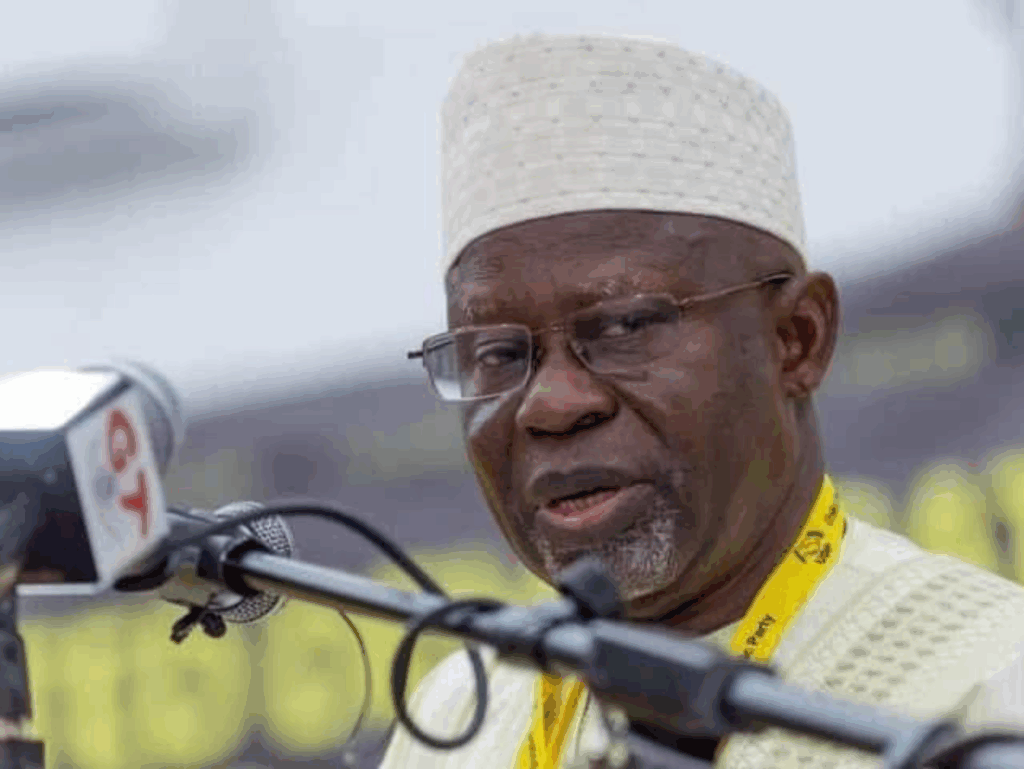
Malagen has obtained the results of the UDP’s rare selection process for the party’s presidential candidate. We sat down with the no-nonsense official overseeing the shortlisting to break it down. The party is expected to announce later today its candidate to face off against President Adama Barrow in next year’s presidential election.
By Nyima Sillah
Out of a possible 250 points, Ousainou Darboe scored 246 when he faced the United Democratic Party’s 11-member selection panel for interview.
But it is not clear what specific questions were asked.
And from a possible 17,075 points from 683 party officials who participated in the “vetting” stage across the country, Mr. Darboe got 16,808, representing a 98.4 percent score. None of his opponents come close.
From these results, Mr. Darboe has so far affirmed his place at the helm of the party he’s been leading since its founding in 1996. But there’s still a step or two for the veteran politician to cross before he’s confirmed to once again face off against his protégé, President Adama Barrow in next year’s polls.
The main opposition UDP announced on Tuesday that only three candidates were shortlisted from the ten applicants who remained in the race for the party’s leadership, following the controversial withdrawal of Talib Bensouda.
Alongside Mr. Darboe, the party’s treasurer Amadou Sanneh and legal secretary Borry Touray were cleared for possible election following a rare two-level selection process, which included an interview and a vetting.
Results obtained by Malagen show that Mr. Darboe was given a near-flawless grading in both the interviews and the vetting by party supporters to not only emerge as the top candidate, but also he was the only one to have met the threshold.
The results compiled by the party’s selection panel were confirmed in a discussion with Alagie S. Darboe, a key party executive member, who heads the 11-member panel mandated to shortlist candidates.
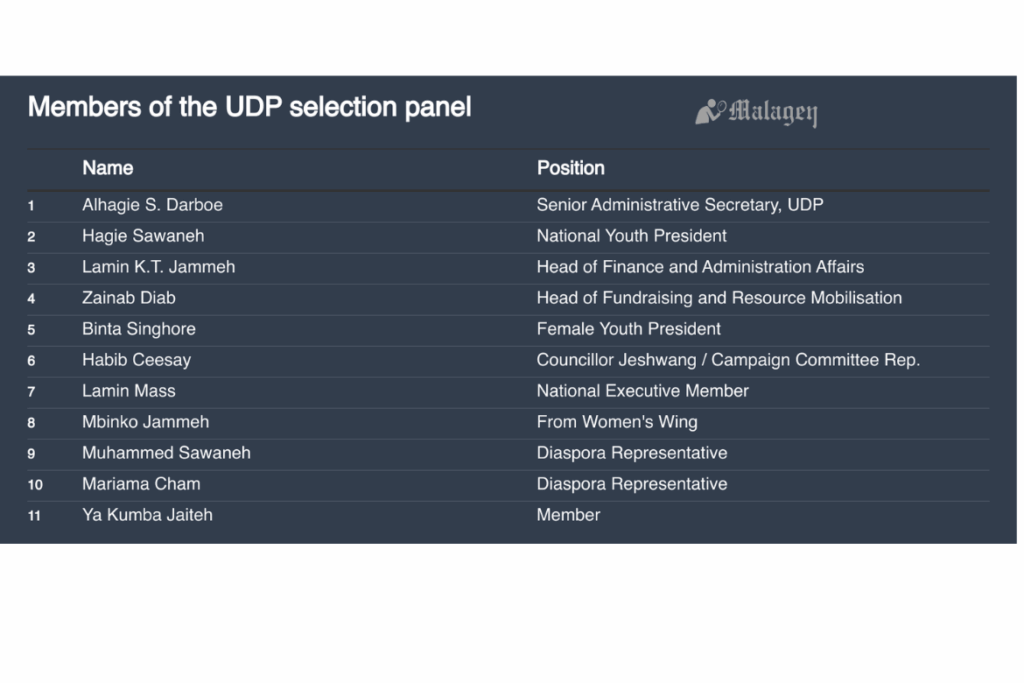
Malagen understands that the three shortlisted candidates are undergoing a “consensus-building” process where they would be urged by the party’s Council of Elders to unite around a single candidate to avoid a contest.
The Council of Elders is an unelected body comprising five males – Bajamba Bojang, Nfansu Sonko, Mansa Ndow, and Àmadou Kora – who were nominated by the local leaders based on their “wisdom and respect within the party” and confirmed by the executive. They do not have any decision-making powers, party officials told Malagen.
“This year’s selection process is significantly more rigorous and comprehensive compared to previous ones,” said Mr. S. Darboe. It was also the first time Ousainou Darboe had faced any notable challenge. As a founding member, his candidacy was never questioned as he led the party through the 1996, 2001, 2006, and 2011 presidential elections.
“During those years, no other aspirant came forward,” said Mr. S. Darboe. “So, the central committee would automatically forward his application to the selection committee for final approval.”
The first time the UDP had more than a single applicant was in 2016, when Mr. Darboe was jailed. Of three people that applied, two were shortlisted, including Adama Barrow, who won the vote by the party’s central committee.
“In 2021, the process was again open,” Mr. S. Darboe explained. “Four people applied, but after screening at the Central Committee level, the committee unanimously endorsed Darboe’s application and forwarded his name to the selection committee for final approval.”
One of the applicants at the time, Lamin J. Darboe, decried that the process was neither transparent nor fair – that he only learned about Mr. Darboe’s selection in the media.
An unprecedented number of people showed interest this time, from a rising young mayor to longtime loyalists – and even a handful of little-known party figures. But out of the initial 11 contenders, only the young mayor of Kanifing, Talib Bensouda, had posed any serious threat to Mr. Darboe’s grip on power at the UDP.
Mr. Bensouda, who was just 10 years old when Mr. Darboe first contested in the presidential elections, pulled out under pressure from a section of the party. Results obtained by Malagen show that besides Mr. Darboe’s exceptional 98 percent score awarded by the interview panel, at least four other applicants got the 60 percent pass mark: Mr. Touray 88.4 percent, Amadou Sanneh 88 percent; Sulayman Saho 76.8 percent and Lamin J. Darboe 65 percent.
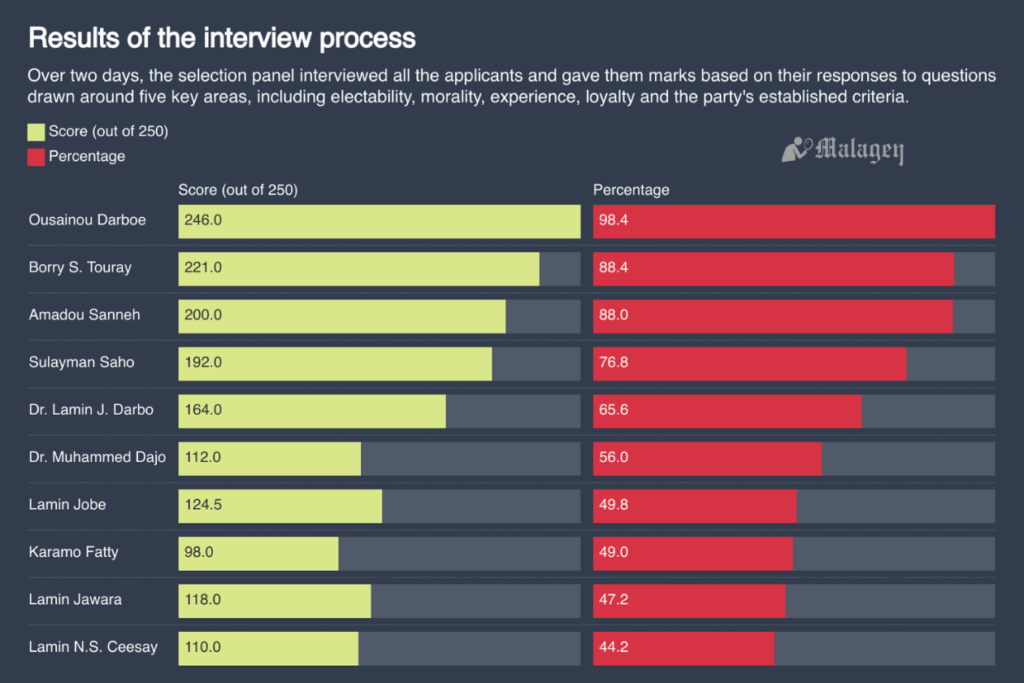
It is not clear what specific questions the applicants were asked during the interview, though the party claims to have assessed them on five broad areas, including whether they have met the established criteria focusing on education, citizenship and eligibility to vote and be voted for.
Then, they were asked about their leadership experience, and policies, including what they would do in their first 100 days.
“Third was their commitment to the party, which looked at their sacrifices, loyalty, and how they intended to promote and strengthen the party,” one member of the panel told Malagen.
Questions were also asked around the integrity, including how they intend to address corruption, and electability, where they were asked how they intend to connect with the grassroots and their ability mobilise support across demographics.
The interviews were followed by a verification process where 683 party members drawn from across the country were asked to vote for the applicants, according to information obtained from the party.
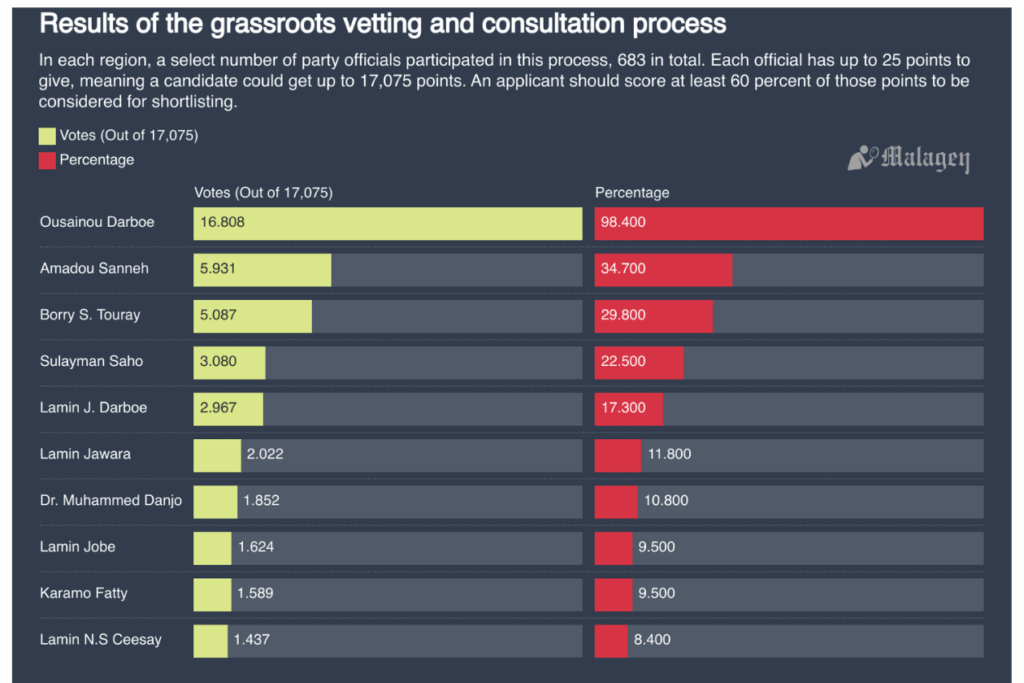
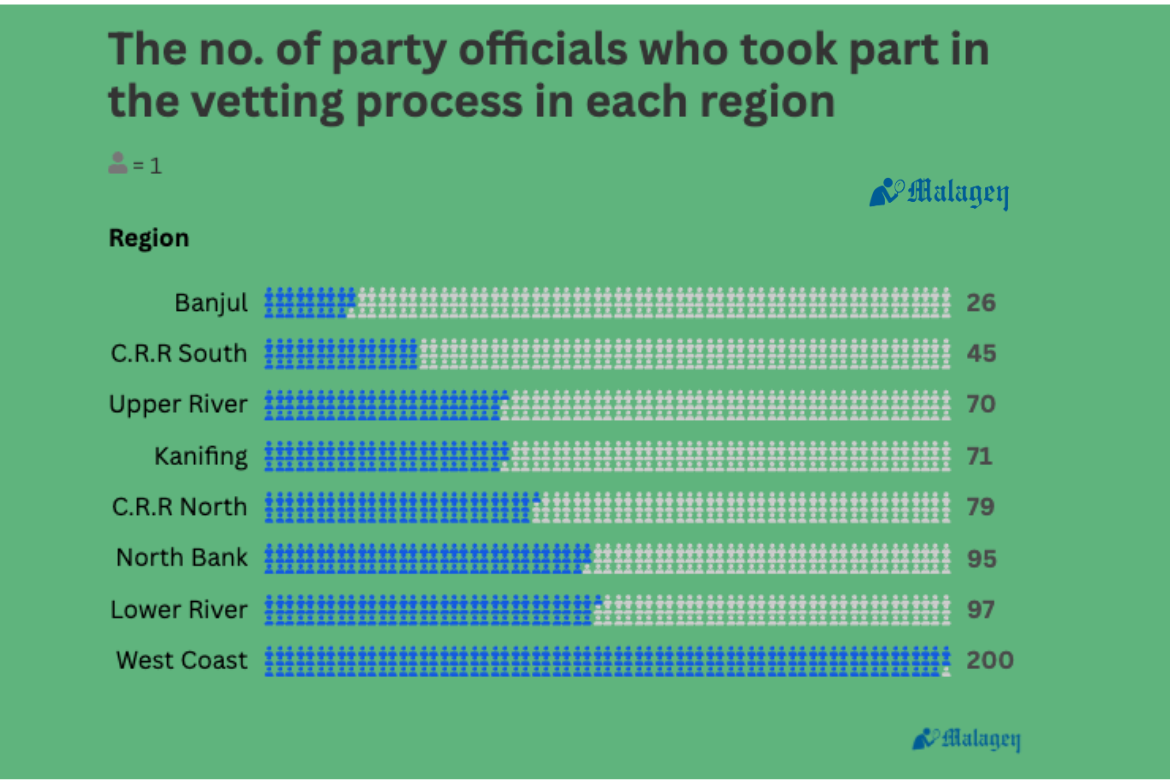
Exactly how this was done is not entirely clear to Malagen. What is known is that the selection committee held consultations in each region, each of which has a certain number of delegates. Each such delegate has a maximum of 25 points, meaning each candidate could score up to 17,075 points.
In this round, which is called “grassroots vetting and consultation”, all the applicants fell far short of the 60 percent threshold, except Mr. Darboe, who scored 98.4 percent, after earning 16,808 out of a possible 17,075 points from 683 party officials across the country.
Per the party’s rules, an applicant must score at least 60 percent in the interview and another 60 percent in the verification stages. And, to be shortlisted, the applicant’s combined score from the interview and vetting must be at least 70 percent.
Only Mr. Darboe got that.
However, Mr. Sanneh who scored 61.35 percent and Borry S. Touray with 59.1 percent when their results were combined, got shortlisted because the rules were not clear in a situation where only one candidate met the threshold, according to Mr. S. Darboe. So, his panel’s recommendation for them to be shortlisted was confirmed by the party’s powerful decision making body, the central committee.
Malagen understands that Mr. Sanneh and Mr. Touray had a marathon consensus building meeting with Council of Elders at the party’s bureau in Manjai, lasting from 3 p.m to 7 p.m. Mr. Darboe was not in that meeting.
It is not clear what the outcome was, and if no consensus is reached, a vote will be held by party delegates today at 11 a.m, marking the first such exercise in the party’s history. The winner will then hope to unseat President Adama Barrow, who has announced plans to seek a third term in next year’s election.
