
SOLD
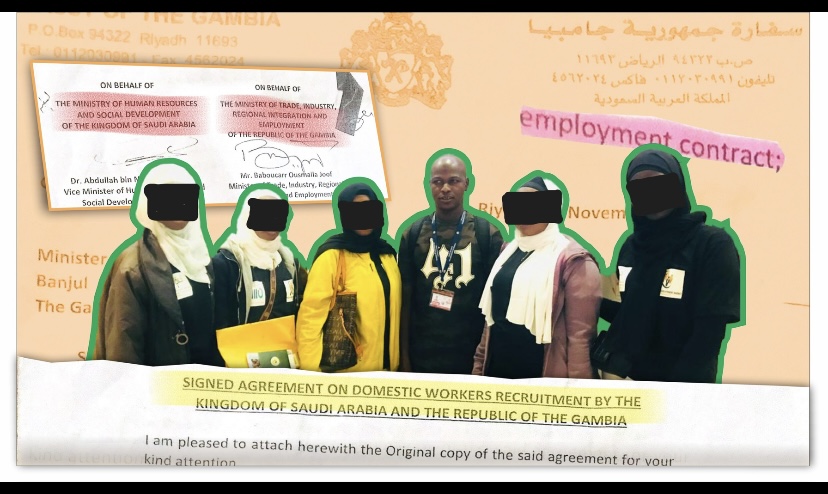
They left for the oil-rich Kingdom of Saudi Arabia with giggles and big dreams for their babies and sick parents. But they were brought back quietly, broke and traumatised.
Ndella* scrolled through her phone, and when she played the audio clip she pulled up, a woman’s voice echoed softly, but urgent in tone.
She scrolled again and played another voice note, this time a man’s, deep and without urgency.
Both audio recordings were in Serer, Nadella’s native language.
The first one, she said, was hers: pleading with then Minister for Trade, Baboucarr Joof, to help save her after she fled from her domestic employer in Saudi Arabia. The second was Mr. Joof’s reply, telling her to bear a little the pain that made her flee.
“I cried when I listened to it,” she said. “I thought he would at least understand our situation.”
Dozens of young Gambian women were sent to the oil-rich Kingdom of Saudi Arabia as domestic workers. One of them is a single mother who would “do anything” for her two-year-old son to have a better future. Another one is a young woman who refuses the trauma of her recent sexual abuse waver her determination to care for her ailing father.
Like Ndella, most of the young women shared a similar, desperate hope for economic relief.
But more than half a dozen have quietly returned home after enduring the very abuses they were promised protection from under the bilateral agreement signed between Saudi Arabia and The Gambia.
The story about the ‘slave-like’ working conditions forcing these young women to leave Saudi was first published by What’s-On-Gambia. When we contacted one of the agencies, they dismissed the reports as false.
Our investigation revealed the situation is more serious than initially reported.
First, their mobile phones and passports were seized and locked away to cut them off from help. Then, the rules became whatever their employer dictated. They were forced to work round the clock with no rest. They were starved and denied medical attention and decent accommodation.
“For the entire three weeks I was there, I slept in the kitchen — on the bare floor,” said Ndella.
She added that when he escaped her “madam” – a term used more often for domestic employers in Saudi – and called Minister Joof, he told her that he did not know anything about the contract she signed.
Photo: Malagen
Mr. Joof confirmed that Ndella had reached out to her. “I referred her to the agency that recruited her,” he said. We asked him what were the details of Nadella’s complaint and whether he made any follow-up either with the agencies or Saudi officials to make sure they were addressed. “My friend, this is repeating the earlier question,” Mr. Joof said. “She didn’t come back to me.”
No regard for agreement
It was Mr. Joof who, in September last year, convinced the National Assembly to approve the agreement, citing that nearly half of the country’s young people were without jobs.
Four agencies were then approved by Mr. Joof’s ministry to recruit domestic workers: Gamjobs, Mbye Consultancy, Tokey Consultancy and Outsource Recruitment.
Only one agency, Gamjobs, appeared to have prior experience. The three others were created just months after the deal was signed with Saudi.
Contract documents and bilateral agreements show that the domestic workers would be protected from abuse and provided decent working conditions.
But those agreements are barely respected by the government or the agencies hired to recruit domestic workers. Under the deal, the government is obliged to provide training on housework in specialised institutes and orient the workers on life in Saudi before sending them.
In a February press statement, the Ministry of Trade said it provided a comprehensive pre-departure training and orientation”, covering Saudi culture, labour laws, workplace safety and migrant workers rights.
Our investigation found this to be untrue.
“All we were told in the two days before departure was to obey our bosses and not to steal,” said Ndella, a view shared by many other workers.
Faba Jammeh, director of employment at the Ministry of Trade, confirmed that no proper training was done. “Yes, I know things were rushed because there was no time,” he told Malagen in May.
Mr. Jammeh said the ministry was working to make “the process more professional by collaborating with established training institutions to prepare the domestic workers.”
No such collaboration had been made as of July, even as the ministry and agencies recruited to replace the workers that returned
A Malagen undercover reporter contacted two major recruitment agencies – Mbye Consultancy and Gamjobs – posing as a prospective applicant.
Without any mention of training or preparation, they offered to start the visa process immediately. The online form has no section on prior training, housework skills, or understanding of Saudi customs and traditions.
Ndella Disappeared
Saudi Arabia recruits hundreds of thousands of domestic workers from low-income countries. But human rights organisations say the country has an awful record of mistreating those domestic workers. Thousands face death or sexual abuse in circumstances that are never investigated.

In recent years, countries like Kenya that traditionally supplies domestic workers have pushed back, imposing bans and demanding stronger protections. The Saudis have since set their eyes on new markets such as Gambia and Sierra Leone.
The Gambian authorities were well aware of the abusive and exploitative environment that prevails in Saudi. In public, they brushed aside those concerns by emphasizing how the agreement makes it safer for people to live and work in Saudi. But away from official briefings, they gave a chilling piece of advice to those recruited. “They told us during the orientation that if you want to come back home alive or in one piece, obey your bosses,” Ndella said.
The interview we had with Ndella in May was promised to be the first of many. But she disappeared afterwards. When she finally responded, it was only to say that she could no longer grant interviews and declined to elaborate.
When Ndella was being interviewed in May this year, there was Natou*, 32, and Mama*, 23. What they all had in common was that they were all unemployed and burdened with responsibilities. Ndella was urged on by her mother despite her husband’s protestations. Natou has a two-year-old son she’d do anything to give a better life to. Mama was seeking a fresh start after surviving sexual abuse at a previous job. “My father was sick and I wanted to help him,” she said.
Word about the ‘life-changing’ opportunity to work in Saudi spread quickly. The workers would make $200 per month, enjoy free housing and food. They would not even have to pay for visa or airfare—all that would be taken care of free of charge, according to advertisements reviewed by Malagen.
A few weeks after submitting their travel documents, the women put their clothes in their bags and headed to neighboring Dakar, Senegal, for their flight to Saudi.
“We giggled all the way to the airport,” Ndella said, Nabou and Mama nodding. “It felt like we had already made it.” For all three of them, it was their first time on a flight.
But none of them lasted more than three weeks on their jobs. Out of the 59 women sent in February, six were returned home in June, and four more had arrived at the Centre in Saudi soon afterwards, demanding to be returned.
One of them, identified only as Jatou, was found sleeping in the streets of Riyadh by a taxi driver after she escaped from her madam. “She said everything was taken from her,” the taxi driver who picked her up and took her to the Centre told Malagen over the phone. “She had no phones. No passport.”
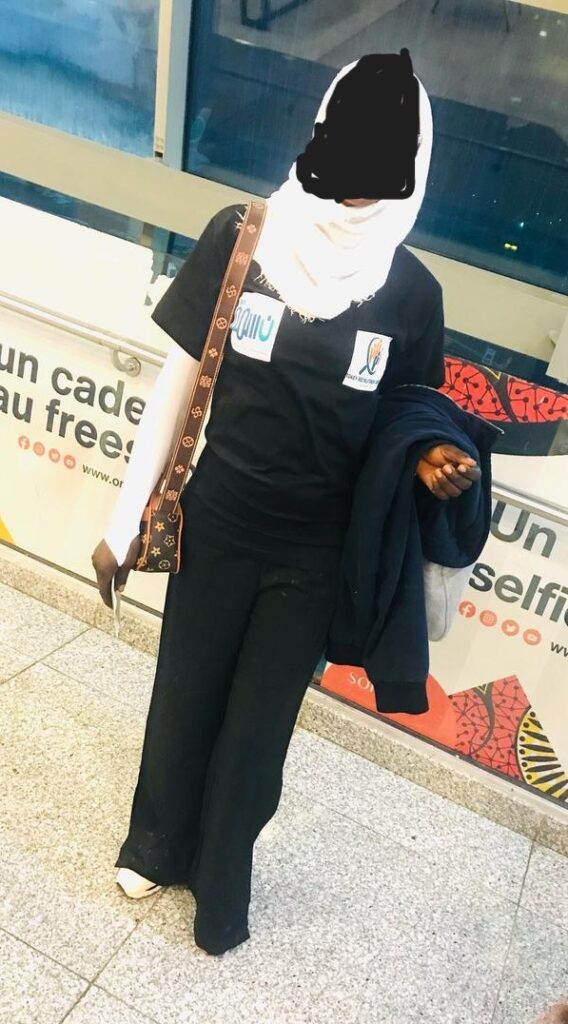
Ndella said when she ran away, she sought refuge at Sadi Medical Centre—a facility in the capital city, Riyadh, where domestic workers recruited from The Gambia stay before their deployment. Once there, she sat quietly in a corner of the room and composed the audio message she’d sent to Minister Joof. Fatigued and in fear in a foreign country, she tightly clutched her phone, which she was seeing for the first time in three weeks. She waited for the Minister’s response, pinning her hopes on it. But when the message came in, it left her crushed.
Mr. Jammeh of the trade ministry said his office had received complaints, mainly regarding hours of work. The women sign up for nine hours of work, but are being forced to work double the agreed time. “Some workers are tolerating the conditions out of economic desperation,” he said. “Some are lying and making up stories.”
Worker refused to be ‘sold’ again
The Gambian agencies were paid $1,300 by the agencies in Saudi Arabia for each domestic worker recruited, so they are not allowed to charge any fees.
But when Nabou left her post, the agency that recruited her, Mbye Consultancy, forced her to pay her own airfare back home after she refused to be ‘sold’ to another madam in another city. Her family confirmed that they took a bank loan of D84,600 (approx. $1,200) to pay for her return.
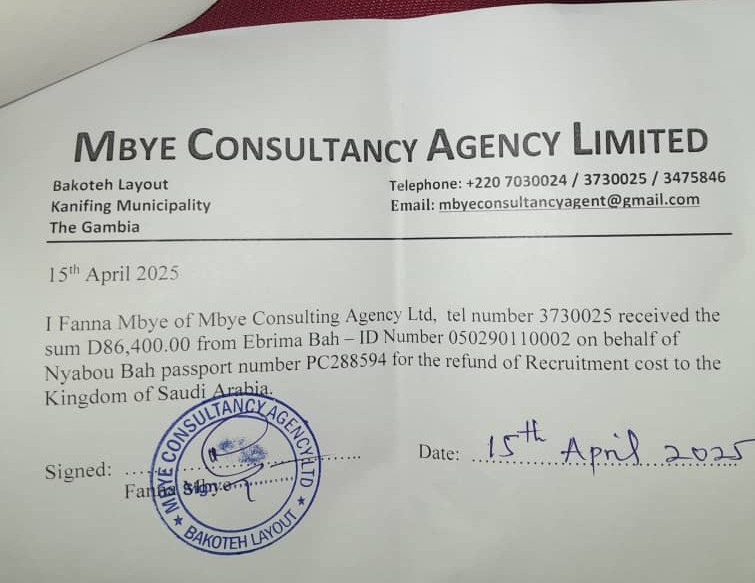
Mbye Consultancy did not respond to requests for comment.
Mr. Jammeh of the trade ministry said it was wrong for the agency to ask Nyabou to pay her airfare back home. But he gave no indication that the alleged violations would be investigated. He instead said some of the returnees signed “refusal to work” letters, meaning they should repay the cost incurred. Nabou denied signing any such letter. “I’m a graduate,” she said. “I read everything before I signed it.”
Malagen contacted all agencies hired by the ministry of trade. Only Modou Camara, the Chief Executive Officer of Outsource Recruitment Agency, responded.
“The workers just didn’t want to work,” he said. “Some didn’t like the food.”
The agreement with Saudi says that complaints of abuse or violation of the contract should be made to the Gambian consulate in Saudi. The workers said an official from the Consulate, Saja Jarju, visited them at the Centre and had a meeting with the officials there. But he reportedly stormed out of that meeting without giving them a clue of what was discussed.
“Since then, he hasn’t answered our calls or responded to our WhatsApp voice notes,” Ndella said. Mr. Jarjue did not also respond to Malagen’s request for an interview.
When asked about the complaints during a May town hall meeting, then-Foreign Affairs Minister Mamadou Tangara responded, “I’m not aware of it,” and provided no indication he would investigate.
Just before going to press, we telephoned Jatou’s mother again to find out her whereabouts. After spending two months at the Centre waiting to be returned, Jatou was finally home. “I am back home,” Jatou said in a brief call. She said three other women remained stranded there.
