
Justice Minister Eliminated These Laws. These Experts Do Not Have Kind Words About It
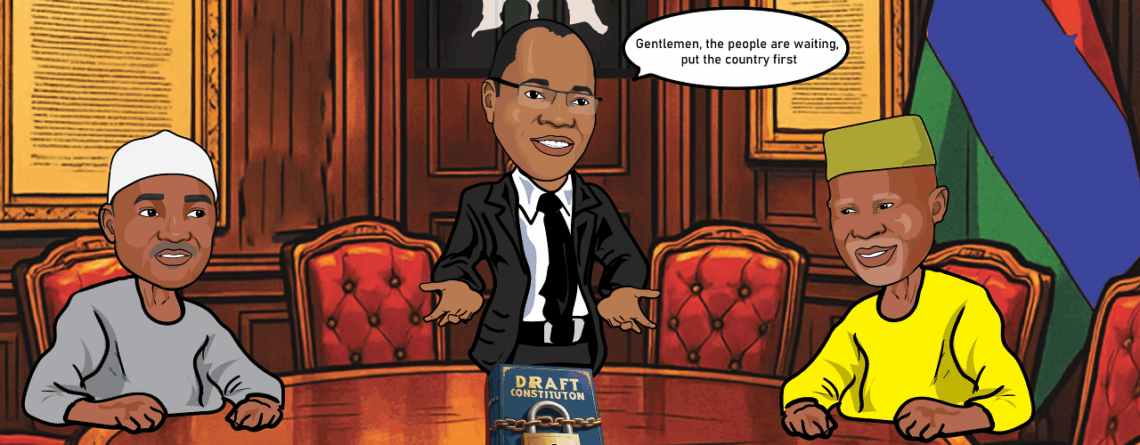
The government made more than 126 changes when revising the draft constitution. About half of these concern provisions related to anti-corruption, human rights and checks on the president’s power. Almost all of them were gutted, and now Mr. Ibn Chambas is pushing to succeed where former Nigerian President Goodluck Jonathan fell short
At 2 p.m. on a Thursday in February this year, opposition leader Ousainou Darboe drove through gates that were familiar, yet reminded him of an unfulfilled ambition: the State House – a place he’s now spent nearly three decades trying to enter as president.
But this entry, or return to where the 76-year-old veteran politician and lawyer had once briefly served as vice president, was of a different kind.
For nearly a decade of democratic transition, the Gambia’s efforts to replace its dictatorship-era constitution continues to stumble. A revised draft, produced four years after the previous version collapsed in parliament, emerged last year.
There were over 126 major changes, according to the document published by the Ministry of Justice.
The experts Malagen spoke to for its investigative study overwhelmingly opposed the changes, warning that the revisions would undercut anti-corruption efforts.
The new draft appeared headed for a certain demise, a fate Mr. Darboe’s United Democratic Party seems determined to ensure.
Days before Mr. Darboe’s highly discreet visit to the State House, Justice Minister Dawda Jallow had telephoned him about a scheduled meeting with President Adama Barrow. There’s no love lost between Mr. Darboe and his former protégé, now bitter rival, Mr. Barrow.
So, the heavy-lifting to arrange this carefully orchestrated meeting was done by a Ghanaian diplomat, Mohamed Ibn Chambas, who had negotiated more crises in Gambia than anyone.
Once inside the State House grounds, Mr. Darboe got out of his car, flanked by Alhagie Darboe, a key member of the UDP, and leader of the minority opposition caucus in the National Assembly.
Mr. Chambas, who had flown into the country specifically to preside over this high-stakes meeting, walked with them into a ‘waiting room’. The Solicitor General, Hussein Thomasi, was in there, waiting, as was Chief of Staff, Mod K. Ceesay.
The president’s Chief of Protocol, Alagie Ceesay, walked in minutes later, and on his instructions, Mr. Darboe slowly entered the ‘meeting room’ where he would come face-to-face with President Barrow. Mr. Chambas followed behind him. The rest stayed behind, in the waiting room.
With the heavy-doors closed behind them, Mr. Chambas urged the two political rivals to put ‘country first’ and support the adoption of a new constitution.
The atmosphere was calm and respectful, according to sources close to both.
But in less than an hour, Mr. Darboe emerged, made straight for his car with Alagie Darboe in tow. The talks would soon be leaked, and with party supporters pressing for details, Mr. Darboe came out to confirm that the talks ended as several similar ones before it: NO DEAL!
The Gambia spent over D116 million drafting a new constitution. Efforts to pass it failed in parliament following the ruling National People’s Party’s objection to some key provisions, chiefly, a two-term limit clause which counted President Barrow’s first term, and effectively disqualified him from attempting a third.
International diplomats have since been shuttling in and out in an attempt to breathe life back into what was a ‘dead’ draft.
In this peaceful yet crisis-prone small nation, Mr. Chambas is widely remembered well. Most recently, he played a key role in negotiating the exit and exile of former President Yahya Jammeh.
With politicians – and civil society actors – sharply divided after the government presented a revised draft, Mr. Chambas was specifically called upon to lead these renewed constitutional negotiations. Previous talks led by former Nigerian President Goodluck Jonathan have failed.
Aiming to move the discourse beyond political posturing, Malagen examined how the two drafts address corruption – a top concern for Gambians, 77 percent of whom say it has worsened, more than doubling in just five years.
We closely studied both drafts, examined position papers presented by CSOs, and the government’s own explanatory memorandum.
Nearly half of the more than 126 provisions revised in the draft constitution focused on anti-corruption and accountability. Almost all of them have either been entirely eliminated or replaced with text similar to the 1997 Constitution, a Malagen analysis revealed.

We then conducted an investigative study by identifying 14 key issues focusing on accountability and public sector corruption. We surveyed 16 key professionals involved in anti-corruption work: anti-corruption experts, investigative reporters and newspaper editors, human rights lawyers, state prosecutors, a Ghanaian judge who’d served in the Gambia, civil society actors and university lecturers.
Across the 14 changes targeted by this investigative study, ‘strongly disagreed’ was the most frequent choice, selected 71 times—or nearly 56 percent of all 127 responses. ‘Disagreed’ followed with 18 percent, ‘neutral’ 4 percent, ‘agreed’ 9 percent, and ‘strongly agreed’ only 3 percent.
Stripping away standards for leadership and integrity
The ministry of justice deleted Chapter V entirely, which establishes ethical leadership standards and compels public officials to declare gifts or donations. One expert, Michael Davies, an anti-corruption activist, supports the ministry’s position that those ‘overly detailed’ provisions are taken care of in other laws.
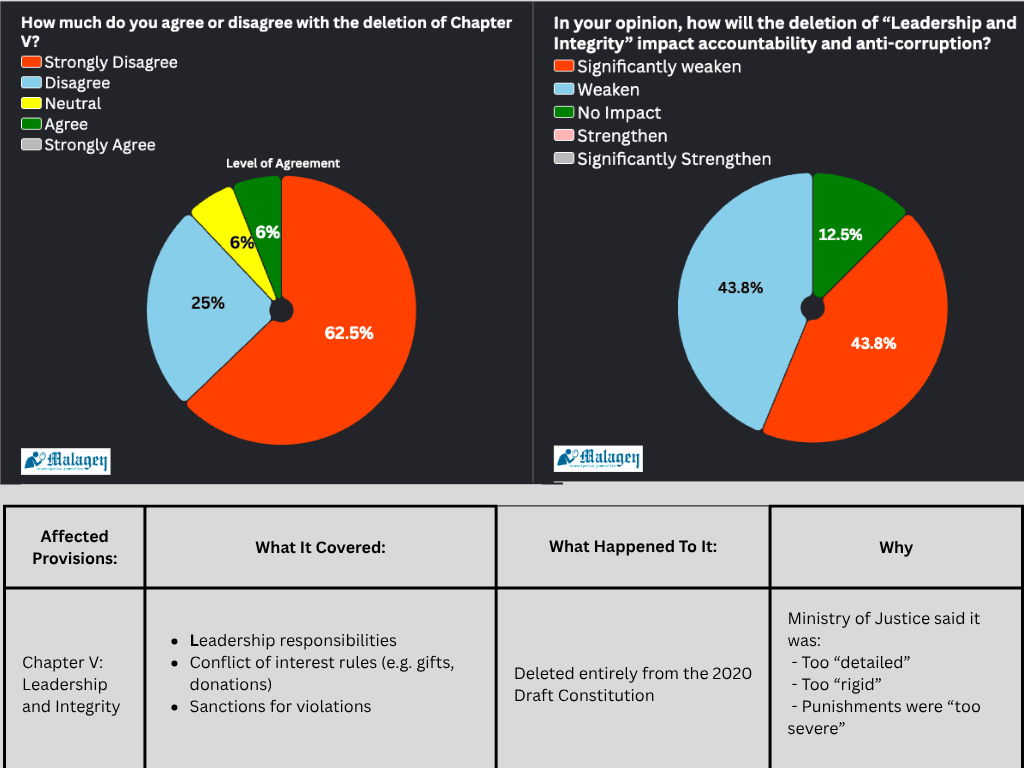
But a vast majority of experts, 14 out of 16 – or 87.5 percent – do not support the removal, and one stayed neutral. Many see Chapter V as foundational for accountability. Biran Gai calls it “fundamental pillar” while his fellow lecturer at the University of the Gambia, Kawsu Jadama, says it is the “cornerstone for accountability” and Essa Njie describes “guiding principle for public officials to uphold ethical standards.”
However, Marr Nyang of Gambia Participates sees leadership and integrity provisions as a useful but flawed tool. While its removal doesn’t erase anti-corruption safeguards, he warned that “it could be used by politicians to hunt persons with integrity in the public service.
On asset disclosures and campaign financing: privacy or protection?
The ministry of justice targeted several provisions on asset disclosure and political funding, citing privacy concerns.
“This is a scam,” said Essa Njie, in reaction to the elimination of post-office asset declaration for vice presidents and ministers. “It is an affront to Gambian taxpayers.”
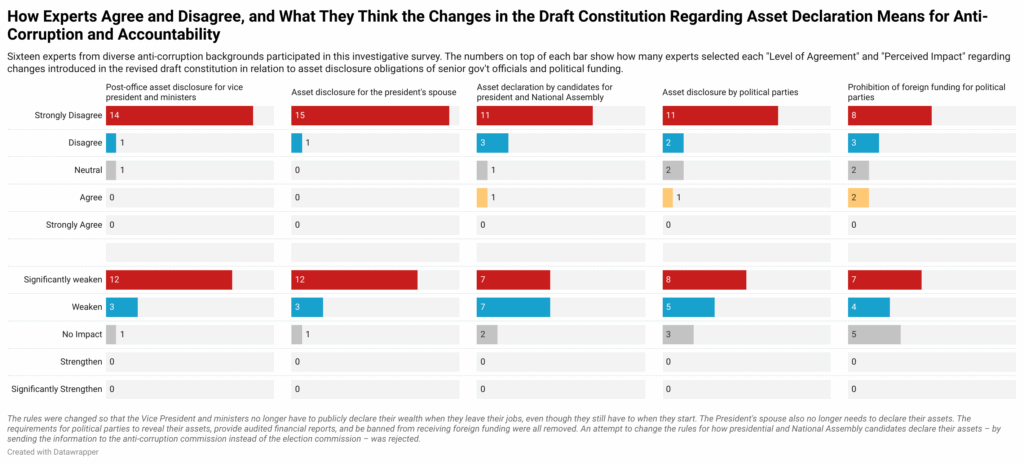
Mr. Njie is among 15 out of 16 experts – 93.8 per cent – who disapproved of the changes, and over 87 percent of them believed it would weaken accountability.
Mohammed S. Bah, a news editor at Foroyaa and former president of the Gambia Press Union, described the changes as “a significant step backwards.”
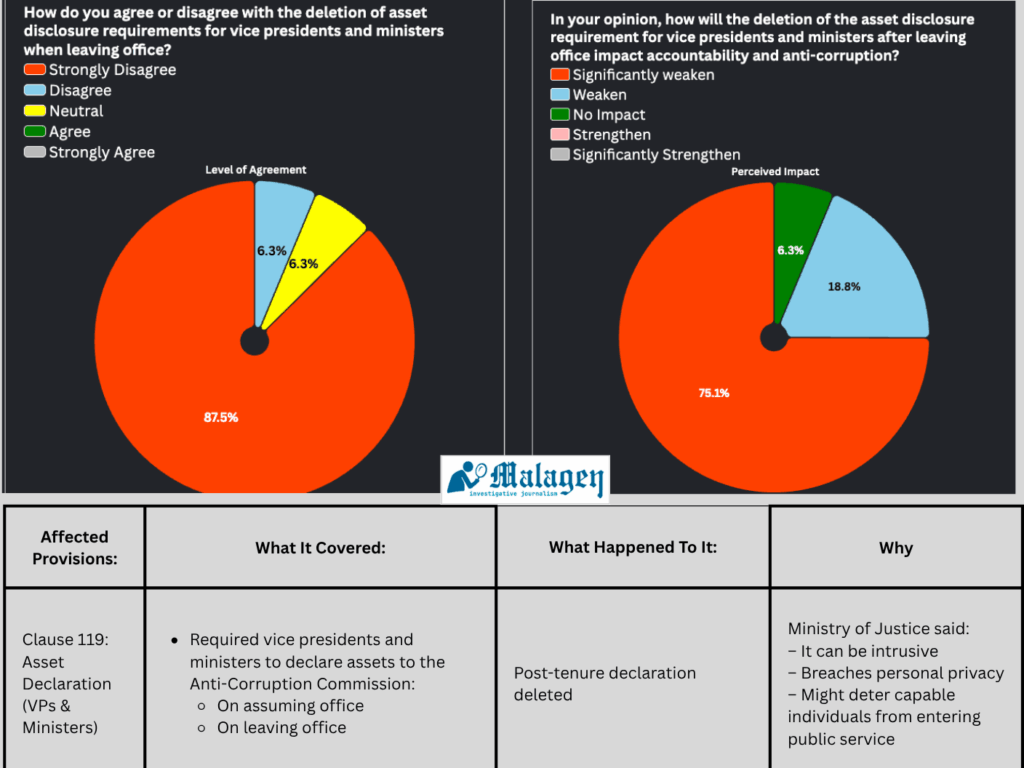
“Disclosing assets when leaving office is just as important as doing so upon entering office,” explained Marr Nyang, an anti-corruption advocate. “This process enables the anti-corruption commission to determine whether the assets acquired during one’s time in office were obtained legitimately.”
The law forcing the spouse of the president to declare their assets and business interests was also removed, a change not a single expert supported, and only one said the changes would have no impact on anti-corruption and accountability.
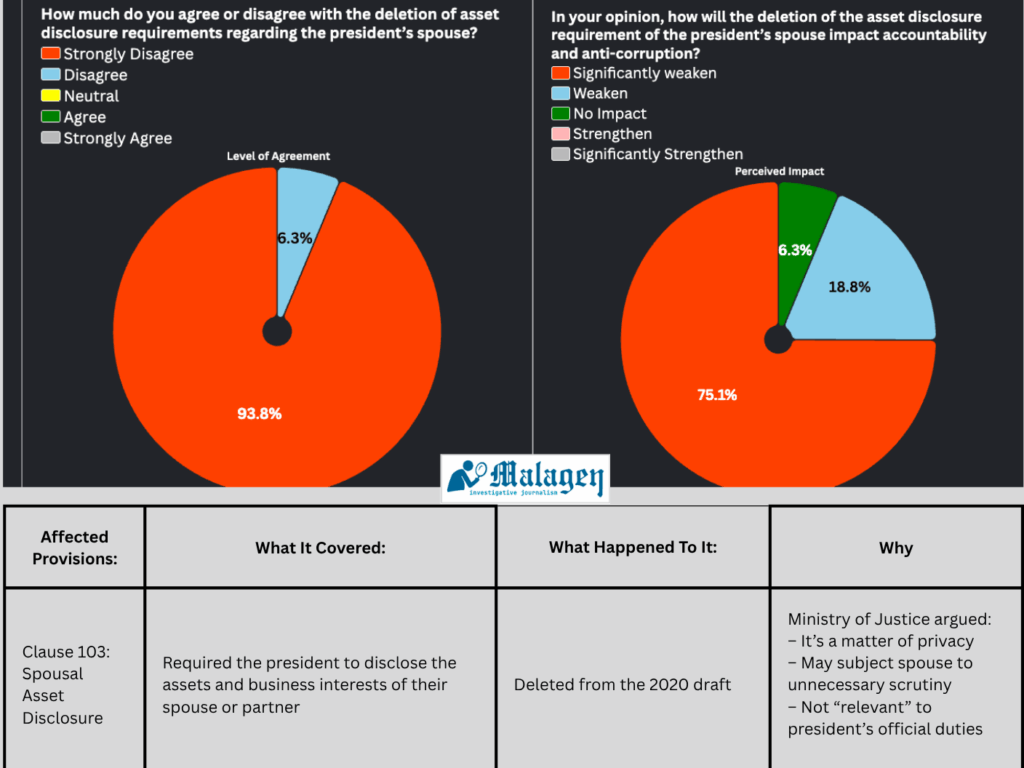
Isatou Kaita, a journalist and president of the Gambia Press Union, said the privacy concerns often cited by the ministry are legitimate, but warned that it shouldn’t outweigh the public’s right to know about potential corruption risks.
A state prosecutor who participated in this survey anonymously, said wives of presidents often illegally gather wealth from public resources. The prosecutor pointed to instances where presidents transfer or list illegally acquired assets, such as land and bank accounts, in the name of their wives to hide them.
Laws around political funding were also targeted, including one that prohibits parties from taking ‘foreign funding’, and another that compels them to declare their assets and provide audited accounts.
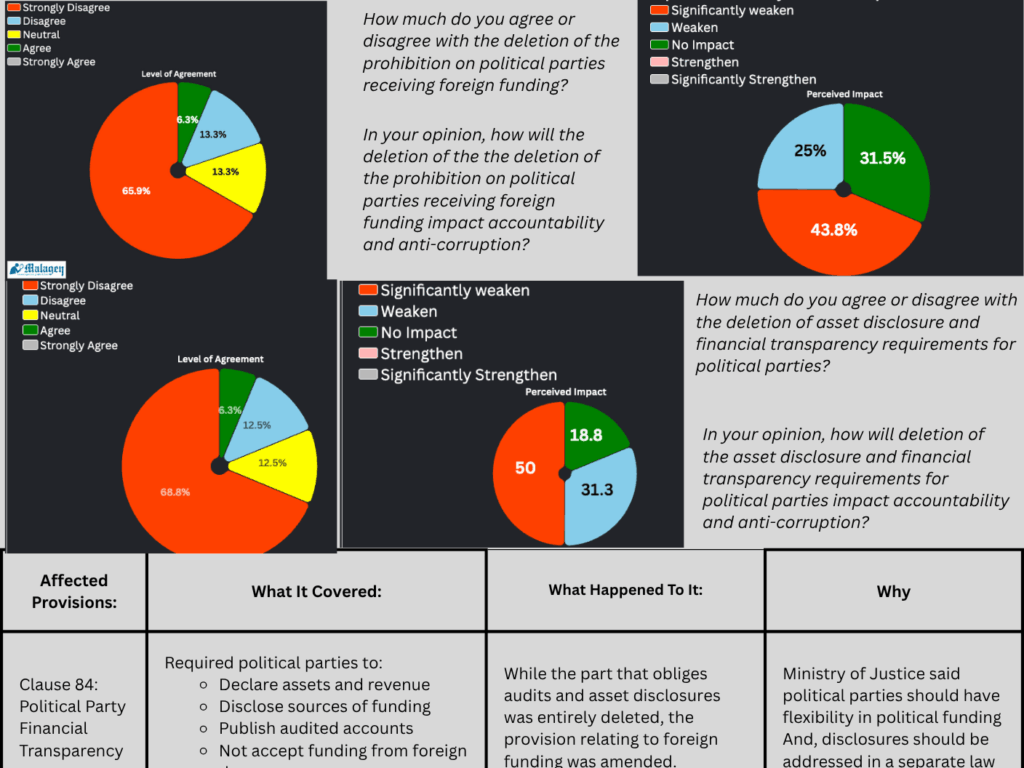
The ministry said the laws were removed because parties should have flexibility in funding, but one of his own staff, a state prosecutor, described this as “silly.”
But Tabora Bojang, a political reporter, agreed with the changes. “Leaving such matters in the constitution may be too rigid especially when entrenched,” he argued. “An Act may be flexible as it could be amended to suit emerging political dynamics.”
Most experts, 15 out of 16 – or 93.8 percent – however believed the laws should not have been changed, and 81 percent said it will weaken anti-corruption efforts.
“This will allow foreign businesses to buy their way into the State House,” said Abdoulie Fatty, a private lawyer and secretary general of the Gambia Bar Association. “Money yields influence. This will inevitably result in a lot of high-level corruption.”
Human rights activist Madi Jobarteh said allowing foreign money will turn elections into a “commodity,” making elected officials beholden to external funders and jeopardising the country’s peace and stability.
For anti-corruption advocate, Michael Oko Davies, allowing foreign funding for political parties without having them to show where funds come from will open invitation for ‘organised criminals such as drug traffickers and money launderers to fund politicians so they could enjoy immunity’.
“The president’s power is unlimited”
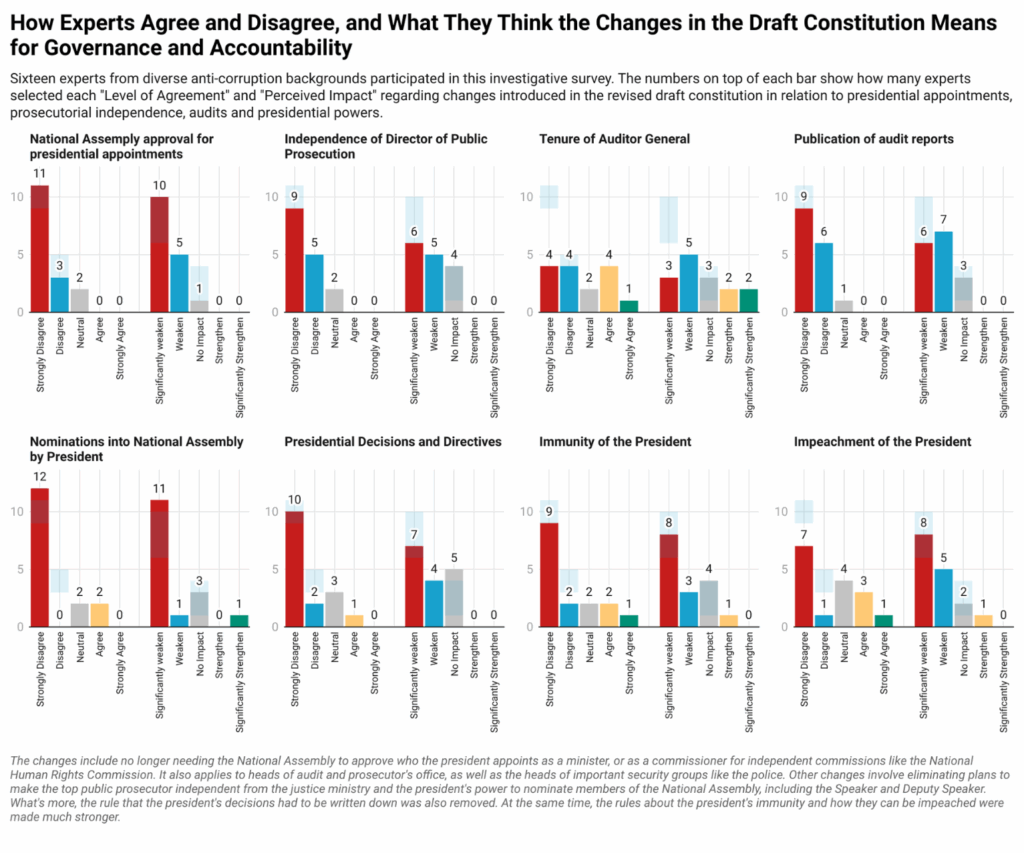
Only one out of 16 experts agree with the changes regarding removal of National Assembly approval of presidential appointments to ministerial positions, independent commissions, audit offices and the director of public prosecution.
“The new draft gives the president greater power over appointments, weakening institutions like ours,” said Emmanuel Joof, chairman of the National Human Rights Commission.
Mariam Sankanu, an investigative reporter, said the changes that removed vetting of presidential appointments for such key positions would undermine the independence of independent state institutions, a view shared by majority of experts.
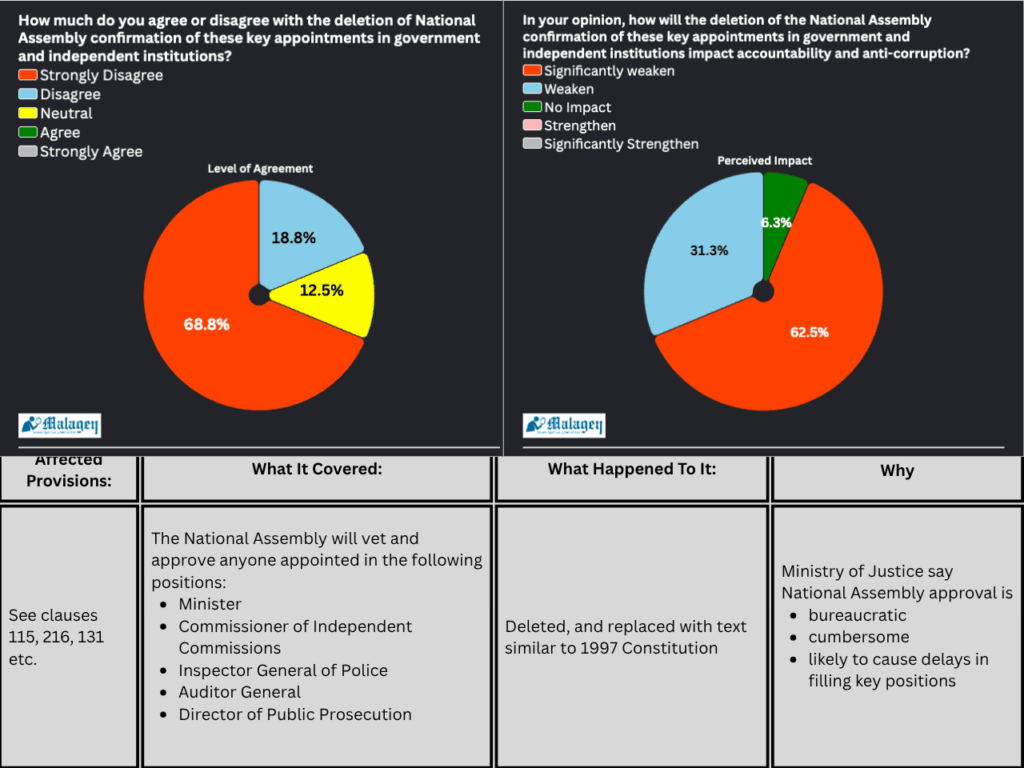
The 2020 draft took away from the president the powers to make nominations to the National Assembly. This was revised and replaced with the text largely similar to that of the 1997 Constitution.
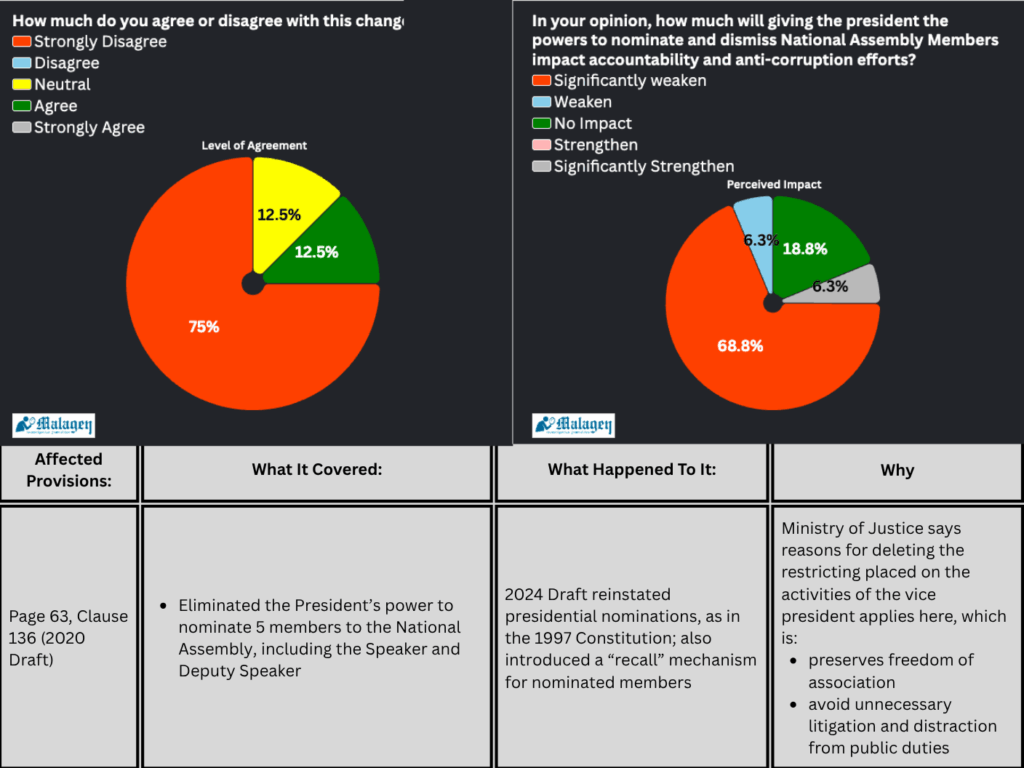
Majority of the experts, 12 out of 16, said the president should possess no such powers in a democracy.
“The president’s power is unlimited,” said Marr Nyang, executive director of The Gambia Participates. “Even in the 1997 constitution, the president can nominate members to the National Assembly but cannot recall them once they are appointed.”
Many experts cited the case of Ya Kumba Jaiteh, a nominated member whose dismissal from parliament was overturned by the Supreme Court, as an attempt by the government to now vest the president with powers he should not have in a democracy.
Constitutional law lecturer Kawsu Jadama highlighted that while nomination is meant to bring in specialised expertise not available in parliament, this power has historically been abused. Instead of choosing qualified, neutral experts, he added, presidents often nominate political allies or loyalists.
Most experts, 12 out of 16, do not support the removal of provisions that require the decisions of the president be formally written, signed and sealed, which the ministry of justice had said could hinder government efficiency, create “legal vulnerabilities” and officials would not “act swiftly on presidential decisions for fear of personal repercussions.”
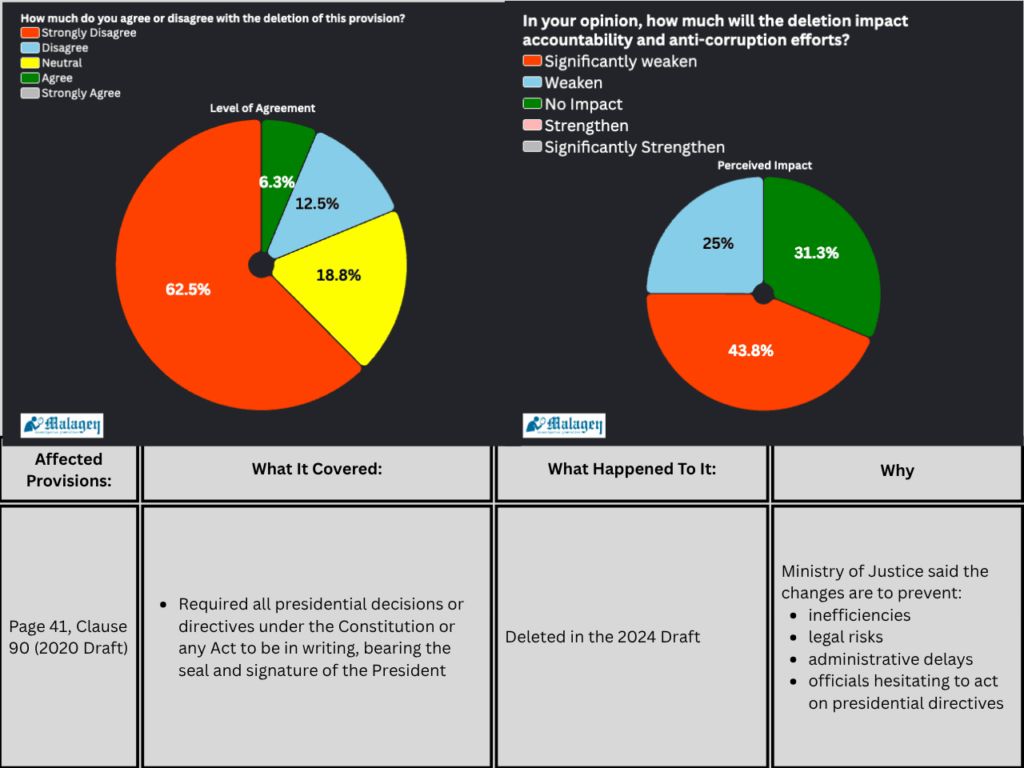
Signed presidential decisions are essential for ensuring accountability for both the president and those who implement their orders, according to many.
“Without signing decisions means the president can merely make verbal decisions for which he cannot be effectively held accountable, and also those who execute such decisions may not be held accountable,” said Madi Jobarteh, human rights activist.
However, Tabora Bojang, a journalist who agrees with the ministry’s stance, said requiring the president to sign off on every decision could “pose rigidity for the president to make quick and easy decisions in the day-to-day governance of the state.”
The 2020 draft aimed to make the Director of Public Prosecution independent of the justice ministry, but this was changed back to the 1997 system, where the chief prosecutor will be under the Minister for Justice. The ministry said the revision is meant to “strengthen executive oversight” and align “prosecutorial decisions with the government’s legal and policy framework”.
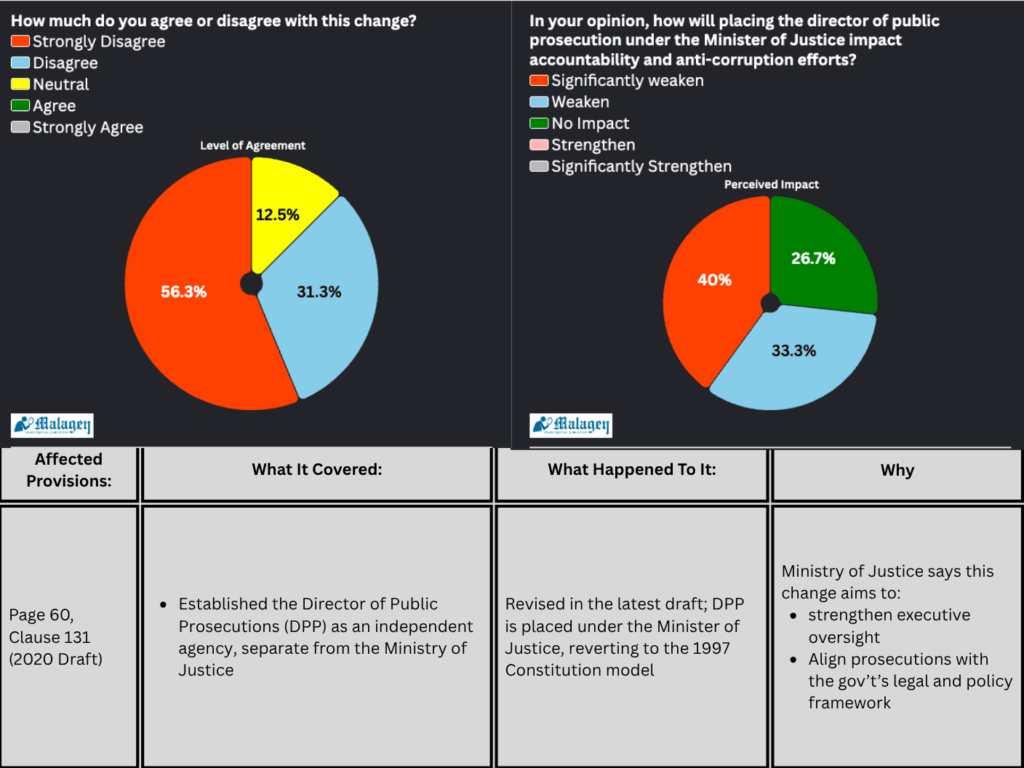
The majority of experts, 14 out of 16, do not support the changes, noting that as chief prosecutor, the director of public prosecution should not be subject to the control of the minister, who is a political appointee.
Many experts drew on the Truth Commission, or TRRC, testimonies to show how prosecutors were influenced by politicians to persecute political rivals and voices critical of the government.
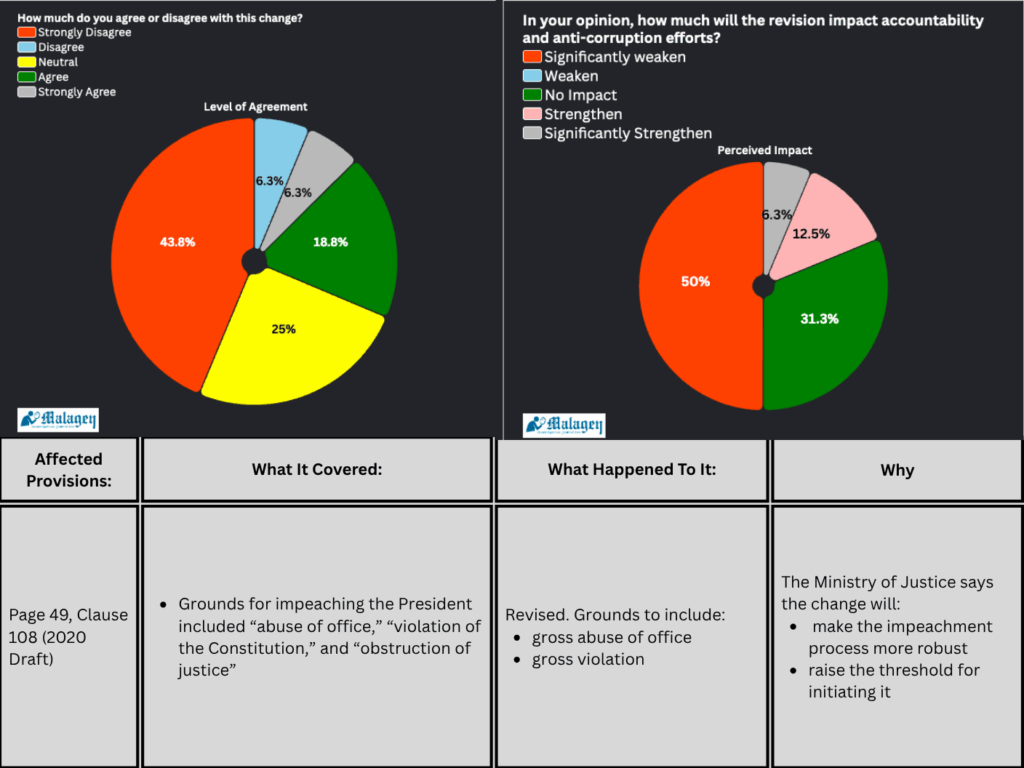
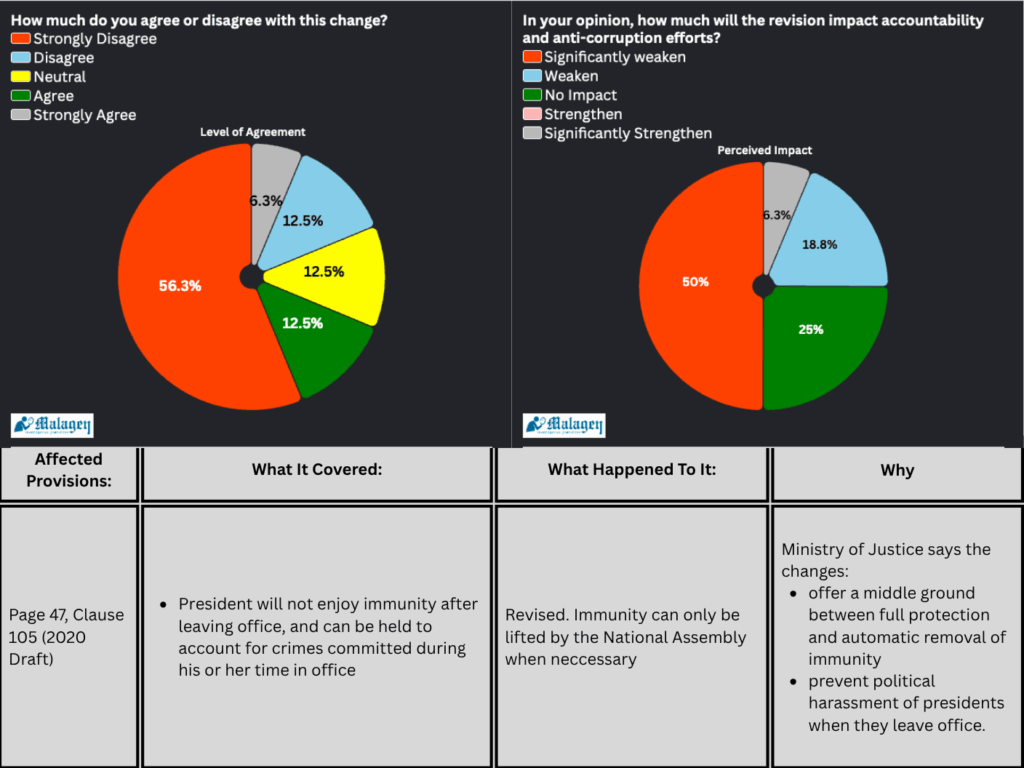
The ministry of justice has meanwhile made issues around immunity and removal of the president “more robust”, an area that has seen improved approval from the experts, though more still believed that the changes undermine accountability.
High-level Discussions Are Stalled
It wasn’t just Mr. Darboe whom Mr. Ibn tried to convince. He held a closed-door meeting with civil society leaders after they overwhelmingly rejected Justice Minister Dawda Jallow’s claim that they had been consulted on the revised draft.
In March this year, the National Assembly was scheduled for the second reading of the draft constitution bill – a vote to decide whether it should advance.
Suspecting a possible failure similar to that of the 2020 draft, Mr. Jallow requested postponement until June to allow “further consensus building.”
But sources close to both Ousainou Darboe and President Adama Barrow told Malagen that the constitutional draft meetings in February yielded neither a deal nor a promise for one.
While both leaders are open to having another face-to-face meeting, chances for a consensus remained slim, according to high-level sources from both parties.
For Mr. Darboe, the starting point for any conversation should be the 2020 draft constitution.
But Mr Barrow seems firm on proceeding with the 2024 draft, and his Justice Minister Mr. Jallow is scheduled to table the bill in parliament today for a crucial vote on the fate of it.
The move is expected to be met with opposition from Mr. Darboe’s party, who hold a crucial minority of 15 seats in the legislative.
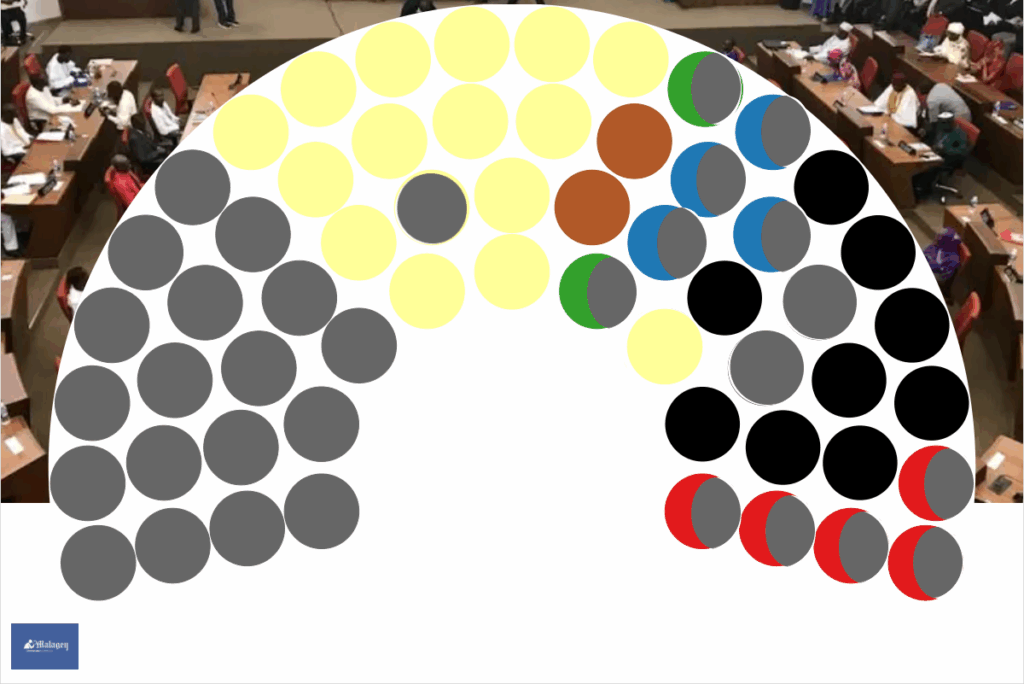
The PDOIS has two members in the National Assembly, and the party has signalled willingness to support the bill to advance to committee stage.
The position of majority of the independent members, reduced from 12 in 2022 to now 9, including four from the Jammeh faction of the former ruling APRC, remains unclear.
But even if all other members in parliament voted in favour of advancing the bill, at least two members of Mr. Darboe’s party would still need to support it in order to meet the 75 percent threshold.
