
Dirty Money Needs a Home. Property Market Offers a Safe Haven
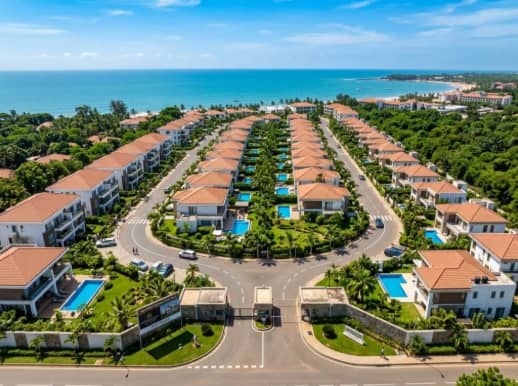
The Gambia’s real estate industry is attracting large amounts of illicit funds. Real estate dealers ask only a few questions even from individuals with questionable sources of wealth, including narco-fugitives.
The real estate industry in The Gambia has seen a massive boom in recent years. Luxury apartment blocks, gated communities and seaside residential properties have sprouted across urban and coastal areas.
But the surge in property transactions is fuelled in large part by dirty money – proceeds from illicit businesses, such as corruption and trafficking in drugs.
The country has enacted several laws that require companies to do thorough checks in large-scale transactions to prevent money laundering. In the property market, dealers ask only a few of those questions. High-profile companies were found to be quite eager to push deals through without much regard to anti-money laundering laws.
The companies have pushed back when confronted with the findings of our investigation, which was done in partnership with DUBAWA, a Nigeria-based independent fact-checking platform.
“Real estate is one of the safest avenues for laundering proceeds of crime and it is one of the country’s largest investment sectors,” said Abubacar Darboe, Secretary General of the Association of Real Estate Companies of The Gambia.
Mr. Darboe said individuals with questionable sources of wealth buy multiple high-value properties in a short period or acquire shares in real estate companies or hotels. “These are substantial investments that do not attract as much public attention as luxury vehicles,” he added.
That much is evident, not least from some of the recent court filings involving high-profile drug cases we have reviewed for this story. Individuals linked to drug trafficking, including narco fugitives who sought refuge in The Gambia, have in recent years invested millions in dollars buying properties to clean their illicit wealth.
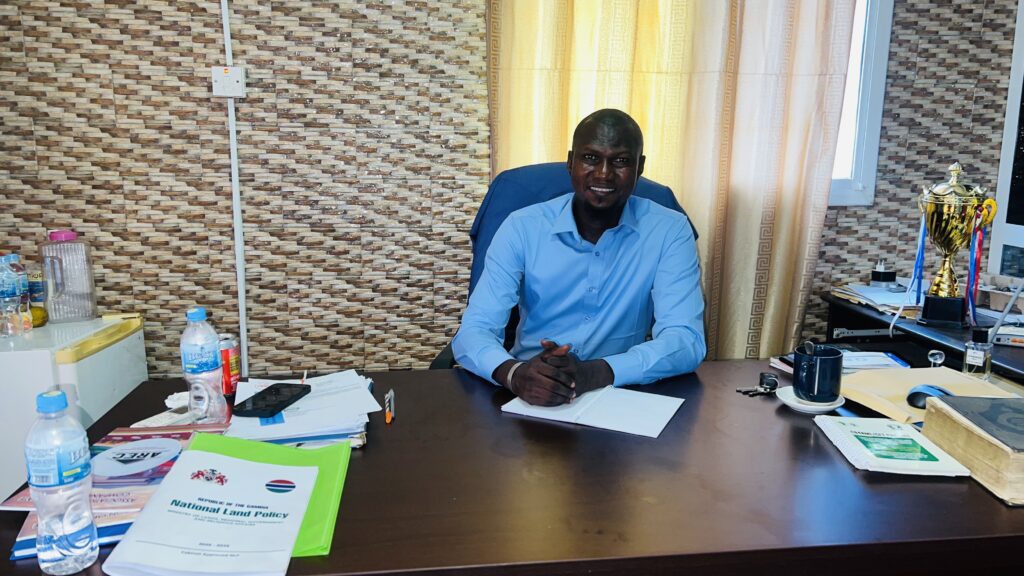
As the property market attracts large, unchecked cash flow, Gambians on regular salaries seem to be paying a steep price. Rent and land prices have gone up beyond what many could afford, and some are blaming it on money laundering, and all that comes with it: fraud and unscrupulous agencies.
Aminata Njie, 38, a primary school teacher on a salary of roughly US$153 now pays about US$76 a month in rent, up from $34. A single mother of one daughter, she lives in one bedroom and a living room in Sanchaba.
“Sometimes I can barely sleep because I don’t know how I’ll pay the next rent. With the way prices keep going up, it feels impossible to manage food, school, or even basic needs on my income. It’s so hard for people like me with a low salary. I just wish the government would step in to control these high rents and help people like us. We need them to regulate the housing market and make it fairer for tenants.”
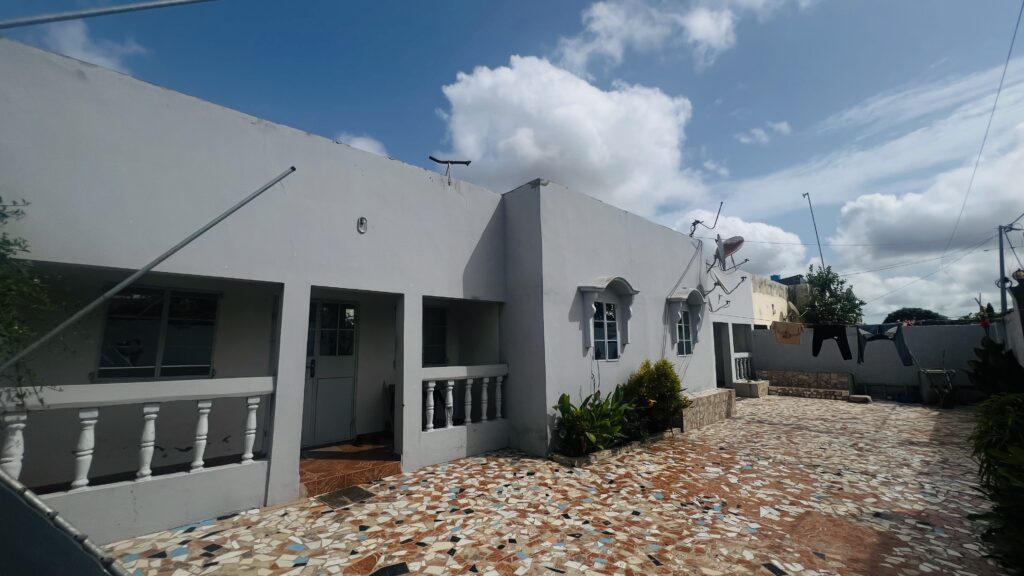
John Njie, 50s, a retired civil servant, also lives in a one bedroom and a living room in Nemasu. He has a backyard with a kitchen and outdoor toilet. Just eight years ago, Mr. Njie was paying about US$34 per month. Now, he pays double US$68. “I’m struggling to afford to pay for this place,” he said, adding that as he tries to find a new place, he encounters agents who demand commissions and up to six months advanced payment.
“Effective regulation would address both the risk of real estate being used to conceal illicit wealth and the difficulties ordinary Gambians face in securing affordable housing.”
Some of the recent high-profile drug cases that made it to the courts offer a glimpse into how those who deal in drugs conceal and move illicit wealth through investments in property.
In 2022, anti-narcotics officials had arrested Omar Fofana, a tourist taxi driver during the seizure of over 800 kilograms of cocaine – the second-biggest inland seizure. Investigators linked him to at least three high-end properties in the coastal areas, including Brusubi, Tanji and Sanyang. His case was dismissed in March this year after he paid D20 million – approx $276,000 – in a plea bargain deal, and it is not clear what would be the fate of his properties.
A previous Malagen investigation revealed that Paulo Djabi, a Bissau-Guinean had allegedly laundered more than US$2.8 million from 2021 when he fled into Gambia to early 2023. Nicknamed Escobar in Bissau – a Colombian drug lord – Mr. Djabi, who is facing drugs and money laundering charges, is linked to at least 17 property purchases in urban, high-end tourism areas in two years.
Another Bissau-Guinean, Braima Seidi Bá, was convicted in absentia in Bissau over the largest cocaine seizure in Bissau. He fled to Gambia in 2019, and has since invested heavily in the property market, including one luxurious holiday property in the Senegambia area, valued at over US$200,000.
The Gambia’s Anti-Money Laundering and Combating of Terrorist Financing Act, 2012, requires property dealers to look beyond buyers’ identification and contact documents: they must verify who their customers are, ask where their money comes from and keep records of their transactions.
But as our undercover investigation found, in practice, those questions often fall by the wayside.
We approached seven of some of the biggest property dealers in the country and posed as interested buyers – as a foreign national and a Gambian living abroad.
Swami India offered a two-bedroom house at its Airport Complex for US$79,500. Blue Ocean’s two-bedroom property at Waterfront Views was priced at US$125,000. TAF Africa Global charged $98,600 for a two-bedroom house at its TAF City Gunjur gated community. A two-bedroom at Global Properties’ Seaview apartment complex in Fajara was priced at US$224,500. Gamreality priced a two-bedroom apartment at Fajara View for $224,500, and an empty plot sold by Songhai Properties in a Seaview location was going for about $97,000.
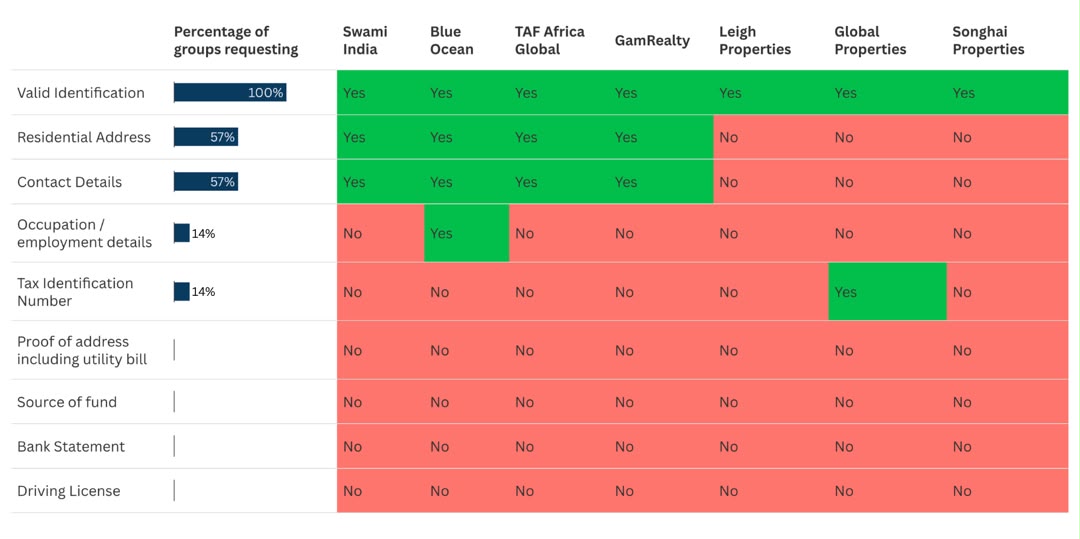
Although the amount of information demanded varied from one company to another, all of them fell remarkably short of applying the level of scrutiny required for due diligence purposes. Notably, none asked for address or evidence of the source of funds. And, almost all of them quoted their prices in foreign currency in what appears to be a violation of Central Bank rules.
When confronted with our findings, most of the companies said their dealings with our undercover reporters had stopped at preliminary stages. They argued that further checks would have been carried out had the transactions progressed.
“Source-of-funds checks are conducted through the due diligence questionnaire before the sale agreement is signed, with supporting documents requested where required by the buyer’s risk profile,” said Abubakar Bensouda, managing director of Blue Ocean Properties.
Ya Bajen Njie, deputy managing director of TAF Africa Global, said the company collects identification documents at the outset and sought additional information about the source of funds or wealth as transactions progressed. Similar procedures exist at Global Properties, according to Nyillan Fye, the company’s general manager.
But at no point did any of the companies indicate that further scrutiny or additional checks would be required at a later stage of the process during our encounters with them. Indeed, court documents show that real estate companies, including some of the ones we approached, had in the recent past sold properties to individuals linked to drug trafficking without due process.
Of 17 properties linked to Paulo Djabi, at least three apartment units were at the Kololi Sands, a luxury beachfront apartment complex built by Omnium Developers. The sale was done through Global Properties.
Some of the companies said it was not their responsibility to investigate how the buyers get their money. “This is the responsibility of the banks processing payments,” said Ebou Jaw, the chief operating officer at Leigh Properties. His position is shared by Sulayman Keita, chief executive officer at Songhai Properties, who confirmed that his company had no internal process to independently verify the source of buyers’ funds beyond the documentation and banking processes involved.
However, officials in banking and real estate said most property purchases are not done through banks. Court records show that the apartment units Mr. Djabi bought from Global Properties at the Kololi Sands were paid in cash.
“Cash transactions remain common in the sector, as many buyers prefer face-to-face payments and physical receipts,” said Mr. Darboe.
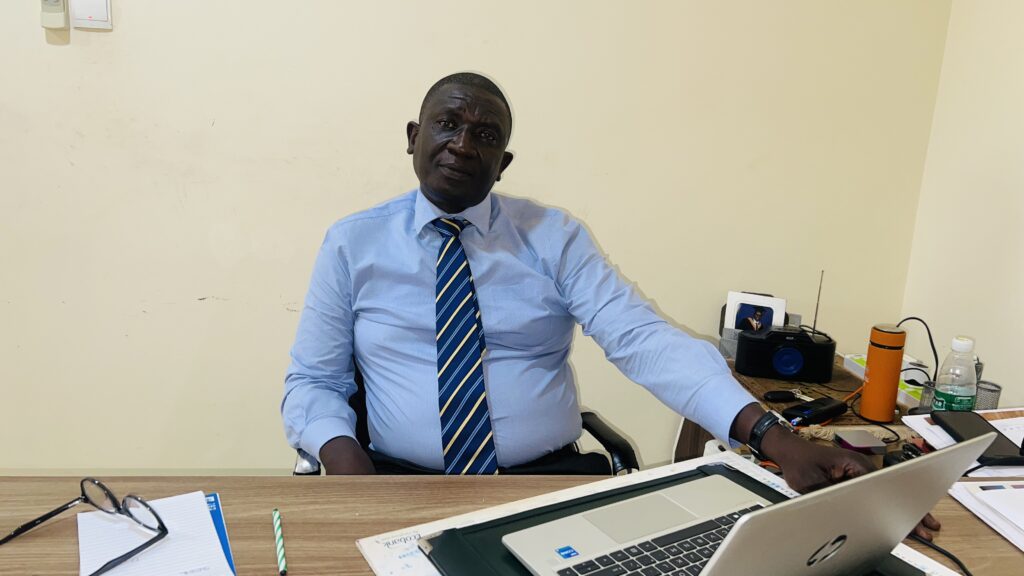
Alieu Ndow, executive secretary of the Gambia Bankers Association, confirmed this, noting that real estate businesses rely heavily on cash transactions, and are therefore “more vulnerable to money laundering.”
Mr. Ndow said in property transactions, banks examine documents such as sale agreements and transfer records to verify the legitimacy of funds. He said suspicious transactions are reported to the Financial Intelligence Unit (F.I.U) for further investigation.
But Mr. Ndow did not elaborate on how compliant banks are in reporting suspicious transactions.
Indeed, banks are involved in some of the property transactions linked to drug dealers.
At least six of Mr. Djabi’s properties were bought from Construct Limited, using Mariam Kaira, a property brokerage as a front, court records show. Some of the payments for these units, including units at Fajara Waterfront involved banks amid deposits of several millions of Dalasis.
When contacted about our findings, the Gambia’s Financial Intelligence Unit, the main agency for gathering and analysing intelligence on suspected money laundering, said that customer due diligence in property transactions goes beyond collecting national identification documents.
“Depending on the nature and risk of a transaction, real estate businesses are expected to obtain sufficient information to understand the customer, the purpose and nature of the transaction, ownership and control, and the circumstances surrounding it,” the F.I.U. said in an email response.
The F.I.U. added: “The absence of a source-of-funds question during an initial interaction does not, by itself, establish a breach of the law. However, Section 25(4) of the Anti-Money Laundering and Combating of Terrorist Financing Act, 2012 requires reporting entities to take reasonable measures to establish the purpose, origin and ultimate destination of cash transactions exceeding US$10,000 or its equivalent in Gambian dalasis.”
