
D7.2 Billion Later, Old Laws, Same Problems for Security Forces

Some said that is so because top gov’t officials who reportedly benefit from contracts they award on behalf of security institutions are blocking draft laws meant to modernise and give these agencies greater autonomy in how they operate.
Sanna Camara
The Gambia government received more than D7.2 billion in international funding between 2017 and 2025 to support reforms in the country’s security institutions.
But eight years into the country’s security reforms programme, which promised to replace oppressive, colonial-era laws that largely govern the security institutions, not a single new law has been passed. More than half a dozen bills – proposed new laws – have been drafted, but only one, the National Security Council Bill, has so far made it to the halls of the National Assembly.
The status of bills for police, immigration, prisons and military remains unclear, with ministries and security institutions trading blame for the delay in getting them passed – in some instances, claiming to have no knowledge of their whereabouts. “I know for certain that quite a number of these bills have not been sent to us,” said Justice Minister Dawda Jallow in February. “People take convenience in saying the bills are at the Justice Ministry. We are used to that.”
The new laws are expected to give more autonomy to security institutions, but also create structures to keep the security forces in check, a measure meant to prevent how they were used to commit human rights abuses and subjected to political interference under the previous regime. While the country’s leadership is wary of the reforms as it can reduce the ability to use them for political purposes, the ministries who currently control their operational and financial decisions are refusing to let loose, according to multiple sources who spoke to Malagen, including security analysts and senior officials within various ministries and security forces.
“For any spending at the Immigration, even power purchase tokens for a station in Basse, it has to go to the ministry of interior for approval,” an official at the Immigration Department who requested anonymity told Malagen, a claim confirmed by a senior official at the Ministry of Interior. And in a recent week, the immigration office that issues ID cards was unable to operate for several days because it ran out of electricity credit and the officials blamed the tight control of departmental budgets by the ministry of interior.
Some sources alleged that certain high-ranking officials at the ministry of interior get kickbacks from contracts they negotiate on behalf of the security institutions that is why they are blocking the bills from progressing. None of our sources could provide concrete proof to support that claim, but several of them pointed to the controversial nature and execution of several contracts, such as those regarding the printing of National Identity cards and passports.
Meanwhile, the use of excessive force and the violation of rights by security forces with impunity is persistment. According to analysts, this is a direct result of the failure to overhaul existing laws governing the security outfits.
Old Laws Still Rule
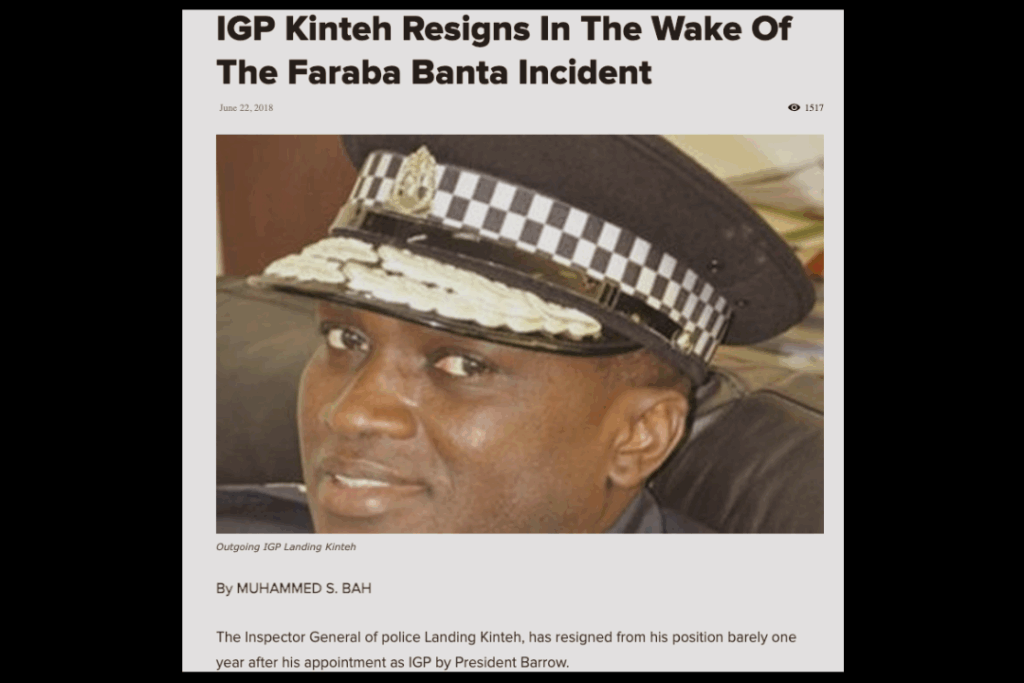
When Police Chief Landing Kinteh resigned under public pressure after the police shot and killed three protesters in Faraba, some reform advocates saw it as more than just an official stepping down – a sign that impunity for security forces was ending. Except that it was not then – and it still doesn’t seem to be.
Just ask Oumou Jallow.
“I saw death,” the 26-year-old business student at the University of The Gambia told Malagen in May, recalling her experience with police brutality. “I still struggle to see clearly when the sun is hot.”
It was a chilly morning, and tensions had been brewing between students and the school authorities over the dismissal of two lecturers who were critical of the university. The anti-riot police had assembled at the university’s Kanifing campus as the students gathered. Ms. Jallow pulled her hoodie tighter as she stepped onto the campus, only to be caught by surprise when an anti-riot police officer fired tear gas at her at close range – without any provocation. Chaos erupted.
“I couldn’t talk or walk,” she said. She collapsed and narrowly survived the stampede, and eventually rushed to the hospital by fellow students. The young woman said that when the tear gas hit her face, she strangely thought of the April 10/11 massacre – when security forces shot and killed over a dozen students in 2000. She was just a year old then, but as she put it, “who in this country doesn’t know about that national tragedy.”
In an unusual move, the police issued a statement acknowledging that a member of the anti-riot unit had “acted outside of command” and promised disciplinary action following an investigation. But as survivors of the April 10/11 massacre continue to seek justice 25 years later, so too is Oumou – six months on, still waiting for answers. We asked the police what action had been taken against the officer responsible, but the public relations officer declined to comment, and didn’t give any reasons.
It wasn’t an isolated case.
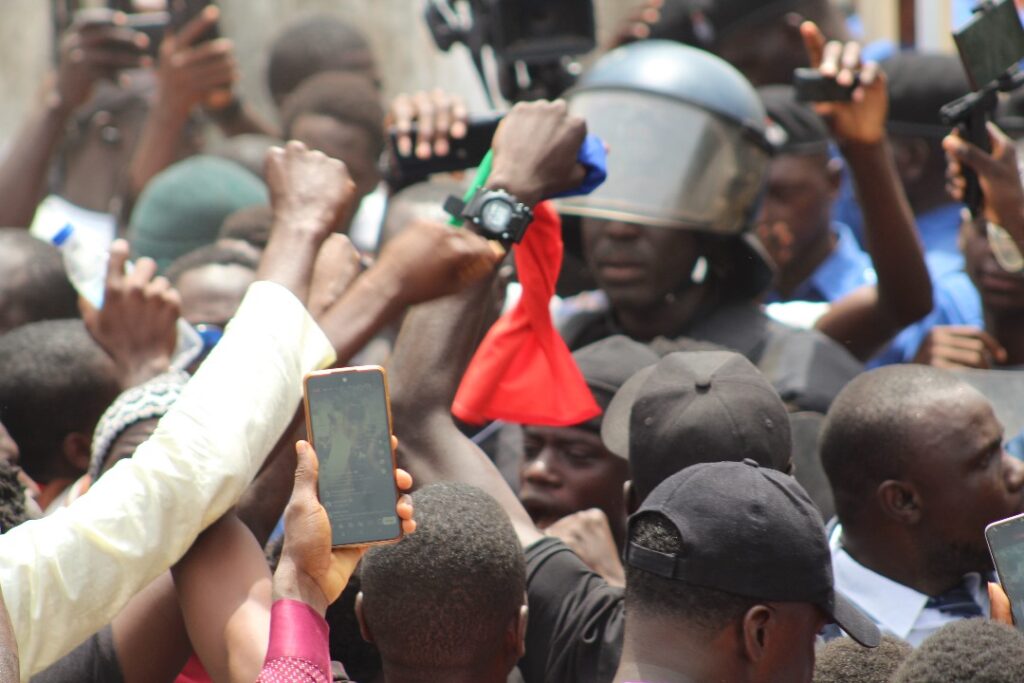
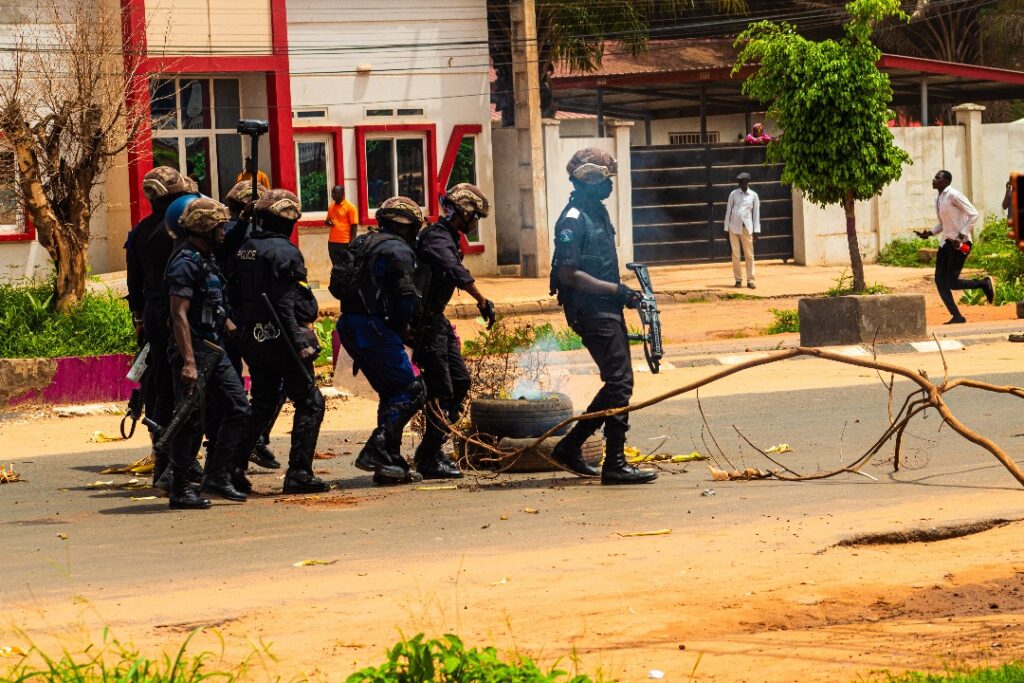

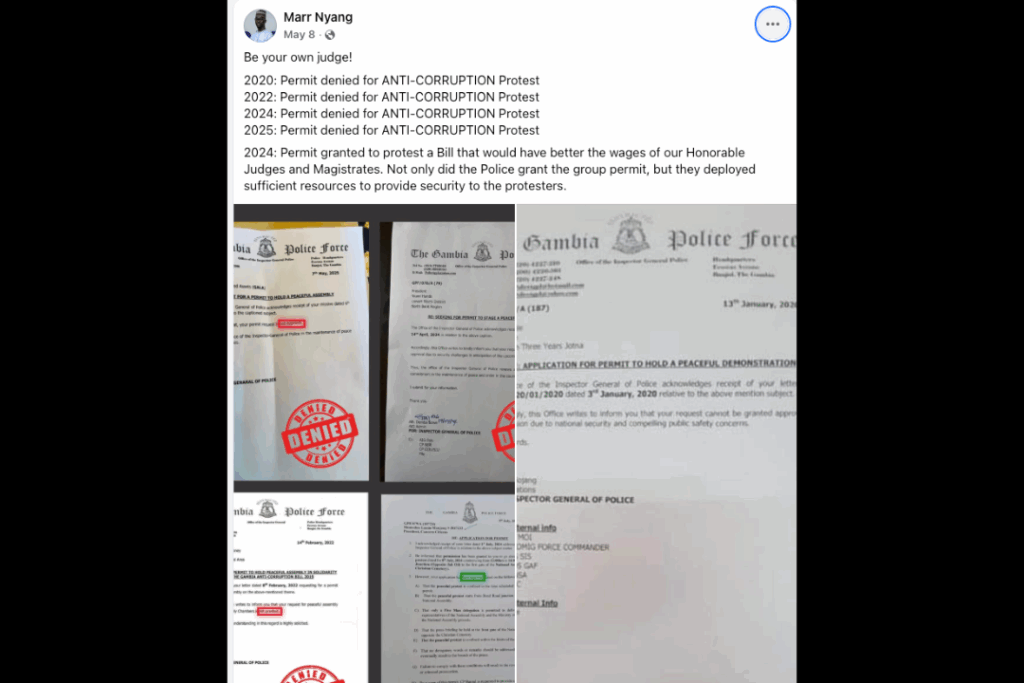
Malagen investigation reveals a pattern of secrecy and impunity around police violence and abuse that persisted eight years since police chief Kinteh stepped down – the first such resignation in The Gambia. Permit for protest is routinely rejected and those who defied it are met with violence and abuse.
While the police never responded to our request for data, our manual analysis of their Facebook Page and other social media posts documenting permit denials suggests that dozens have been rejected over the past few years. At least four of the permits refused are related to protest against corruption, according to anti-corruption advocate, Marr Nyang.
Efforts to scrap the protest laws have been met with resistance from the government, including an attempt last year by an opposition National Assembly Member to pass a bill eliminating the requirement to obtain a police permit to stage peaceful protest. “This law costs lives,” said Sulayman Saho of Baddibu Central. “It caused the death of Solo Sandeng, and continues to deny the people fundamental rights to express their feelings and thoughts towards national issues.”
The government has also rejected reforms of protest laws when revising the draft constitution, changing it back to the text of the 1997 Constitution.
New Laws Gathering Dust
Colonial-era laws still govern four of the six state security agencies – police, immigration, prisons, and fire and rescue services. Security and human rights experts said the laws are unfit for today’s human rights standards and a 2017 government assessment report found them to be “obsolete” and lacking oversight and accountability.
“This law should be changed,” said prisons chief, Ansumana Manneh, referring to the 1954 Prison Act. “It is all about retribution, retribution and retribution.”
The Police Act was enacted in 1949, and according to Yankuba Sonko, a former police chief who spent 39 years in the service, the law contains “funny instructions.”
The intelligence agency, NIA, is governed by a 1994 decree.
But even laws passed more recently, like those for the military in 1985 and the anti-drug agency in 2003, are in need of substantial revision, according to experts and government assessment reports.
National Security Adviser Baboucarr Jeng said “significant work” has been done on the bills related to reform of the security institutions. “Following cabinet approval, they have been sent to the National Assembly,” Mr. Jeng added, blaming the busy schedules of the National Assembly for the delay in getting them enacted.
However, Alhajie Kanteh, an opposition National Assembly Member who sits in the committee on defense and security matters, said none of the security related bills, except one, were submitted to the National Assembly. That is the National Security Council Bill, which only seeks to enhance coordination between the various security institutions.
Interior Minister Abdoulie Sanyang said he had recently issued an instruction to all the security agencies under his watch to ready the bills before the end of June, but multiple sources the delay is instead from his ministry. No bill has been submitted to the National Assembly as of the June deadline Mr. Sanyang said he’s declared.
The Gambia Armed Forces Bill will be presented to cabinet in June, according to deputy national security adviser, Col. Omar Bojang. That too hasn’t been done, according to National Assembly sources.
The government and development organisations supporting them said improvements have been made especially in the areas of capacity building of security personnel and establishment of internal policies. But human rights and security experts believe that real reform of the security forces depends on having the right laws in place to guide them on what to do and how to do it.
“Without suitably modernised laws governing the security sector institutions, the country risks falling back into authoritarianism,” said David Kujabi of Geneva Centre for Security Sector Governance (DCAF), an organisation that has been supporting the security sector reforms.
Contracts Over Reforms
Plans to modernise and professionalise the security institutions attracted a lot of international support – more than $100,000, 000 – approx. D7.2 billion – came in as contributions from development partners, Malagen investigations revealed, a figure confirmed by Mr. Jeng was fairly accurate.
The Geneva-based international think tank specialised in security sector governance, DCAF, a major player in the security reforms in the country has overseen projects totaling more than D5 billion from a range of sources.
The United Nations Development Programme is currently implementing a $3 million project while Germany’s GIZ office in the country has spent more than $8 million on security sector reforms.
The D7.2 billion total excludes several UN projects that phased out over the years, and support from other critical donors, such as the United States, United Kingdom and some European Union funding.
The figures were obtained from publicly available data, including media reports and senior officials whose identity we have not disclosed because they are not authorised to speak.
Most funding organisations or those that received funds, such as DCAF, refused to disclose details such as disbursed amounts and expenditure breakdown.
National Security Adviser Mr. Jeng however pointed out that the contributions were largely managed directly by the donor countries or implementing partners. But security experts involved in the sector sector reforms said that the government cannot still be excused. An analysis of security sector reforms funding shows that a big part of the money is meant for policy reforms, including replacing old and outdated laws.
Most bills have gone through a review and validation process, but have been left to gather dust mainly at the Ministry of Interior, which oversees all the security institutions, except the army, customs and intelligence agencies. In recent years, the Minister of Interior has negotiated three multi-million dalasi contracts. The production of vehicle license plates are implemented by the police while travel passports and various national and alien identity documents are handled by the Immigration Department.
The Immigration Department had repeatedly expressed frustrations over how the Ministry of Interior sidelines them when negotiating important contracts regarding their functions, according to sources at the ministry interior and the immigration department.
“These contracts are national contracts,” Interior Minister Abdoulie Sanyang told Malagen at his office in June. “They are not contracts of the security agencies implementing them.”
Mr. Sanyang then turned to the immigration chief, Ebrima Mboob, who was curiously present in his office during the interview to support his point. “To be honest,” Mr. Mboob said, visibly cornered and uncomfortable as he shifted in his seat, “we would prefer to have at least an advisory role in the contract negotiations, to provide technical expertise and ensure the Ministry is properly guided.”
Contracts signed with Semlex for national ID card production and Africad for passport issuance contain provisions that not only create operational challenges for the GID but also include terms that are not enforced. Official documents seen by Malagen show that the government was supposed to retain full control over all revenue generated from the issuance of official documents such as driver’s license and ID cards. But Semlex had instead been collecting the revenue, according to senior officials familiar with the matter.
When the Immigration Department raised concerns, the Ministry of Interior reportedly responded that the Accountant General’s Department would be consulted — but no clear action followed. The contract also provides that the government should assume full control of the project. Yet, immigration officials have been denied access to critical Information Technology systems — including the Orbis administrative database and firewall security — both of which remain under Semlex’s control.
“They thought they could take over the system easily,” a source familiar with Semlex said. “But they were wrong – the government never had access to the original system, which was built and operated entirely by Semlex.”
“Yes, the Semlex contract was a disaster,” the source added. “But $800,000 worth of equipment and trained staff are available to the government currently. These ID printers are no longer used by the GID.”
