
Probe Finds Record Gaps in Jammeh Asset Sales Despite D1.7B Recovery

The 324-page report revealed significant gaps in the management of Jammeh-linked assets, highlighting discrepancies in financial accounting, missing livestock from seized farms, disregard of due process, and systemic governance weaknesses that undermined oversight and transparency throughout the asset sales and disposal process.
A parliamentary inquiry into the sale and disposal of assets linked to former president Yahya Jammeh has uncovered financial discrepancies, missing livestock and major governance weaknesses that complicated efforts to fully account for proceeds generated from the sales.
The findings are detailed in a 324-page report by a Special Select Committee of the National Assembly established in 2025 to investigate how assets identified by the Janneh Commission were sold, managed and accounted for after being forfeited to the state.
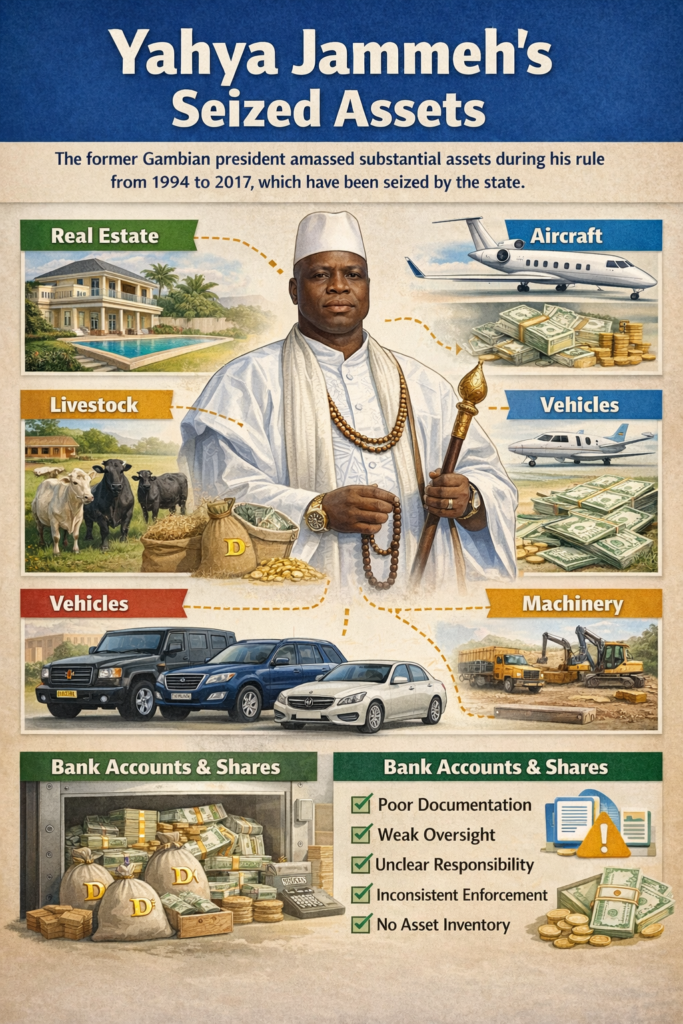
Lawmakers examined records covering the sale and disposal of a wide range of assets connected to Jammeh and his associates. These included livestock from farms, vehicles, aircraft, heavy machinery, landed properties, bank accounts and shares in companies that were either seized or placed under receivership following the commission’s findings.
Total money generated from asset sales
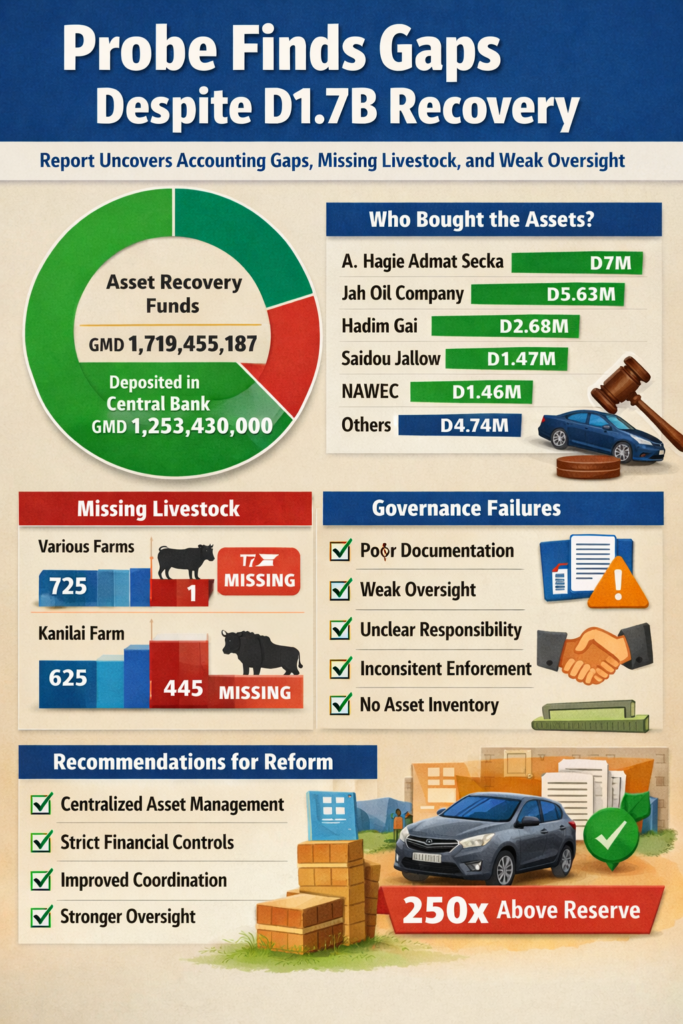
According to the committee’s report, a total of GMD 1,719,455,187.21 (about D1.72 billion) was generated between June 2019 and December 2025 from the sale and management of Jammeh-linked assets.
The funds came from several streams tied to the asset recovery process, including:
- proceeds from the sale of seized assets
- income generated by companies placed under receivership
- dividends and other business revenues
- proceeds from shares and financial holdings
While the overall recovery figure is substantial, the committee found inconsistencies in how the funds were ultimately tracked and deposited.
Only GMD 1,253,430,000 was confirmed to have been transferred into the Central Bank’s Asset Recovery Account, the official account designated to hold proceeds from forfeited assets.
This means roughly GMD 466 million flowed through receivership accounts but was not directly reconciled with deposits into the Central Bank account, raising concerns about gaps in financial tracking and reconciliation.
Where the money went
The inquiry found that revenues generated from asset sales and business operations linked to Jammeh were first deposited into accounts managed by a court-appointed receiver responsible for overseeing the liquidation process.
These accounts received money from a variety of transactions, including:
- sales of vehicles and heavy machinery
- disposal of livestock and farm equipment
- dividends from companies linked to Jammeh
- proceeds from other seized properties and assets
From there, funds were expected to be transferred into the Central Bank’s Asset Recovery Account.
However, lawmakers said inconsistent financial documentation and incomplete transaction records made it difficult to fully reconcile all funds generated through the sales.
In some cases, the committee said, the absence of a clear audit trail complicated efforts to determine whether all proceeds had been properly transferred into the official recovery account.
Who bought Jammeh’s assets
Auction records reviewed by the committee show that a relatively small group of buyers accounted for a large portion of purchases during the asset sales.
The largest single buyer was businessman A. Hagie Admat Secka, who spent D7 million on a lot of Toyota scrap vehicles, making it the highest-value single transaction recorded during the auctions.
Energy company Jah Oil Company emerged as the second-largest buyer, spending D5.63 million across 23 lots that included vehicles, generators, containers and buses.
Other major buyers included:
- Hadim Gai, who purchased assets worth D2.68 million
- Saidou Jallow, who spent D1.47 million across 33 lots, the highest number of individual items purchased by a single bidder
- state-owned utility National Water and Electricity Company (NAWEC), which spent D1.46 million on equipment such as pumps, pipes and compressors
Additional buyers included Edrissa Cham (D1 million), Omar Jallow (D946,000), Ebrima Krubally (D720,000), Ebrima Jallow (D541,000) and Yaya Jallow (D530,000).
The committee noted that while several participants took part in the auctions, a relatively small number of buyers accounted for a significant share of the total value sold.
In some cases, assets sold far above their reserve prices. One example highlighted in the report involved a Hyundai Santa Fe vehicle with a reserve price of D4,000 that eventually sold for D1 million, illustrating how competitive bidding sometimes drove prices sharply upward.
Missing livestock and asset losses
Beyond financial discrepancies, the inquiry uncovered inconsistencies in records relating to livestock seized from farms associated with Jammeh.
According to the report, 725 cattle were reportedly sold, but when records from individual farms were compiled the total came to 724, leaving one animal unaccounted for.
More significant discrepancies were discovered in records relating to livestock from Jammeh’s farms in Kanilai.
The committee found that 625 cattle were reportedly disposed of from the farm, yet records from a court-supervised auction showed only 445 cattle were sold, leaving 180 cattle unaccounted for.
Investigators also received reports suggesting that some animals may have been moved or slaughtered during disputes surrounding the farms. Estimates presented to the committee indicated that hundreds of animals may have been lost or slaughtered during that period.
The committee concluded that the absence of reliable inventory records made it difficult to determine the exact fate of many of the animals seized.
Institutional failures uncovered by Parliament
The report attributes many of the discrepancies uncovered during the inquiry to broader institutional weaknesses in the management of seized assets.
Among the problems identified were:
- poor documentation and record-keeping
- weak coordination between government institutions
- unclear administrative responsibility for seized assets
- inconsistent enforcement of court orders
- lack of proper asset inventory systems
These weaknesses, lawmakers said, undermined the ability of authorities to fully track assets and verify whether all proceeds were properly accounted for.
In several instances, institutions responsible for safeguarding seized assets failed to maintain adequate records, forcing investigators to reconstruct transactions and asset movements after the fact.
According to the committee, these shortcomings exposed significant governance gaps in the management of one of the country’s largest asset recovery efforts.
Committee recommendations
To address the issues identified during the inquiry, the committee proposed a series of reforms aimed at strengthening transparency and accountability in future asset recovery processes.
Key recommendations include:
- establishing a centralised asset management framework for forfeited properties
- introducing strict documentation and inventory systems for seized assets
- strengthening financial reconciliation procedures to ensure all proceeds are tracked and deposited into official accounts
- improving coordination between government institutions responsible for asset management
- creating stronger oversight mechanisms to monitor asset disposal processes
The committee also called for clearer legal and administrative procedures governing the disposal of seized assets to prevent similar discrepancies in future recovery efforts.
The sale of Jammeh-linked assets represents one of the most significant asset recovery programmes undertaken by the Gambian state since the end of his 22-year rule.
But the parliamentary inquiry suggests that while the process generated substantial revenue for the state, weaknesses in oversight and record-keeping may have limited authorities’ ability to fully account for every asset and every dalasi generated from their sale.
