
Fact-Check: Is the Gambia’s Maternal Mortality Rate at 38%?

Dr Ceesay’s claim that The Gambia’s maternal mortality rate is 38% is incorrect. Official data from the World Bank and Macrotrends show the maternal mortality ratio at 354 deaths per 100,000 live births.
Claim: The Gambia’s maternal mortality rate is at 38%
Source: Dr Ismaila Ceesay, Minister of Information, The Gambia
Verdict: False
On 4 November 2025, during the program QTV State of Affairs (mark at 30:24), Dr. Ismaila Ceesay claimed that maternal mortality in The Gambia has “gone down drastically” and is now at 38 per cent
Fact- Check:
Maternal mortality is not measured as a percentage of total births. Instead, it is expressed as the number of maternal deaths per 100,000 live births, a standard international metric used to allow comparison across countries and regions.
According to World Bank data (2023), The Gambia’s maternal mortality ratio is 354 deaths per 100,000 live births, highlighting that maternal deaths remain a significant public health concern. Similarly, Macrotrends, an online research and data platform, reports the same figure, confirming the consistency of these estimates.
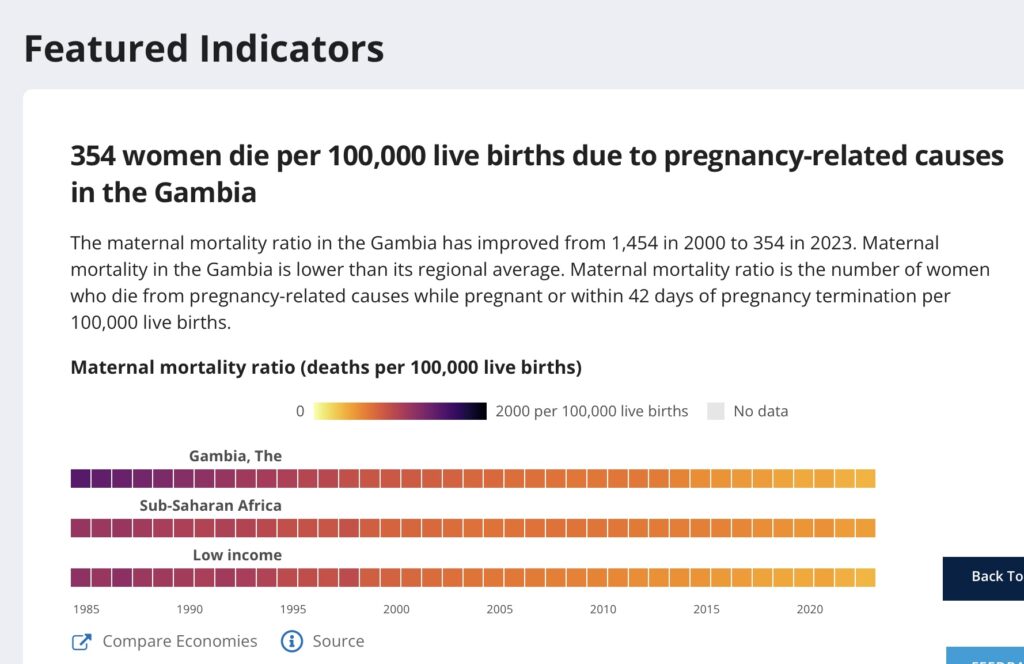
The Gambia Demographic and Health Survey (2019–2020) also notes that, despite some gradual improvements in recent years, maternal mortality continues to be high, particularly in rural areas where access to quality healthcare and emergency obstetric services is limited.
These figures underscore the ongoing challenges the country faces in ensuring safe pregnancies and deliveries for all women.
What Does This Mean?
A maternal mortality ratio of 354 per 100,000 live births means that for every 100,000 babies born, about 354 mothers die due to pregnancy-related complications.
In simpler terms, the maternal mortality ratio of 354 deaths per 100,000 live births means that out of every 1,000 babies born, roughly 3 mothers die due to pregnancy or childbirth complications.
It is important to note that expressing maternal mortality as a percentage, such as the 38% figure cited by Dr, is incorrect. A percentage in this context would imply that 38 mothers die out of every 100 births, which is vastly higher than the reality and would dramatically overstate the risk.
Using the standard metric of deaths per 100,000 live births allows for consistency and comparability, making it possible to evaluate maternal health trends across different countries and regions, regardless of population size. This approach ensures policymakers, health organizations, and researchers can accurately track progress, identify high-risk areas, and target interventions where they are most needed.
Ranking:
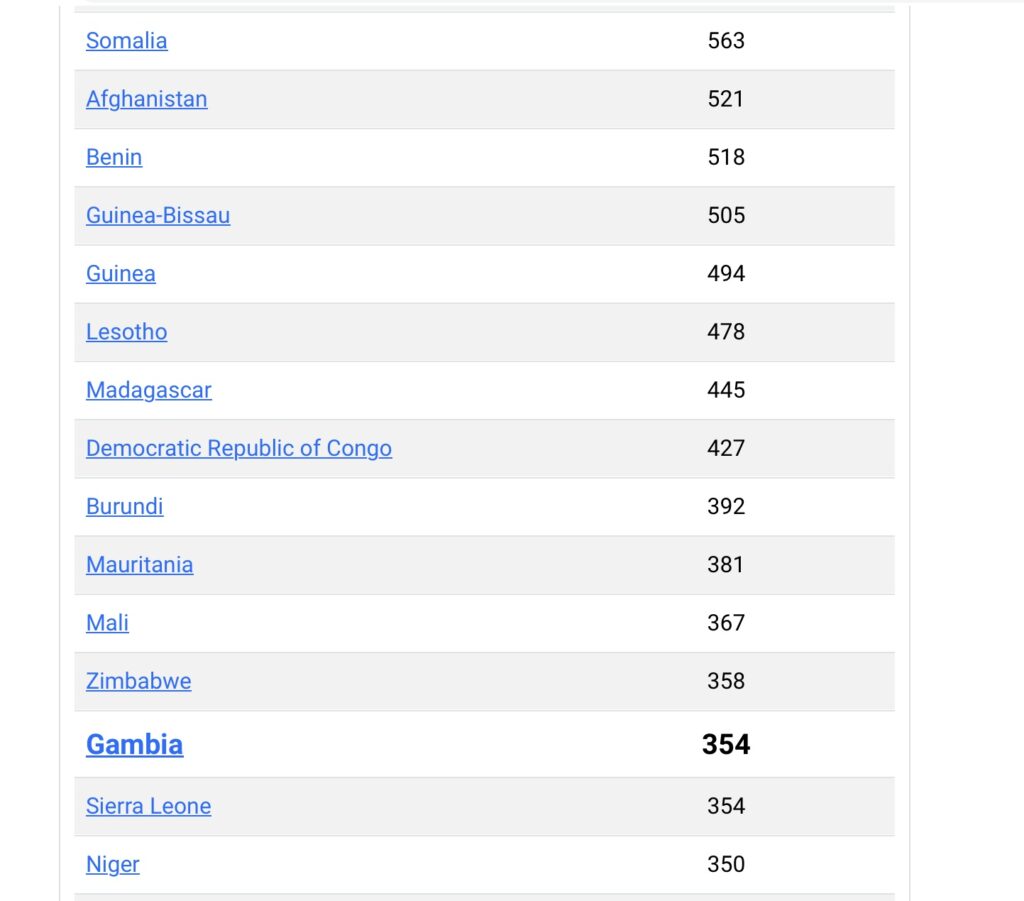
Sub-Saharan Africa has the highest maternal mortality in the world, with 448 deaths per 100,000 live births, highlighting the persistent challenges the region faces in maternal health. Within the continent, The Gambia ranks 18th worst, with 354 deaths per 100,000 live births, underscoring the ongoing risks that Gambian mothers encounter during pregnancy and childbirth despite recent improvements.
Conclusion
There is no official data supporting Dr. Ceesay’s claim of 38%. Maternal mortality is not measured in percentages, and using the correct metric shows that The Gambia’s maternal mortality, while declining, remains high and a significant public health concern.
Verdict: Inaccurate
