Claim 1: Executive order (directives) is law
Source: Deputy Inspector General of Police Momodou Sowe
Verdict: The claim is false
On November 2, a local newspaper in the country published an article quoting the deputy inspector general of police Momodou Sowe saying executive orders are law.
Some observers expressed disappointment at such statement coming from a police chief. Gambia has just emerged from 22 years of dictatorship during which executive directives were frequently used by ex-president Yahya Jammeh to arrest, detained or make declarations such as turning the country into an Islamic State in 2015.
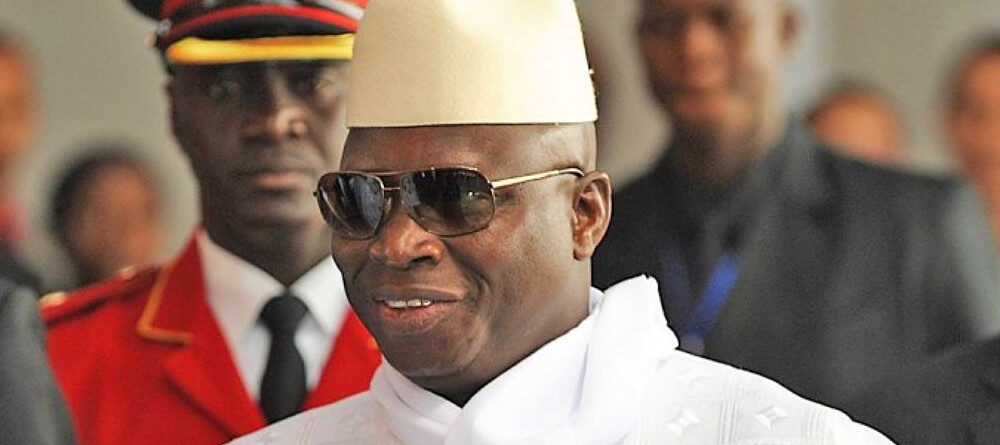
In the last few days, Gambian social media sites were saturated with a video recording of a phone call the ex-Gambian leader Yahya Jammeh made to his supporters during a rally in Gunjur on October 23.
In his address, Jammeh made several claims about developments he did in the country, that he said were destroyed by President Adama Barrow in 4 years. In this article, we look into the accuracy of those claims.
Claim 1: The 2016 election was rigged
Source: Ex-president Yahya Jammeh
Verdict: Inaccurate
Claim
President Barrow took over or assumed power after defeating Jammeh at the polls in 2016. The former President rejected the election results, few days after accepting defeat, describing the process as the “most transparent”, “rig-proof” elections in the world.
His rejection of the results prompted a military intervention by regional leaders dubbed “operation restore democracy”. Jammeh eventually left the country for Equatorial Guinea where he currently lives in exile.
In his widely circulated address to his supporters at the said rally in Gunjur, Jammeh claimed the election was rigged by Barrow with the help of unnamed powers.
“In fact, 2016 they didn’t win… They rigged the elections with support of some powers…,” he said.
Fact-check
In 2016, an amendment to the electoral laws introduced what is called an on-the-spot counting system. The results are counted where votes are cast and results displayed on the wall, after each party agent records in their votes.
According to the Independent Electoral Commission, the difference of votes between Jammeh and Barrow is 19, 221. With a simple majority voting system, just a vote ahead qualifies one to be president.
Jammeh relied on the IEC tabulation error to annul the results. He claimed there was error in the results from the Basse region. However, the Electoral Commission declared the elections as credible, free and fair.
Verdict:
The claim is inaccurate.
Claim 2
Claim 2: 99% chance of maternal death
Source: Ex-president Yahya Jammeh
Verdict: Inaccurate
In the same address to his supporters, the ex-Gambian leader, touting his achievements as a president, claimed maternal mortality rate is at a scale never seen in the country.
Jammeh puts chances of death while giving birth at 99%.
“Even pregnant women are afraid to go to the hospital because there is a 99% likelihood that they will not come back alive,” he said.
Fact-check
There have been frequent protests by activists and women groups about ‘rising’ maternal death in the Gambia. The available data shows the country is far behind in meeting the Sustainable Development Goal target of reducing maternal mortality ratio (MMR) to less than 70 per 100,000 live births by 2030.
However, all available data have shown a decline in maternal death. Not an increase. A recent performance audit published by the National Audit Office (NAO) in September 2020 shows a 36.8% reduction in maternal mortality rate between the year 2000 and 2017.
Meanwhile, the results from the Demographic and Health Survey 2019/2020 estimated that the MMR, in the 7 years preceding the survey, was at 289 maternal deaths in every 100,000 live births. And pregnancy related death within the same period was 320 for every 100,000 live births.
A more recent data on MMR has been published by the Ministry of Health in the first week of October for years 2019 and 2020. The data gathered from public health facilities across the country showed that MMR has declined from 221 deaths per 100, 000 live births in 2019 to 169 deaths per 100,000 live births in 2020.
This shows a significant improvement in MMR from 2007. According to the 2007 Situational Analysis of Obstetric Fistula In The Gambia Report, the maternal mortality ratio was 556 per 100,000 live births. By all indications then, MMR has significantly reduced in The Gambia, between 2007 and 2020.
Deliveries at health facilities
The recent media reports on increased maternal deaths have caused apprehension among women, according to Dr Musa Marena, a gynecologist and head of the Health Ministry’s unit responsible for maternal health.
“We are receiving reports that some people are avoiding the [public] health centers and hospitals because of fear that it is not safe to deliver in these places,” said Dr Marena.
“And when complications arise because of the time they take hesitating to visit the health facilities, it is often late to [save] some of them.”
Despite this though, the Demographic and Health Survey has shown that successful deliveries have actually increased at heath facilities.
“Health facility deliveries increased from 63% in 2013 to 84% in 2019-20, while home deliveries fell from 37% to 15%,” stated the DHS.
Therefore, available data by government agencies and from studies have shown that maternal death has declined under Barrow administration, not increased as claimed by Jammeh.
Verdict:
The claim is inaccurate.
Claim 3
Claim 2: Decline in NAWEC’s capacity
Source: Ex-president Yahya Jammeh
Verdict: Inaccurate
The claim
In the same address to his supporters in Gunjur, the ex-Gambian leader, touting his achievements as a president, said the country is witnessing a declining energy supply.
Jammeh said Gambia’s electricity supply was one of the best on the continent during his time, before he took time to lambast Barrow for destroying it.
“One week after I left the Gambia, the electricity and water goes down… When it comes to electricity, we were one of the best in Africa,” he said.
Fact-check
We looked at these claims from two angles. The first part was answering the question relating to the financial status of NAWEC as at the time President Barrow took over. According to a forensic audit by a UK audit firm Ernst and Young, the national energy company was indebted or owing over D9 billion, with a total liability that exceeded its total assets.
And NAWEC has been increasingly reliant on externally obtained debt to finance not just its capital expenditure, but also its day-to-day operations to service its current debt.
According to a World Bank assessment, NAWEC was essentially bankrupt with a negative net worth of about 6 percent of GDP. The British audit firm also said the energy company has been insolvent for seven years preceding 2018. Therefore, from a financial point of view, the Barrow administration inherited a NAWEC which was on its knees, if not ‘bankrupt’.
Power generation
At the beginning of 2017 towards 2018, NAWEC’s power supply was at its lowest ebb, prompting a protest called #OccupyWestfield. The national energy company reacted to the poor power supply with two short-term measures.
They signed a power purchase agreement with SENELEC—a Senegalese energy company—to give electricity supply to the North Bank and Lower River Regions. The energy company also entered into another power purchase agreement with Karpowership, a Turkey-based company, for supply of 30 MW of energy.
According to the World Bank— sponsored Gambia Electricity Restoration and Modernization Project, Gambia’s installed capacity of the grid was 99 MW (of which 88 MW was in Greater Banjul Area [GBA]) as of 2018. This was an improvement from 2017 when the available capacity in the GBA deteriorated to 44 MW.
Now, despite the continuous poor energy situation, according to the national energy strategic roadmap developed by the energy ministry, as of mid-2021, the total net installed capacity of NAWEC is 154.5 MW of reciprocating engines, but only 97.0 MW are currently available for power generation.
The data quoted in the national energy strategic roadmap developed by the energy Ministry shows blackouts in the country have also reduced. In 2017 the country witnessed 36 blackouts, 45 blackouts in 2018, 25 blackouts in 2019, 12 blackouts in 2020 and 11 blackouts in 2021.
Conclusion: The established facts have shown that the Barrow administration inherited an insolvent NAWEC, with huge debt. Not a buoyant energy company as suggested by Jammeh. In addition, the power generation capacity of the national energy company did not decline under Barrow. It improved.
Verdict: the claim is inaccurate
Researched by Mustapha K Darboe
In recent weeks, the mainstream and social media have been saturated with news on maternal death at the various health facilities in The Gambia.
The news generated fear, apprehension and concern from the public, leading to a number of protests, both online and on the streets. It also triggered debates about the risk associated with childbirth at public health facilities.
Dr Musa Marena, a gynecologist, is the head of the health ministry’s unit responsible for maternal health.
“We are receiving reports that some people are avoiding the [public] health centers and hospitals because of fear that it is not safe to deliver in these places,” said Dr Marena.
“And when complications arise because of the time they take hesitating to visit the health facilities, it is often late to [save] some of them.”
This factsheet contains the trend of maternal death in the country as well as the major causes, and what is being done about it.
The stats show decline in maternal death
There is very little availability of adequate and reliable data that deals with emergency obstetric care in The Gambia from open sources. But, there are some studies on the issue, including performance audit published by the National Audit Office (NAO) in September 2020.
According to the NAO study, over the years, The Gambia has made significant progress in reducing maternal mortality rate. However, the country is far behind in meeting the Sustainable Development Goal target of reducing maternal mortality ratio (MMR) to less than 70 per 100,000 live births by 2030.
The Gambia’s overall reduction rate in MMR between the year 2000 and 2017 is 36.8%.

All the data collected from various sources shows a decline in maternal death. But there are variances. For example, the results from the Demographic Health Survey 2019/2020 estimated that the MMR, in the 7 years preceding the survey, was at 289 maternal deaths in every 100,000 live births. And pregnancy related death within the same period was 320 for every 100,000 live birth.
“… for every 1,000 births in The Gambia, about 3 women die during pregnancy or within 2 months of the end of a pregnancy from any cause including accidents or violence,” states the demographic health survey.
A more recent data on MMR has been published by the Ministry of Health in the first week of October for years 2019 and 2020. The data gathered from public health facilities across the country showed that MMR has declined from 221 deaths per 100, 000 live births in 2019 to 169 deaths per 100,000 live births.
There is a significant regional variance in the MMR. While Central River Region witnessed a decline from 2019 to 2020, the North Bank Region witnessed an increase. For example, North Bank recorded 388 MMR per 100, 000 live births in 2020 compared to 82 per 100, 000 in 2019. Whereas the Central River Region witnessed a decline from 349 per 100, 000 live births in 2019 to 152 per 100, 000 in 2020.
Causes of maternal death
Though the data shows a decline in maternal deaths, the figures are still unacceptably high, said the NAO in their performance audit.
“For The Gambia to achieve the target of having less than 140 deaths per 100,000 live births in MMR by 2030 (SDG 3), it needs to achieve an overall reduction rate of 77% from the 2017 figure, more than twice the current reduction rate,” said the NAO.
According to data recorded by the Reproductive, Maternal, Neonatal, Child and Adolescent Health Department of the health ministry, maternal deaths are largely due to “avoidable” complications such as hemorrhage (37%), hypertensive disorders of pregnancy (11%) and sepsis (11%).
Causes of complications
The data from the Health Ministry shows at least 15% of all pregnant women will develop complications during pregnancy, labour or postpartum.
Dr Marena said some of the complications cannot be prevented or even predicted. Education, nutrition and childhood immunization, male involvement, financial and social empowerment of women, family planning will help prevent some of these complications, he said.
Other issues responsible for complications during childbirth include teenage pregnancy, anaemia, short interpregnancy intervals, poor nutrition, pregnancy whilst being sick and pregnancy at old age.
“Prenatal and antenatal care as well as birth preparedness will help with early detection and management of some of these complications,” said Dr Marena.
“Birth preparedness and complication readiness will prevent the delay in recognizing danger signs, in decision making or delay in reaching the health facility.”
Limited, ill-equipped EmOC
As part of their performance audit of emergency obstetric care across the country, the NAO observed the following weaknesses in the health care delivery.
n Most of the facilities have the capacity to provide basic emergency obstetric care (EmOC) functions. However, there are equipment and human capacity gaps in the provision of assisted vaginal delivery to complete the set of basic EmOC functions.
n There are gaps in the provision of comprehensive EmOC services as more than half of the mandated CEmOC centres are not providing either blood transfusion or both blood transfusion and caesarean section, also known as C-section.
The Lower River Region has no CEmOC centre, delaying access to comprehensive EmOC for women in that region.

Claim 1: The contractor of the Banjul Rehabilitation Project requested to be paid in Dalasi
Source: President Adama Barrow
Verdict: The claim is false

One of the flagship infrastructure projects undertaken by the administration of President Adama Barrow is the US$36 million Banjul Rehabilitation Project. The single-sourced project was criticized for flouting basic procurement regulations.
Claim
In his recent interview on QTV’s State of Affairs programme, the Gambian leader claimed the contractor of the project, Haddim Gai, requested to be paid in dalasi while submitting his proposals to him at State House.
“When he came to my office, what he told me, it was too good to believe. “I will pre-finance and I will accept you to pay me in dalasi”,” said Barrow.

Fact-check
The Banjul Rehabilitation Project and the loan agreement between Haddim Gai and Gambia government was signed in May 2019.
This was after Gai’s initial meetings with President Barrow at the State House.
Clause 12.4 of the credit facility of the Banjul Project states: “Any payment which is due to be made by the Borrower (Government) under this agreement shall be made in United States Dollar.”
It was much later after the contract was signed— on the advice of the International Monetary Fund (page 59)— that an addendum was done in October, 2019, to fix this issue. The finance minister Mambureh Njie confirmed this.
“Initially, it was in dollar terms. We knew after that that it was going to add up to their (sic) debt. Then through the negotiation, we made into dalasi denominated,” said Njie in February, 2020.
In the same interview, the President told the reporter that the Gambia’s partners were initially against the Banjul Project.
“Today, now our partners are working with us on the Banjul Project. First time they said no but later they accepted,” said the President.
However, the President fell short of explaining what the partners were against. Both IMF and the World Bank’s advices were on three major things: the initial dollar denominated nature of the project, the 6-year payment plan and the waiver of procurement regulations by the Executive to sole-source such a large contract to Gai Construction.
The advice from the World Bank would in fact lead to steps by authorities to amend the Gambia Public Procurement Authority Act, a process currently stuck at the parliament. In their Systematic Country Diagnostic report released in May, 2020, the World Bank states on page 42:
“The authorities have committed to a number of measures to avoid such episodes (sole-sourcing large projects like Banjul Project) from reoccurring: (i) tightening the legal framework for public procurement, which currently makes it legal for the executive to overrule standard procurement requirements; (ii) strengthening the capacity of The Gambia Public Procurement Authority (GPPA); and (iii) improving the project selection process by empowering the recently created Gambia Strategic Review Board (GSRB) and providing it with proper project selection criteria.”

The World Bank added:
“… In May 2019, the government signed a U.S. dollar–denominated local credit facility for the Banjul Rehabilitation Project worth US$36 million (2 percent of GDP). The dollar-denominated nature of the facility was nullified and an addendum to the contract was signed in October 2019 to stipulate that government obligations would be settled in dalasi in full through the annual budgets, in step with the phased implementation of the project.”
In their April, 2020, staff monitoring programme report, IMF noted the following on page 59:
“The implementation of the SMP (Staff Monitoring Programme) encountered several challenges. In our efforts to improve the sanitation and traffic congestion in Banjul, we signed a dollar-denominated financing arrangement for the Banjul Rehabilitation Project (BRP). Also, given the emergency character of the work that needed to be initiated ahead of the rainy season, the procurement of the project did not follow the standard process. Subsequently, upon consultation with the IMF staff, we recognized that this arrangement, if implemented, would have been inconsistent with the zero ceiling on new non-concessional external debt contracted and that the single-sourcing of the contract put in question the governance aspects of the project and potentially compromised its value for money. To redress these problems, the financing arrangement was revisited to eliminate debt creation, with payments to be made in dalasi in step with project implementation.”

Conclusion
The Gai Construction was to be paid in dollars, according to the initial agreement government had with the company. It was the insistence of the World Bank and IMF that changed that.
Verdict: The claim is false
Claim 2: The contractor requested to be paid in 10 years
Source: President Adama Barrow
Verdict: The claim is false

According to the President in the same interview, Haddim told him he would do the contract in 5 years and be paid in 10 years.
“I do it in 5 years and you pay me in 10 years,” he quoted Haddim to have said.
It should be clear that President Barrow’s meeting with Haddim was when the contract was being proposed. The project document would be signed later in May 2019 and amended in October the same year.
The initial contract agreed to by the Gambia government with the contractor was a 5-year payment plan. Not 10 years.
Clause 6.1 of the credit facility that would later be amended stated that the loan is to be paid through a five-year installment plan.
There was an anomaly in the contract though. Schedule 6 contradicted Clause 6.1, stating that the payment will be over a period of six years starting February 2020 to 1st February 2025.
This payment plan will also be spread to 10 years on the advice of the IMF and the World Bank.
Verdict: The claim is false
Researched by Mustapha K Darboe
Note: We have reached out to State House media team for a comment on our findings but we have not received any response as at the time of this publication. We will update the story as soon as we have a response.
Claim: Gambia’s GDP currently growing at 6% +
Source: President Adama Barrow
Verdict: Inaccurate
President Adama Barrow in a recent interview on the State of Affairs television programme on the QTV, said the Gambian economy is growing at “6% plus”.
The current government took over the reins of government under very difficult circumstances after the outgoing Yahya Jammeh administration refused to willingly relinquish power. This prompted a regional military intervention in The Gambia which subsequently affected tourism- a major income earner for the country.
Business activities were also temporarily halted, which in turn negatively affected the economy. The country was also struggling with a very high, unsustainable public debt situation which was at 120%, debt to GDP ratio.
The claim
President Barrow when touting the achievements of his administration in turning around the fortunes of the country in the recent interview said:
“The economy was growing at between 1.5 to 2% at most. So, this was the situation…”.
However, “our economic growth: we are growing at 6% plus,” he boasted.
Fact-check
If President Barrow was referring to the average performance of the economy during the four years prior to becoming president, then average growth between 2013 and 2016 was 1.875%, according to data from the World Bank and the IMF.
It is accurate that the GDP growth rate recorded in 2019 was at 6.1%, according to International Monetary Fund.
However, this declined to zero percent growth in 2020, due primarily to a sharp contraction in revenue from the tourism sector caused by Covid-19.
A press release from the Finance Ministry sometime ago said: “The economy is expected to grow by 4.9% in 2021 with some recovery in the tourism sector anticipated in the fourth quarter of this year.”
The IMF made a similar forecast in their June 2021 report:
IMF: “The second wave of the COVID-19 pandemic has dampened economic activity, with attendant socio-economic costs. However, with the global vaccine rollout, development partners’ support of The Gambia’s vaccination campaign, and the resilience of some economic sectors, growth is expected to rebound to 4.9 percent in 2021.”
The projection from the Central Bank of the Gambia is even lower. The May, 2021, Monetary Policy Committee of the Central Bank of the Gambia, states the following: “The Central Bank’s Composite Index of Economic Activity (CIEA), which is a statistical measure of aggregate economic activity, forecast the economy to grow by 4.1 percent in 2021 indicating recovery in economic activity that started in Q4, 2020 and is expected to continue in 2021 as some of the lockdown measures were relaxed to allow movements of persons, goods, and services.”
The African Development Bank made the following projection:
“The outlook is positive, if the economy reopens, good rains aid agriculture, global demand improves, structural reforms are instituted on non-performing SOEs, monetary policy is accommodative, and negotiations to restructure public debt continue as a complement to fiscal consolidation efforts. Real GDP is projected to pick up gradually—growing by 3.2% in 2021 and 5.1% in 2022.”
Growth is expected to rebound this year but no available statistics including from Finance Ministry, Central Bank and the IMF puts the figures at over 6%.
Verdict:
The claim is inaccurate.
Researched by Mustapha K Darboe
Note: We have reached out to State House media team for a comment on our findings but we have not received any response as at the time of this publication. We will update the story as soon as we have a response.
Claim: Tax revenue has increased by over 100% since 2017
Source: President Adama Barrow
Verdict: FALSE
President Adama Barrow in a recent interview on the State of Affairs television programme on QTV, claimed tax collection by Gambia Revenue Authority (GRA) has increased under his administrations by over 100%.
The Gambia is gearing up for Presidential elections in December, a crucial democratic exercise for citizens to pass verdict on the current administration that took over the mantle of governance after years of dictatorship in 2017.
President Barrow ahead of the election continues to defend the performance of his administration and is touting his achievements.
But how true is this claim?

Claim:
“Today, our (Tax) collection have increased by 100%. We were collecting about 500 million a month. We are now collecting a billion— more than a billion. So, it have (sic) increased by 100% plus,” the President claimed during the recent interview.
Fact-check
To verify the claim made by the President, we need to establish how much the Gambia Revenue Authority (GRA) has been collecting in tax revenue since the current administration took over the reins of government starting in 2017.
Available data from the GRA shows the Authority started collecting a little over D 500 million a month since 2014.
Tax collection has increased from D7.8 billion in 2016 to 11.8 billion under President Adama Barrow.
This means that the tax collection from 2016 to 2020 increased by about 50% and not 100% plus as suggested by the President.

Verdict
The claim by the President is exaggerated and false.
Researched by Mustapha K Darboe
Update: On August 11, the director of press and public relations at the State House, Amie Bojang, sent Malagen a response, stating that figures quoted by the President were from his briefing with the Economic Council.
“The GRA collection this year stands on the average of a billion per month. However, some months we do collection over D1.2 billion for example in the month of March 2021 and July 2021 the collections were over D 1.2 billion,” Bojang quoted the Economic Council to have said.
But this does not affect our verdict. The information used by Malagen are the tax collection records of GRA verified to be correct by the institution’s press office prior to our publication.

In his recent interview with the State of Affairs television programme on QTV, the Gambian leader Adama Barrow suggested his government has managed the country’s debt well by reducing it.
“Our debt to GDP used to be 120%. Today, it is around 77%,” said President Barrow as he recounts his achievements.

Rebasing of GDP
It is accurate that Gambia’s public debt to GDP ratio was at 120% by the end of 2016. It is also correct that the current debt to GDP ratio is at 77.2%, according to the International Monetary Fund.
But after the regime change in 2017, the government of Adama Barrow rebased the GDP, which led to a revision of the growth figures upwards from 3.5 percent to 4.6 percent in 2017.

Rebasing of GDP means replacing the old base year used for compiling the GDP with a new, more recent, base year for computing the constant price estimates.
Hence, the increase in GDP brought the debt to GDP ratio down to 88%. This further declined, according to statistics from the International Monetary Fund (IMF) to 77%.
An IMF report released in June 2021 stated a “decline of the public debt-to-GDP ratio (from 80.1 percent at end-2019 to 77.2 percent at end-2020).”
However, the actual debt (in numbers) inherited by President Adama Barrow did not decrease. Instead, it increased.
As at the end 2016, the public debt was D58 billion. But a more recent IMF report on Gambia published in June 2021, said the debt has increased from 73.2 billion in 2019 to 74.9 billion in 2020 and 80.6 billion in 2021, as of June.
The Finance Ministry’s debt bulletin published on their website recorded D79.9 billion as the country’s outstanding debt as of June.
Actual debt has increased under President Barrow from D58 billion to 80.6 billion as of June this year.
Conclusion
The reduction in Gambia’s debt to GDP ratio from 120% to 77.2% was due to the rebasing of the GDP and not because the current government has not been borrowing.