
The Shadow That Won’t Leave
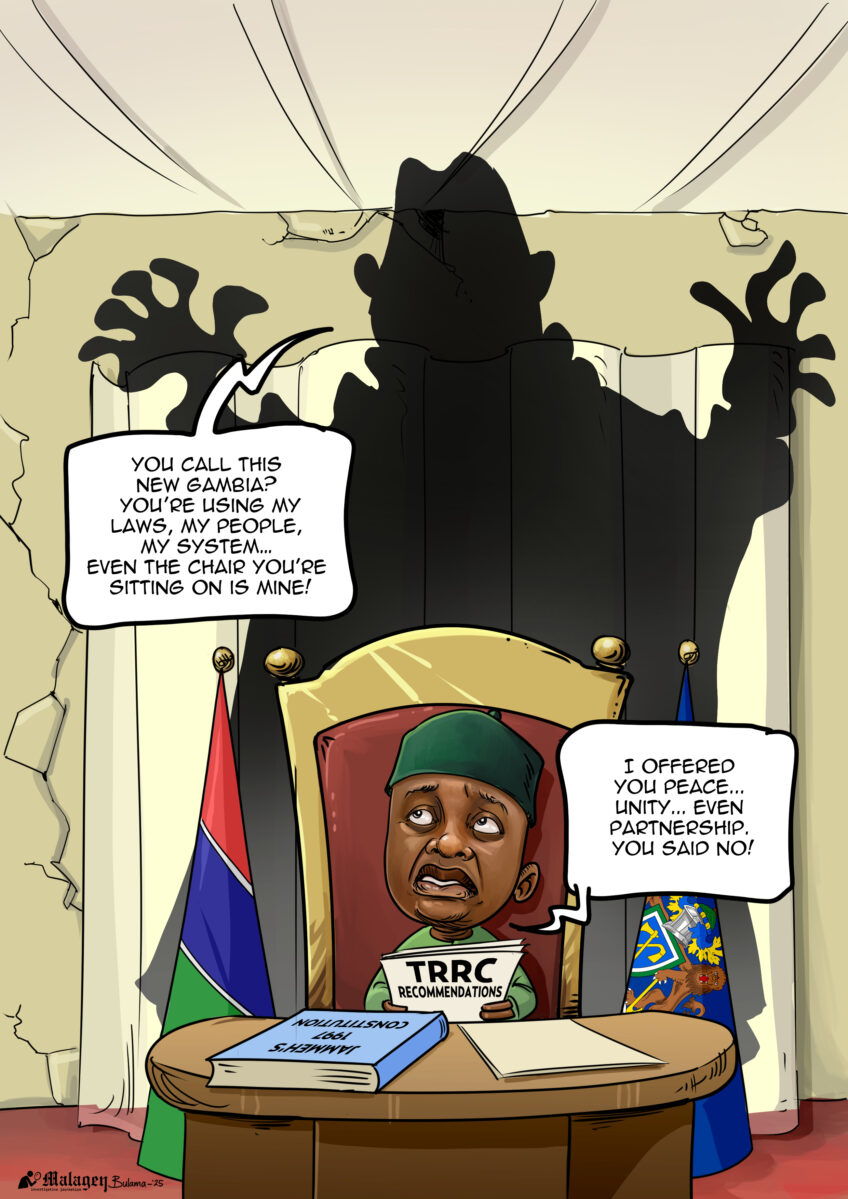
“The Shadow That Won’t Leave” is grounded in months of careful observation and study of the country’s transitional justice processes and mechanisms, from the formal structures designed to deliver truth and accountability, to the political maneuverings that undermine them.
The stories told by Abdoulie Sanyang on the Coffee Time Show were so fantastical that many wondered whether he was just a poor liar, or if something was genuinely wrong with him. Yet, the government took him very seriously. He was arrested and put on trial not for lying, but for arson.
The background to that story dates back to the lead-up to the 2016 presidential election. A group of soldiers reportedly stormed the APRC bureau and set fire to thousands of suspected fraudulent voter cards.
One soldier, Tumani Jallow, widely regarded as brave and principled, lost his life in what has since been hailed as an act of patriotic resistance. Mr. Sanyang is alleged to have said on the Coffee Time Show that he participated in that attack.
If the accounts of that attack are accurate, the implications are profound and may have decisively altered the course of Gambian history. The opposition coalition defeated Mr. Jammeh won by just 18,000 votes, while the number of voter cards allegedly uncovered and destroyed by the attackers was as high as 50,000.
Mr. Sanyang’s case speaks volumes about the contradictions and moral ambiguity at the heart of the country’s democratic transition and its troubled transitional justice efforts.
“The Shadow That Won’t Leave” is grounded in months of careful observation and study of the country’s transitional justice processes and mechanisms, from the formal structures designed to deliver truth and accountability, to the political maneuverings that undermine them.
As you’d find out in the stories and investigations in the subsequent pages, Mr. Jammeh’s legacy endures not only in unpunished crimes but within the very fabric of the state, through unreformed security forces, unrepentant enablers, and political actors unwilling to fully sever ties with the old order.
Today, the very laws and systems imposed by Mr. Jammeh are still being used to shape the country’s future. Lest we forget that the man at the helm of the National Assembly, the institution meant to mediate these reforms, spent a lifetime crafting, nurturing, and defending that exact system.
