
Gambians to Pay Over D1M for U.S. Visa
The Gambia has escaped the travel ban imposed by the U.S. President Donald Trump earlier this year. But the hefty visa bond could bite just as hard.
Omar Wally
Gambians applying for visas to travel to the United States will pay a security deposit that can cost up to $15,000 – approx. D1 million – according to the U.S. State Department. The new rule will come into effect in two weeks – on Oct. 11, and applies to those applying for B1/B2 short-term visas for tourism, business, family visits, medical treatment, conferences, and social events.
“A bond does not guarantee visa issuance,” the State Department cautions. “If someone pays fees without a consular officer’s direction, they will not get that money back.”
The Gambia has been in the crosshairs of President Trump’s hardline immigration policies. Despite having one of the highest visa overstay rates in Africa, and a threat of travel ban, the country escaped Mr. Trump’s travel ban, which affected 19 countries, mostly from Africa.
But the visa bond, which targeted two other African countries, namely Malawi and Zambia, could bite just as hard.
“Any citizen or national traveling on a passport issued by one of these countries, who is found otherwise eligible for a B1/B2 visa, must post a bond for $5,000, $10,000, or $15,000,” the U.S State Department announced.
The exact amount an applicant must pay will be decided at the time of the visa interview. Only those who comply with terms of the visa bond will get their money back. Those terms include leaving before the visa expires and entering and exiting the U.S. only through one of three airports – Boston Logan International Airport, John F. Kennedy International Airport and Washington Dulles International Airport. The money paid will not be returned to anyone who overstays or attempts to change his or her immigration status.
The visa bond is a new U.S. immigration measure – a pilot programme – targeting countries with high rates of visa overstays. In June this year, President Trump imposed a full travel ban on 12, and a partial ban on 7 countries, citing visa overstays and lack of “appropriate screening and vetting measures.” Most of those affected were African countries.
The Gambia was put on a “yellow” list of 22 countries given 60 days to clear up perceived deficiencies, with the threat of facing new visa restrictions if they did not comply.
At least two diplomatic sources told Malagen that the ban was avoided thanks to intense lobbying effort led by Justice Minister Dawda Jallow, who held meetings with senior U.S. State Department and Congressional officials.
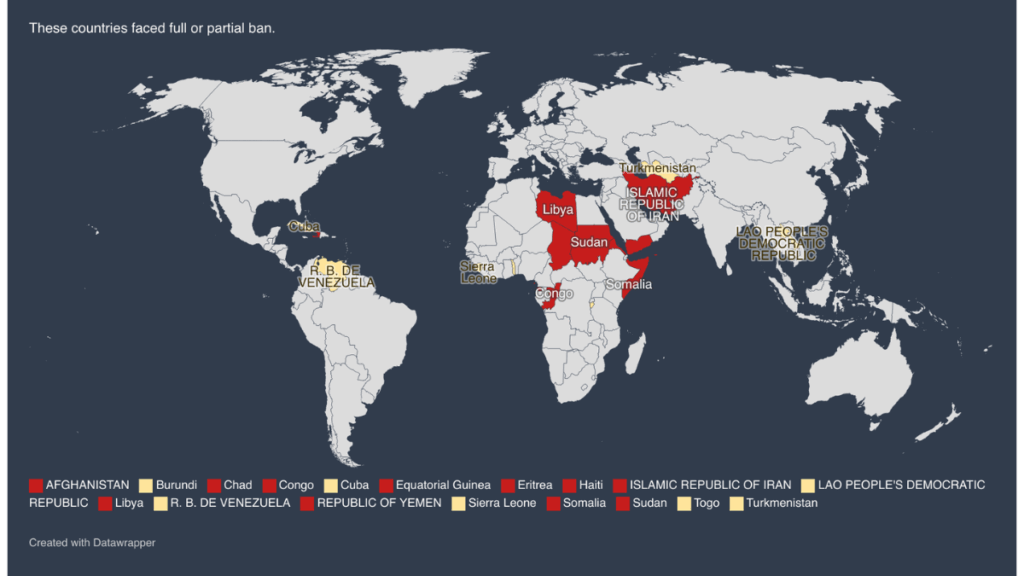
Nearly 2000 Gambians who were supposed to leave the U.S. had not done so as of last year, according to data from the U.S. Department of Homeland Security.
An estimated 1,630 of those entered on B1/B2 visas, 214 on student visas and 129 on “other” visas, such as workers and fiancés.
The overstay rate for Gambians issued B1/B2 visitor visas stands at 12.7 per cent, which is the sixth highest in Africa and 17th in the world, out of 135 countries listed. The rate is much higher for student visa overstays, at 38.79 per cent, which is second highest in Africa, and third in the world. Those who enter on “other” visa categories, such as workers and finances overstay less – 18.6 percent, which ranks 15 in Africa and 18 in the world.
The absolute numbers of Gambians who have overstayed their visas are very low compared to many countries. But these overstay rates are considered high by U.S. immigration standards.
The announcement of the visa bond came barely a few days after the U.S. Embassy in Banjul denied visas for two dozen Gambians, mostly senior government officials, planning to attend the United Nations General Assembly in New York. Hundreds of Gambians took to social media to celebrate the move, seeing such large delegation trips as a waste of public funds and an opportunity for collecting hefty per diems.
But they won’t be as delighted by this visa bond decision, which affects thousands of Gambians. Most people earn less than $2,000 a year in the country, and the visa bond could make travel to the U.S. nearly impossible for many.
