
FACT-CHECK: No evidence confirms Jammeh’s return to The Gambia

A single flight itinerary was enough to reignite speculation about Yahya Jammeh’s return, but a closer look reveals how easily unverified documents can fuel political rumours in The Gambia’s digital space.
A viral flight itinerary circulating on Facebook claims that former Gambian President Yahya Jammeh is scheduled to return to The Gambia from Equatorial Guinea. However, Malagen’s independent verification found no evidence that the document belongs to the former president or that he has plans to return to the country.
The claim was shared by Facebook user Mustapha Manjang, a Gambian DJ with a significant online following. The post included what appeared to be a Royal Air Maroc flight itinerary showing a passenger named “Mr Yaya Jammeh” travelling from Malabo International Airport in Equatorial Guinea to Banjul International Airport on May 15, 2026.
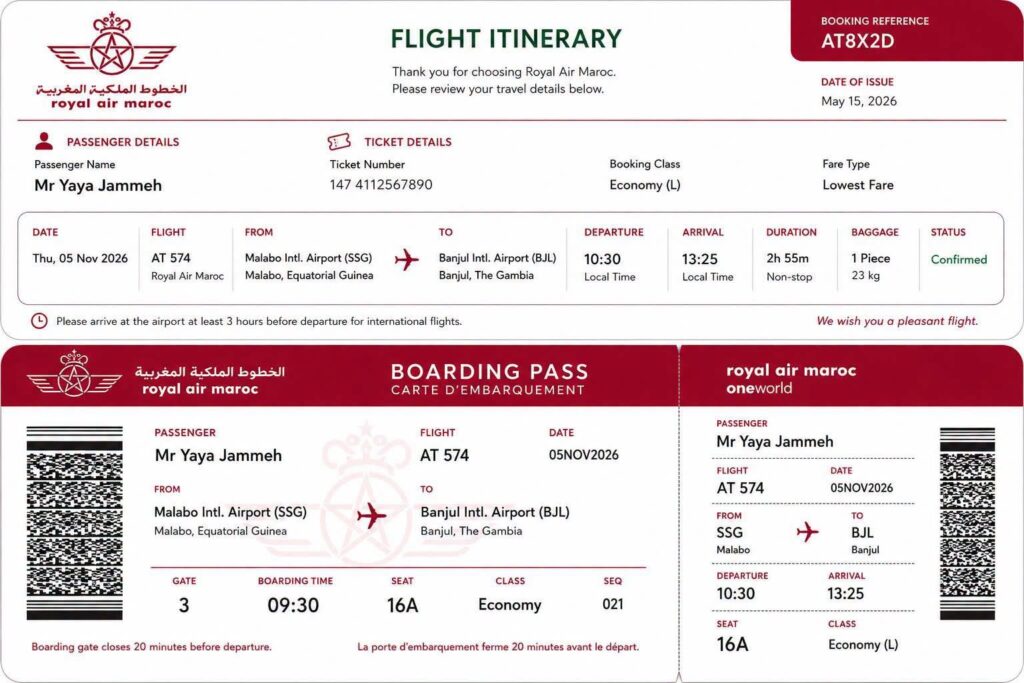
The post quickly gained traction, attracting hundreds of reactions and comments, with some users interpreting the document as evidence that Jammeh was preparing to return to The Gambia. However, the itinerary itself raised questions about its credibility, as the travel date displayed on the document was 15 May 2026—a date that had already passed at the time the claim began circulating in August 2026. This discrepancy further cast doubt on the authenticity and relevance of the document as proof of any planned return.
How Malagen verified the claim
Malagen reviewed the circulated flight itinerary and independently examined the information surrounding the claim. As part of the verification process, we contacted the Gambia International Airport (GIA) and Royal Air Maroc to seek confirmation of the document’s authenticity and whether it was linked to Yahya Jammeh’s travel plans. GIA confirmed to Malagen that the claim is false and that the information circulating online should be disregarded.
Why Yahya Jammeh remains in exile
Yahya Jammeh has lived outside The Gambia since leaving office in 2017, after more than two decades in power. He seized power in a military coup in 1994 and ruled the country until his defeat in the December 2016 presidential election by opposition candidate Adama Barrow.
Although Jammeh initially conceded defeat, he later rejected the election results and refused to hand over power, plunging the country into a political crisis. After diplomatic efforts failed, the Economic Community of West African States (ECOWAS) deployed regional forces to pressure him to step down. Jammeh eventually left The Gambia in January 2017 and went into exile in Equatorial Guinea, where he has remained since.
Why Jammeh’s return remains politically sensitive
Any claim about Yahya Jammeh’s return carries significant political and social implications because of his lasting influence and the unresolved legacy of his 22-year rule.
Human rights organisations and victims have accused his government of serious abuses, including arbitrary arrests, torture, enforced disappearances, and killings. These allegations were later uncovered by The Gambia’s Truth, Reconciliation and Reparations Commission (TRRC), which documented testimonies from hundreds of witnesses about alleged violations committed during his presidency.
At the same time, Jammeh continues to maintain support among some Gambians, particularly within his former party, the Alliance for Patriotic Reorientation and Construction (APRC). Any confirmed return could therefore trigger strong reactions from both supporters and critics, making the issue politically sensitive.
Why this claim matters
The claim is circulating at a politically sensitive time as The Gambia approaches another presidential election cycle, when information about major political figures can strongly influence public conversations.
False or unverified claims involving influential leaders can shape public perceptions, fuel political speculation, deepen divisions, and create unnecessary tensions.
Yahya Jammeh remains one of The Gambia’s most prominent and controversial political figures, with both strong supporters and critics. As a result, claims about his movements or a possible return to the country can spread quickly online and influence political narratives, even when they are not supported by evidence.
Conclusion
The claim that Yahya Jammeh is returning to The Gambia based on the circulated flight itinerary is false.
The document circulating online does not provide evidence that it belongs to Jammeh or that he has plans to return to the country. Any confirmed decision regarding his return would be expected to come through credible and official channels, rather than an unverified document shared on social media.
