
Fact-check: Is this viral image of a flooded poultry farm real?
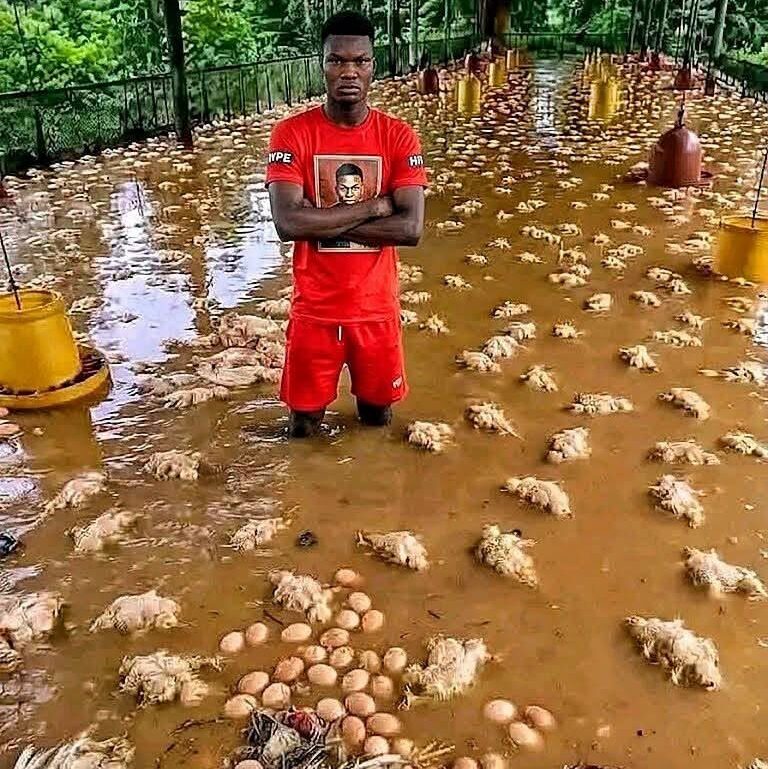
Malagen’s verification found that the image circulating online was AI-generated and does not show a verified real-life incident.
Claim:
A Facebook post claims an image shows a poultry farmer whose business was destroyed by heavy rainfall. A Facebook page, “Focus on Gambia,” shared the image with the caption: “Sad story of Poultry farmer whose entire business is ruined by Heavy rainfall.”
The image shows a man standing inside what appears to be a flooded poultry farm, with water reaching his knees, while dead chickens and eggs appear to be scattered in the water.
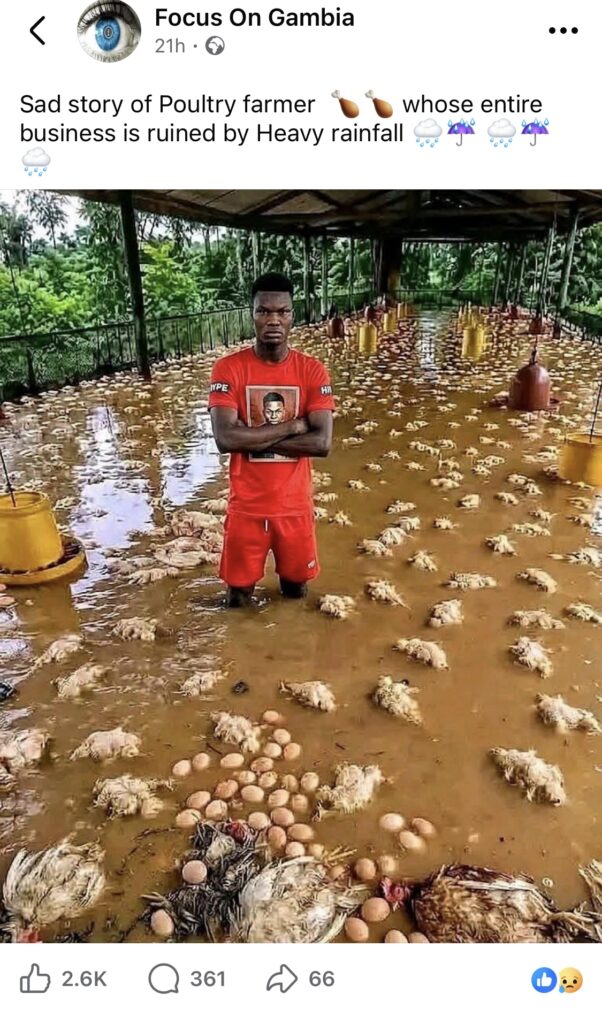
The post generated significant engagement, attracting more than 2,000 likes and comments, as well as over 60 shares. Many users expressed sympathy and reacted as though the image showed a real poultry farmer affected by flooding.
Verification:
Malagen’s verification found that the image circulating with the claim is AI-generated and does not show a verified real-life incident of a poultry farmer affected by heavy rainfall.
Malagen conducted a reverse image search and analysed the image using AI detection methods, which identified several indicators consistent with AI-generated imagery, including unnatural details and inconsistencies within the image. No credible original source, location, or evidence linking the image to an actual poultry farm could be independently established.
The Facebook post also does not provide key details needed to verify the claim, including:
- the farmer’s name;
- the location of the farm;
- the date the incident occurred; or
- any independent reports confirming the event.
While poultry farmers can suffer losses due to flooding and extreme weather, the image being shared as evidence of such an incident is not an authentic photograph.
Although the Facebook page references The Gambia, the post itself does not claim that the farmer is Gambian. However, because it was shared by a Gambian-focused page, some users may assume it relates to a local incident.
Why this matters:
The spread of AI-generated images is making it increasingly difficult for users to distinguish between real events and fabricated visuals. Images showing suffering, disasters, or personal tragedies can attract strong emotional reactions and spread rapidly before they are verified.
In this case, hundreds of users appeared to accept the image as genuine based on the comments and reactions under the post.
How to spot AI-generated images
Before sharing emotional or shocking images online, users should look out for:
- and objects that may appear unnatural.
- Unusual backgrounds: AI-generated images often contain objects that appear blurred, duplicated, or incorrectly shaped.
- Inconsistent lighting: Check whether shadows, reflections, and water effects appear realistic.
- Lack of information: Be cautious when posts do not provide basic details such as names, locations, dates, or original sources.
- Reverse image searches: Use tools such as Google Lens to check whether an image has appeared elsewhere or is being used with a different claim.
Conclusion:
The image shared by “Focus on Gambia” should not be considered evidence of a real poultry farm disaster. As The Gambia moves closer to the 2026 elections, the spread of AI-generated content and misleading visuals could become an increasing challenge, particularly when such content is designed to trigger strong emotional reactions.
False or manipulated images can shape public perceptions, fuel confusion, and influence conversations online. Users are encouraged to verify the source of images, question sensational claims, and seek credible information before sharing content.
