
FACT-CHECK: Has the Government Fully Implemented 60 TRRC Recommendations?

The President’s statement that 60 TRRC recommendations have been fully implemented is misleading. It appears he may have mistaken completed activities for recommendations: two distinct categories within the monitoring framework used to assess implementation progress.
On 26 March 2026, President Adama Barrow delivered his State of the Nation Address before the National Assembly, outlining government achievements, economic performance, and institutional reforms. Among the updates was a progress report on the implementation of recommendations made by the Truth, Reconciliation and Reparations Commission (TRRC).
The TRRC process remains one of the most consequential reforms undertaken since the end of authoritarian rule. Because its recommendations are tied to justice, accountability, and institutional restructuring, any claims about implementation carry significant public weight.
This fact-check examines the President’s statement using the latest monitoring data published by the National Human Rights Commission (NHRC), the body mandated to independently track progress on the Government’s White Paper.
The Claim:
In his address, the President stated:
“The Government has fully implemented sixty (60) recommendations of the Truth, Reconciliation and Reparations Commission (TRRC), with implementation of one hundred and forty-three (143) ongoing.”
The claim suggests that 60 TRRC recommendations have been fully completed and that more than half are currently being implemented.
What the NHRC Monitoring Report Shows
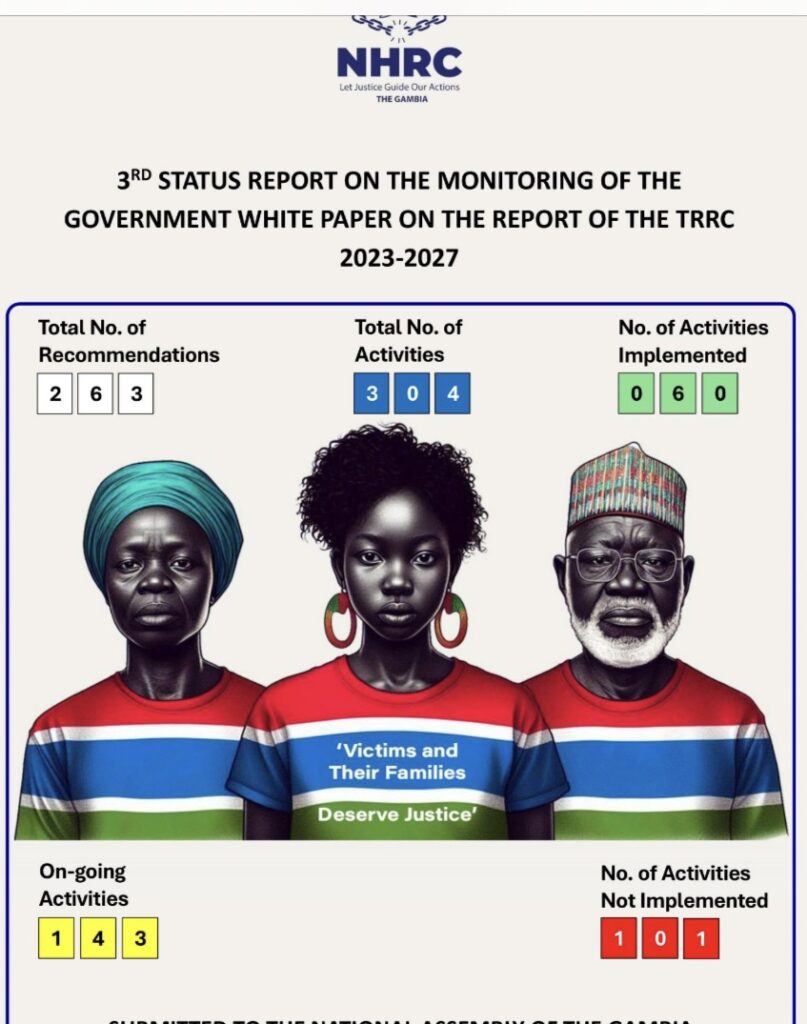
The National Human Rights Commission’s Third Status Report (2025) evaluates progress using a structured monitoring framework. Importantly, it measures implementation primarily through activities, which are the specific actions required to fulfil broader recommendations.
NHRC
Out of 304 activities derived from the 263 recommendations accepted by the Government:
- 60 activities were fully implemented
- 104 activities were ongoing
- 101 activities had not been implemented
This means the figure “60” cited in the President’s address corresponds to completed activities, not completed recommendations.
The distinction significantly affects how progress is understood.
Understanding the Difference: Recommendations vs Activities
A recommendation is a broad reform directive issued by the TRRC. It may call for institutional reform, legislative amendments, prosecutions, reparations, or policy changes.
An activity, by contrast, is a specific action taken to fulfil part of that recommendation. One recommendation can generate multiple activities.
For example, a recommendation on security sector reform may require:
Drafting new legislation
Conducting personnel vetting
Establishing oversight mechanisms
Implementing training programmes
Each of these is counted separately as an activity in the NHRC monitoring framework.
Under this system, a recommendation can only be classified as “fully implemented” when all related activities are completed. Therefore, completing 60 activities does not automatically mean 60 recommendations have been fully implemented.
When assessed at the recommendation level, the NHRC report indicates that fully implemented recommendations account for approximately 18% of the 263 accepted recommendations, roughly 47 to 48 recommendations, not 60.
This suggests the President’s statement overstates the level of full implementation.
Examples from the Report
The gap between activities and recommendations becomes clearer when examining specific thematic areas.
Attack on the Media
Under this thematic area:
- Total activities: 18
- Fully implemented: 5
- Ongoing: 7
- Not implemented: 6
Although five actions have been completed, more than half remain either ongoing or unimplemented. This means the broader reform objective relating to media protection cannot yet be considered fully implemented.
Attack on Religious Freedom
Not implemented: 6
Total activities: 10
Fully implemented: 0
Ongoing: 4
Here, none of the required actions have been fully completed. As a result, the recommendation remains unfulfilled.
Institutional Hearing: Prisons
- Total activities: 29
- Fully implemented: 6
- Ongoing: 16
- Not implemented: 7
While some steps have been taken, the majority of required reforms are still underway or untouched. The recommendation therefore remains partially implemented.
These examples demonstrate that counting completed activities alone does not capture whether entire reform recommendations have been fulfilled.
Why This Matters
The TRRC was established to investigate human rights violations committed during the 22-year rule of former president Yahya Jammeh. Its recommendations aim to deliver justice for victims, reform institutions, and prevent recurrence of abuses.
For victims, survivors, and civil society, implementation is not symbolic; it represents tangible progress toward accountability and structural change.
Public accountability therefore depends on precise reporting of:
- What has been fully completed
- What remains in progress
- What has not started
When completed activities are presented as completed recommendations, it risks creating a perception that reforms are further advanced than independent monitoring data supports.
In a transitional justice context, accuracy in reporting is essential to maintaining public trust.
Conclusion
The claim that the Government has “fully implemented 60 recommendations” is misleading.
The figure 60 refers to completed activities, not recommendations. According to the NHRC’s 2025 monitoring report, fully implemented recommendations represent approximately 18% of accepted recommendations, about 47 to 48 recommendations.
While implementation efforts are ongoing in several areas, the available monitoring data does not support the claim that 60 TRRC recommendations have been fully implemented.
You can read the full NHRC report here.
The President appears to have conflated completed activities with completed recommendations, resulting in an overstatement of full implementation progress.
Verdict: False.
