
Malagen Fact-Check: VP Jallow’s Claims Progress on Rights at UNGA: Evidence Shows Ongoing Violations
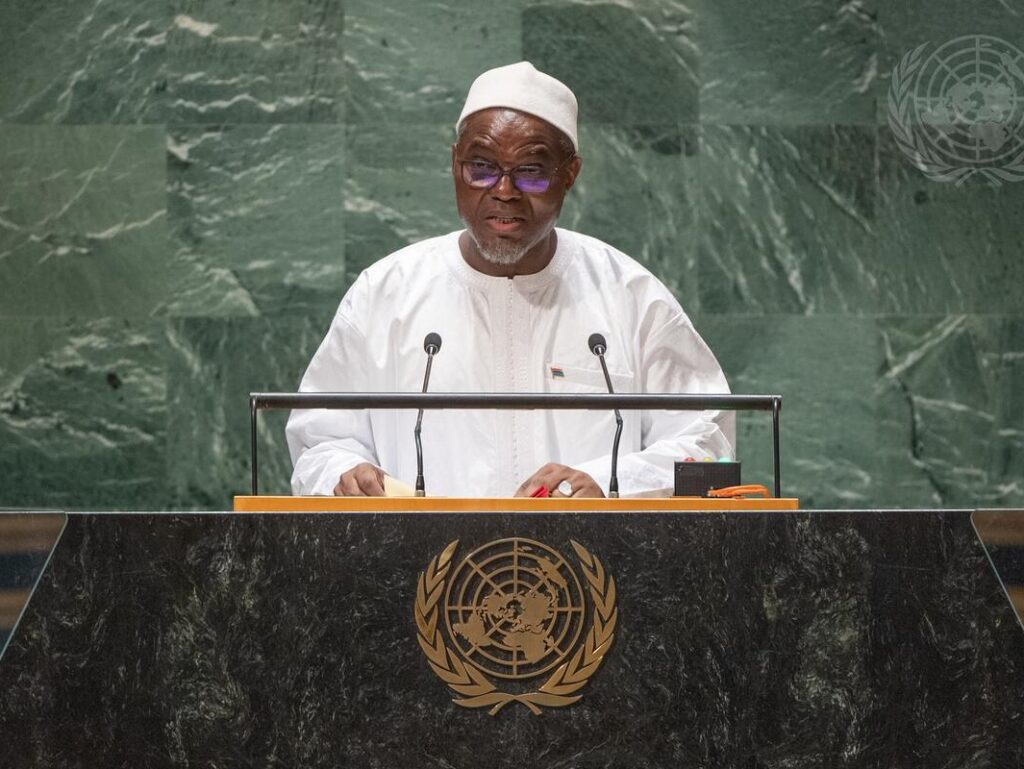
We find that key institutions remain unestablished, TRRC recommendations are only partially implemented, and the continued arrests of peaceful protesters and journalists reveal a significant gap between government claims and reality.
At the 80th United Nations General Assembly in September 2025, Vice-President Muhammad B. S. Jallow painted a picture of steady progress in The Gambia since 2017 arguing that the Barrow administration has pursued inclusive development, peace, and respect for fundamental rights; that it is implementing the recommendations of the Truth, Reconciliation and Reparations Commission (TRRC); and that it is also strengthening institutions through legislative reform to prosecute grave crimes and fight corruption.
We examined those claims against government documents, rights-monitoring reports and recent news coverage.
Claim 1: Since 2017 the government has pursued inclusive development, peace and respect for fundamental rights and freedoms.
The vice-president presented a broad claim that the administration has prioritised inclusion, peace and fundamental rights. It is true that the government has advanced a number of development projects and repeatedly emphasised rights and inclusion in its public messaging. At the same time, independent rights monitors and recent events show important limits to a blanket claim of full respect for fundamental freedoms.
On 22 August 2025, police arrested protesters who had gathered at the offices of the Public Utilities Regulatory Authority (PURA) in Kanifing to oppose a regulatory decision on internet pricing. Twenty-three youths were detained and are now facing trial for unlawful assembly. A week later, 21 more youths were arrested during a separate protest over the jailing of the initial group at Mile 2 State Central Prison.
Rights groups, including ARTICLE 19, have condemned the arrests as unlawful and raised concerns over the detention of peaceful demonstrators. Earlier in May, 2025, 9 protest organized by Gambians Against Looted Assets (GALA) over the sale of former President Yahya Jammeh’s assets also led to the detention of at least 27 demonstrators and two journalists, who were later released.
These arrests—alongside repeated complaints from civil society about harassment and prosecutions of critics—undermine the impression that freedoms of expression and assembly are consistently protected. In short, the government has pursued development and has taken some reform steps, but documented arrests of protesters and actions against critics make the vice-president’s claim misleading when presented without this context.
Claim 2: The government is implementing the TRRC recommendations as part of an inclusive reform agenda.
VP Jallow said the TRRC recommendations are being implemented and integrated into national reforms. The government has indeed adopted a White Paper and produced an implementation plan that sets out responsibilities and timelines. However, official monitoring and civil-society tracking indicate that implementation remains slow. The National Human Rights Commission and independent trackers report that only a small fraction of the 263 TRRC recommendations are fully complete; public summaries commonly cite about 16 recommendations as fully implemented, with many more classified as “ongoing” and several not yet started.
The government has committed to a multi-year timetable for implementation, but the numerical gap between accepted recommendations and completed actions shows that while the process is underway, the pace and scope are far from complete. Thus the claim is technically correct in that implementation has begun, but it overstates progress
Claim 3: We are building stronger state institutions and expanding the criminal jurisdiction to prosecute international atrocity crimes.
The vice-president also pointed to concrete legislative reforms designed to strengthen accountability. This part of his address is supported by verifiable legal changes. The Special Prosecutor’s Office Act (2024) now published in final form by the Ministry of Justice. Notwithstanding the office is yet to be created which would have the mandate to investigate and prosecute serious human-rights violations, including crimes identified by the TRRC.
Secondly , the Anti-Corruption Act (passed in 2023) establishes a legal framework for an Anti-Corruption Commission and toughens offences and penalties for corrupt conduct. Similarly, the Commission has not yet been created as the commissioners and staff are yet to be appointed to carry out its mandate. These laws are real, significant steps toward institutional reform. That said, passing laws is only the first step: their ultimate effect will depend on adequate staffing, funding, operational independence and consistent enforcement. The factual claim that legislation has been enacted is true; but the institutions are yet to be established.
Claim 4: Our reforms prioritise meeting the needs of the people and materialising the TRRC recommendations.
The speech linked legislative change and social priorities — presenting reforms as instruments for delivering justice and public goods. Government planning documents (including the TRRC White Paper and its implementation plan) do frame TRRC follow-up as part of a national development priority.
But the gap between planning and delivery is significant for citizens seeking reparations, accountability or structural redress. Civil society and monitoring reports highlight frustration with the slow pace of reparations and the logistical and financial challenges of full implementation; the government has publicly estimated substantial costs to complete the TRRC program.
Framing reforms as already meeting people’s needs therefore glosses over ongoing delays and the practical hurdles that remain.
Overall assessment and context
Vice-President Jallow’s UNGA speech mixed verifiable achievements with optimistic framing. Legal and institutional reforms — notably the Special Prosecutor’s Office Act (2024) and the Anti-Corruption Act (2023) — are real, verifiable advances but the institutions are not there yet to enable the implementation of their mandate.
The government has a declared plan to implement TRRC recommendations and has begun work. But repeated arrests of peaceful protesters, the documented detention of journalists during demonstrations, and the slow, partial implementation of TRRC recommendations demonstrate that claims of full respect for fundamental freedoms and completed transitional-justice processes are, at best, incomplete and, at worst, misleading by omission.
The law reforms are necessary steps, but they must be matched by transparent, timely implementation and institutional independence to translate into meaningful accountability and reparations for victims
Malagen will continue to monitor these developments, track government reporting on TRRC implementation and assess whether new institutions achieve the independence and capacity necessary to deliver justice, reparations and strengthened rights for all Gambians.
